How to Play Chess - Ancient Chess History - - Xiangqi - Shogi
How to Play ChessDownload
a free rule booklet ------
Shop
for a playing set _
_
The Modern
Chess of Europe,
now considered International Chess
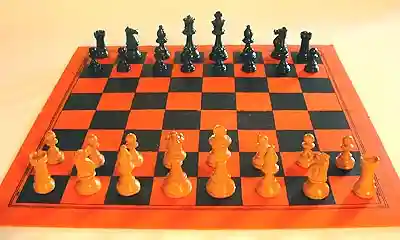
Of the many forms of chess that have developed, only the Chinese, Japanese, Thai, Korean and European varieties are commonly played today. While the Chinese chess, xiangqi, is probably played by more people than any other board game, the European chess — what we simply call "chess" — is most widespread across the globe, and is unique in its extensive literature of strategic analysis.
These are the rules of play that first appeared just over 500 years ago, in northern Italy and Spain, and quickly spread throughout Europe. Over subsequent centuries, this chess was carried to every continent, along with other aspects of European culture.
The idea of chess is that two players, commanding armies of equal strength and composed of variously empowered pieces, compete to entrap a central figure from the other side — the king. The players take turns, each time moving one piece according to its assigned movement pattern, creating a complex dynamic of attack and defense, until one finally proves most effective.
|
|
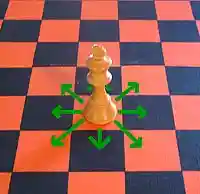
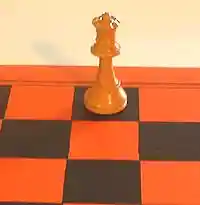
| The queen moves any number of squares straight forward, backward, right, left or diagonally, as shown at the left. | |
| The rook
may move any number of squares straight forward, backward, right
or left. |
|
The bishop
moves diagonally, as many squares as it chooses. Note that one
bishop will always be on the dark “black” squares,
and the other will always be on the “white” squares. None of the pieces mentioned so far may move past a piece standing in its way. |
|
The knight goes just two squares forward, backward, left or right, and then one square at a right angle, making an L-shape, as shown in the diagram. The knight is the only piece that can not be blocked by another piece — if another piece stands in its way, the knight simply jumps over it. |
|
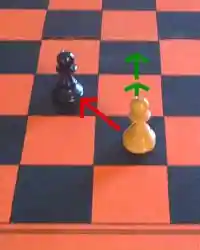
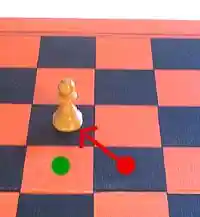
The pawn moves one square forward, and has the option of moving two squares forward on its first move. But it does not capture this way. It captures by moving forward-diagonally (as shown below by the red arrow). It never captures by moving straight forward.
|
|
|
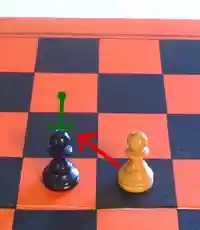
In the unusual case where one pawn moves two spaces forward (as the black pawn shown at the left), and an opposing pawn (the white pawn shown) could have captured it if it had moved only one square, the opposing pawn may move to capture it as if it had moved only one square. The captured piece is removed from the board (shown here by a green dot). This is called capturing en passant (French: “in passing”). This can only be done immediately following a pawn’s double step. Afterwards, that particular opportunity to capture en passant is lost. |
If a pawn reaches the far side of the board, it is promoted. So doing, the pawn is removed from the board and replaced by a piece of the player’s choosing, either rook, knight, bishop or (most often) queen.
|
|
|
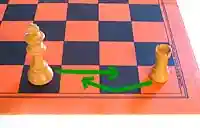
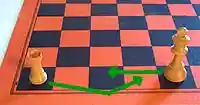
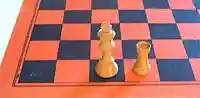
One more
special move rule:
|
|
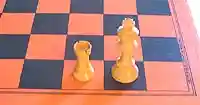
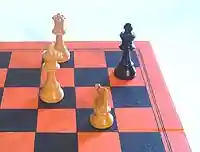
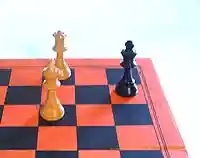
All pieces capture by moving onto a square occupied by an enemy piece. The captured piece is removed for the remainder of the game. Only the pawn has a special move for capturing (forward-diagonally), different from its normal move (straight ahead). When a king is threatened with capture, it is said to be "in check," and the threatened player must move "out of check" so the king can not be taken. It is not legal to move so that one’s own king remains in check. If the king is in check and can not possibly move out of check, he has lost, and is said to be in checkmate, as shown here. |
|
The game is set
up at the left (and at the top of this web page). Note
that each player has a light colored square in his right hand corner.
In order that the kings face each other across the board, each player
sets his queen on its “own color” (light on light; dark
on dark).
White makes the first move, and the two take turns. There are several ways the game can end in a draw: |
| Some Courtesies: 1) Before the game begins, it is common for one player to hide a black pawn in one hand and a white one in the other. The other player picks a hand, and plays the color he has chosen. (White moves first.) 2) When a player removes his hand from a piece, his move is decided, and it's too late two take it back. Be carefull! It's a very delicate game! 3) If you are playing in a tournament, or with a bit of a stickler, the rules of "touch-move" apply. In that case, when you merely touch one of your pieces, you are obligated to move it. The idea is that all thinking must be done in the player's head — not on the board. In actual tournament play, more specific rules apply regarding time controls, special endgames, and all sorts of proper behavior — you can learn those when you really need to! |
|
| An intriguing
story tells of the greatest male chess player of all time,
Gary Kasparov, playing against the greatest female player ever born,
Judit Polgar. Judit saw Gary touch his knight — but leave
it in place; Gary said he never touched it. For several years animosity
brewed over that game since, if Gary had been compelled to move
his knight, he would have lost the game, giving Judit an historic
victory!
The 17th century chess writer, J. Barbier, tells us most eloquently: "What man or piece soever of your owne you touch, or lift up from the point whereon it standeth, that must you play for that Draught ... according to the ancient saying, Touch man and goe, Out of hand and stand: Because, besides that the contrary were Childes play: were you allowed a two-fold study on every Draught, you would make the Game not tedious onely, but intollerable." —The
Famous Game Of Chesse-play, |
Download
a free rule booklet ------
Shop
for a playing set
__