
PhD candidate, LMU Munich
I am a PhD candidate at the Bavarian AI Chair for Mathematical Foundations of Artificial Intelligence at LMU Munich under the supervision of Prof. Gitta Kutyniok. Furthermore, I am an associated PhD at the Konrad Zuse School of Excellence in Reliable AI (relAI) and the Munich Center for Machine Learning (MCML).
My research interests:
- Uncertainty quantification
- Probabilistic predictions
- Physics-informed machine learning
My research revolves around uncertainty quantification, probabilistic modeling, and its applications in the natural sciences. I have a strong interest in the theoretical foundations of such methods, as well as in their practical applications. Furthermore, I am interested in developing novel probabilistic or uncertainty quantification-related methods for neural networks. Applications of the developed methods include meteorology, dynamical systems, energy systems or quantum physics.
Before the start of my PhD I obtained a Bachelor’s degree in Industrial Engineering and a Masters’s degree in Mathematics from Karlsruhe Institute of Technology.
If you have any questions regarding my research or want to collaborate feel free to contact me anytime.
news
selected publications
-
TMLR
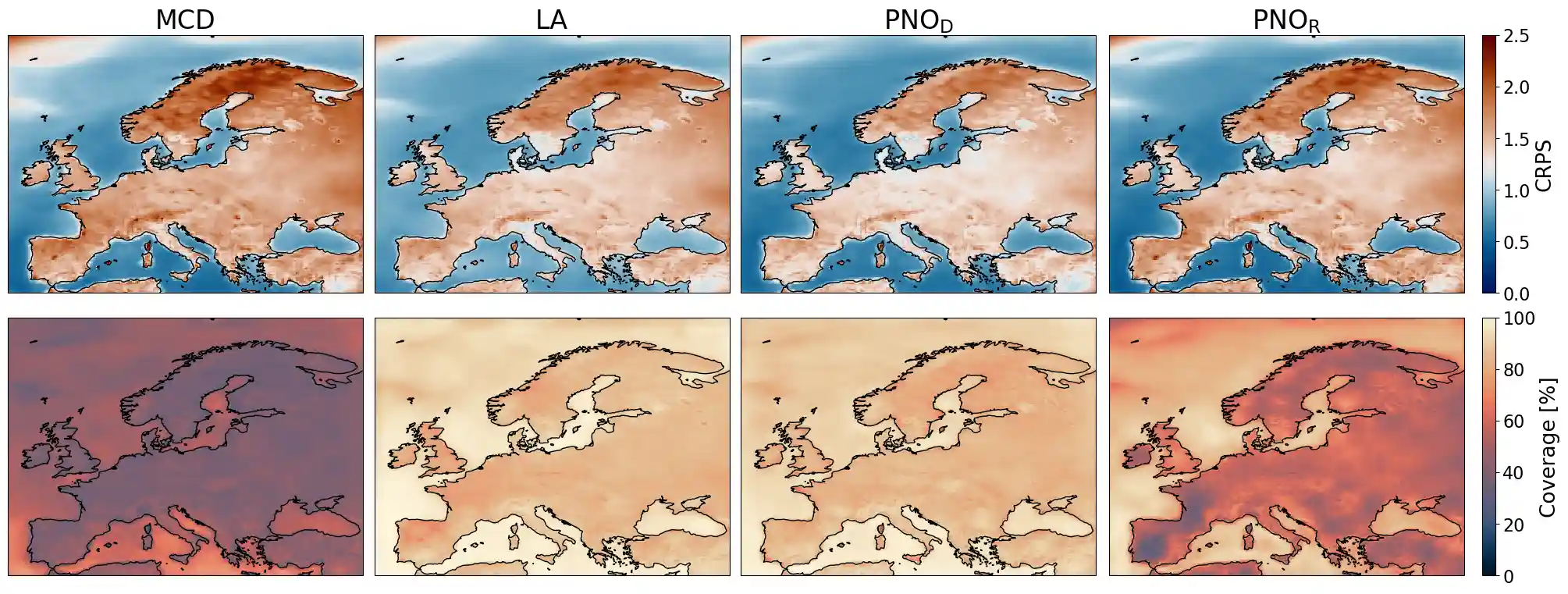
Probabilistic neural operators for functional uncertainty quantification
Transactions on Machine Learning Research, 2025
Neural operators aim to approximate the solution operator of a system of differential equations purely from data. They have shown immense success in modeling complex dynamical systems across various domains. However, the occurrence of uncertainties inherent in both model and data has so far rarely been taken into account—a critical limitation in complex, chaotic systems such as weather forecasting. In this paper, we introduce the probabilistic neural operator (PNO), a framework for learning probability distributions over the output function space of neural operators. PNO extends neural operators with generative modeling based on strictly proper scoring rules, integrating uncertainty information directly into the training process. We provide a theoretical justification for the approach and demonstrate improved performance in quantifying uncertainty across different domains and with respect to different baselines. Furthermore, PNO requires minimal adjustment to existing architectures, shows improved performance for most probabilistic prediction tasks, and leads to well-calibrated predictive distributions and adequate uncertainty representations even for long dynamical trajectories. Implementing our approach into large-scale models for physical applications can lead to improvements in corresponding uncertainty quantification and extreme event identification, ultimately leading to a deeper understanding of the prediction of such surrogate models.
-
AIES
Uncertainty quantification for data-driven weather models
Christopher Bülte, Nina Horat, Julian Quinting, and Sebastian Lerch
Artificial Intelligence for the Earth Systems, 2025
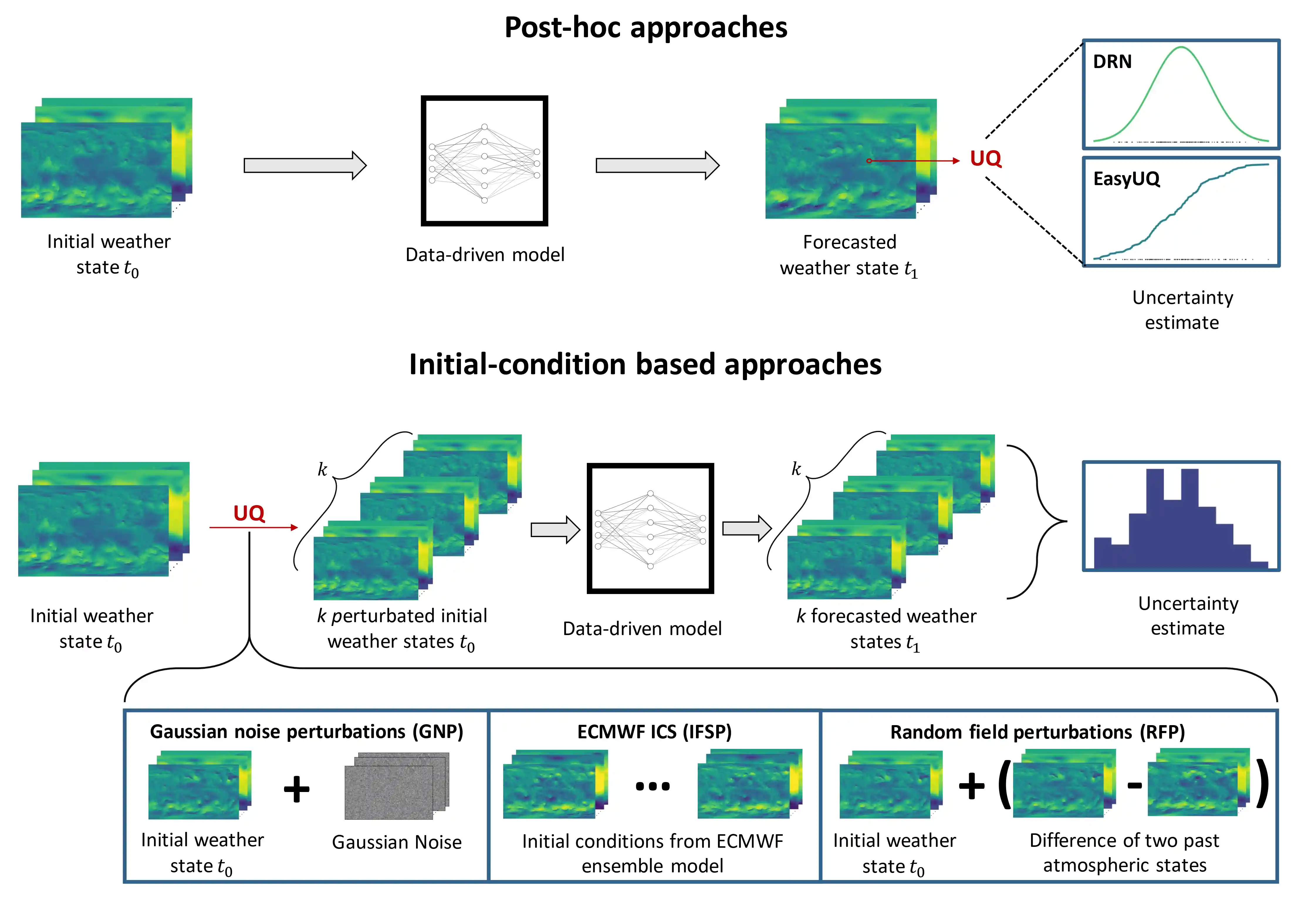
Artificial intelligence (AI)-based data-driven weather forecasting models have experienced rapid progress over the last years. Recent studies, with models trained on reanalysis data, achieve impressive results and demonstrate substantial improvements over state-of-the-art physics-based numerical weather prediction models across a range of variables and evaluation metrics. Beyond improved predictions, the main advantages of data-driven weather models are their substantially lower computational costs and the faster generation of forecasts, once a model has been trained. However, most efforts in data-driven weather forecasting have been limited to deterministic, point-valued predictions, making it impossible to quantify forecast uncertainties, which is crucial in research and for optimal decision making in applications. Our overarching aim is to systematically study and compare uncertainty quantification methods to generate probabilistic weather forecasts from a state-of-the-art deterministic data-driven weather model, Pangu-Weather. Specifically, we compare approaches for quantifying forecast uncertainty based on generating ensemble forecasts via perturbations to the initial conditions, with the use of statistical and machine learning methods for post-hoc uncertainty quantification. In a case study on medium-range forecasts of selected weather variables over Europe, the probabilistic forecasts obtained by using the Pangu-Weather model in concert with uncertainty quantification methods show promising results and provide improvements over ensemble forecasts from the physics-based ensemble weather model of the European Centre for Medium-Range Weather Forecasts for lead times of up to 5 days.
-
Energy & AI

Multivariate Time Series Imputation for Energy Data Using Neural Networks
Christopher Bülte, Max Kleinebrahm, Hasan Ümitcan Yilmaz, and Juan Gómez-Romero
Energy and AI, 2023
Multivariate time series with missing values are common in a wide range of applications, including energy data. Existing imputation methods often fail to focus on the temporal dynamics and the cross-dimensional correlation simultaneously. In this paper we propose a two-step method based on an attention model to impute missing values in multivariate energy time series. First, the underlying distribution of the missing values in the data is learned. This information is then further used to train an attention based imputation model. By learning the distribution prior to the imputation process, the model can respond flexibly to the specific characteristics of the underlying data. The developed model is applied to European energy data, obtained from the European Network of Transmission System Operators for Electricity. Using different evaluation metrics and benchmarks, the conducted experiments show that the proposed model is preferable to the benchmarks and is able to accurately impute missing values.