Java Program to Multiply Two Matrices
This article covers a program in Java that find and prints the multiplication result of any two matrices, entered by user at run-time of the program. The program is created in following two ways:
- Multiply two 3*3 given matrices
- Multiply two matrices of given order and elements
Multiply Two 3*3 Given Matrices in Java
The question is, write a Java program to perform matrix multiplication based on user input. The program given below is its answer:
import java.util.Scanner;

public class CodesCracker
{
   public static void main(String[] args)
   {
      int i, j, k, sum=0;
      int[][] matrixOne = new int[3][3];
      int[][] matrixTwo = new int[3][3];
      int[][] matrixThree = new int[3][3];
      Scanner scan = new Scanner(System.in);

      System.out.print("Enter 9 Elements of First Matrix: ");
      for(i=0; i<3; i++)
      {
         for(j=0; j<3; j++)
         {
            matrixOne[i][j] = scan.nextInt();
         }
      }
      System.out.print("Enter 9 Elements of Second Matrix: ");
      for(i=0; i<3; i++)
      {
         for(j=0; j<3; j++)
         {
            matrixTwo[i][j] = scan.nextInt();
         }
      }

      // multiplying the two matrices
      for(i=0; i<3; i++)
      {
         for(j=0; j<3; j++)
         {
            sum = 0;
            for(k=0; k<3; k++)
            {
               sum = sum + (matrixOne[i][k] * matrixTwo[k][j]);
            }
            matrixThree[i][j] = sum;
         }
      }

      System.out.println("\nMultiplication Result of Two Matrices is:");
      for(i=0; i<3; i++)
      {
         for(j=0; j<3; j++)
         {
            System.out.print(matrixThree[i][j]+ "  ");
         }
         System.out.print("\n");
      }
   }
}
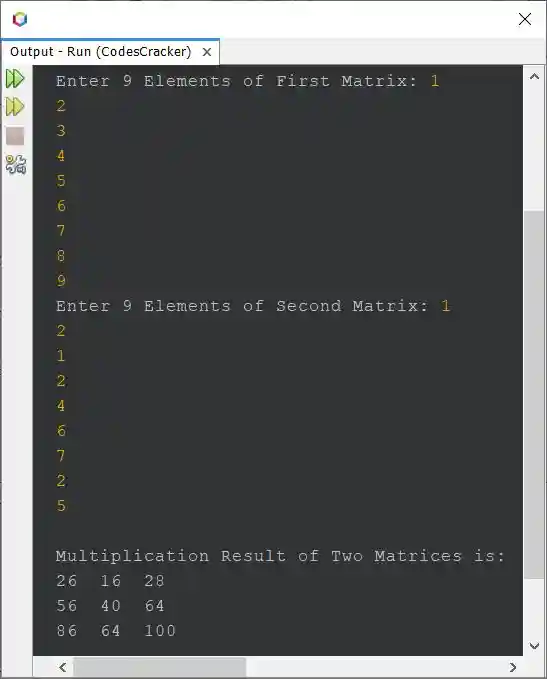
The snapshot given below shows the sample run of above program with user input 1, 2, 3, 4, 5, 6, 7, 8, 9 as nine elements for first, whereas 1, 2, 1, 2, 4, 6, 7, 2, 5 as nine elements for the second matrix:
Multiply Two Matrices of Given Order and Elements in Java
This program is basically the modified version of previous program. As this programs works to multiply 3*3 matrices as well as any other matrix of any order, entered by user at run-time:
import java.util.Scanner;

public class CodesCracker
{
   public static void main(String[] args)
   {
      int i, j, k, sum=0, rOne, cOne, rTwo, cTwo;
      Scanner scan = new Scanner(System.in);

      System.out.print("Enter First Matrix's Row Size: ");
      rOne = scan.nextInt();
      System.out.print("Enter First Matrix's Column Size: ");
      cOne = scan.nextInt();
      int[][] matrixOne = new int[rOne][cOne];
      System.out.print("Enter " +(rOne*cOne)+" Elements of First Matrix: ");
      for(i=0; i<rOne; i++)
      {
         for(j=0; j<cOne; j++)
            matrixOne[i][j] = scan.nextInt();
      }
      System.out.print("Enter Second Matrix's Row Size: ");
      rTwo = scan.nextInt();
      if(cOne != rTwo)
      {
         System.out.println("\nMultiplication not possible!");
         return;
      }
      System.out.print("Enter Second Matrix's Column Size: ");
      cTwo = scan.nextInt();
      int[][] matrixTwo = new int[rTwo][cTwo];
      System.out.print("Enter " +(rTwo*cTwo)+" Elements of Second Matrix: ");
      for(i=0; i<rTwo; i++)
      {
         for(j=0; j<cTwo; j++)
            matrixTwo[i][j] = scan.nextInt();
      }

      int[][] matrixThree = new int[rOne][cTwo];

      // multiplying the two matrices
      for(i=0; i<rOne; i++)
      {
         for(j=0; j<cTwo; j++)
         {
            sum = 0;
            for(k=0; k<cOne; k++)
               sum = sum + (matrixOne[i][k] * matrixTwo[k][j]);
            matrixThree[i][j] = sum;
         }
      }

      System.out.println("\nMultiplication Result of Two Matrices is:");
      for(i=0; i<rOne; i++)
      {
         for(j=0; j<cTwo; j++)
            System.out.print(matrixThree[i][j]+ "  ");
         System.out.println();
      }
   }
}
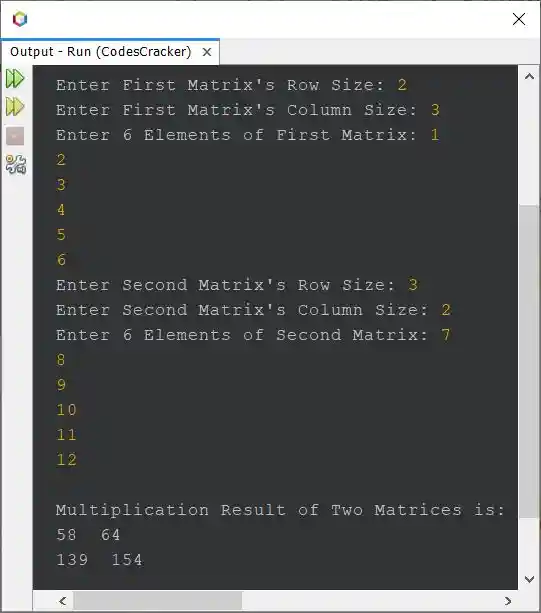
The sample run of above Java program, on multiplying two matrices of given order and elements, is shown in the snapshot given below:
Same Program in Other Languages
« Previous Program Next Program »
Liked this post? Share it!