Python join() Function
The join() function in Python is used when we need to join all the items of an iterable into a string. For example:
mylist = ["01", "Dec", "2021"]
str = "-"

res = str.join(mylist)
print(res)
The output will be:
Python join() Function Syntax
The syntax of join() function in Python, is:
where str refers to the string and iterable refers to an iterable object. When dictionary is used as an iterable, their keys will get used.
Note: The str acts as a separator among all the joined items of specified iterable.
Python join() Function Example
Here is an example of String.join() function in Python:
a = ["We", "love", "codescracker"]
b = ("Python", "is", "fun")
c = {"Date": "01", "Month": "Dec", "Year": "2021"}
d = {"01": "Date", "12": "Month", "2021": "Year"}
e = {"Dec", "2021"}

m = " ".join(a)
n = " ".join(b)
o = "/".join(c)
p = "/".join(d)
q = ", ".join(e)

print(m)
print(n)
print(o)
print(p)
print(q)
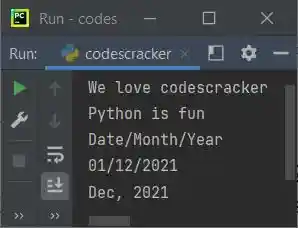
The snapshot given below shows the sample output produced by above program, demonstrating the join() function in Python:
Of course the above program can also be created in this way too:
print(" ".join(["We", "love", "codescracker"]))
print(" ".join(("Python", "is", "fun")))
print("/".join({"Date": "01", "Month": "Dec", "Year": "2021"}))
print("/".join({"01": "Date", "12": "Month", "2021": "Year"}))
print(", ".join({"Dec", "2021"}))
« Previous Function Next Function »
Liked this post? Share it!