Python oct() function
The oct() function in Python is used when we need to convert any specified integer value to its equivalent octal string. For example:
num = 7
print(oct(num))
num = 8
print(oct(num))
num = 87965
print(oct(num))
The output will be:
That is,
- 7 (in decimal) is equivalent to 7 (in octal).
- 8 (in decimal) is equivalent to 10 (in octal).
- 87965 (in decimal) is equivalent to 253635 (in octal).
Note: The prefix 0o refers to the fact that the value is in the octal number system.
Python oct() function syntax
The syntax of the oct() function in Python is:
where integerValue refers to a value of the int type.
Python oct() function example
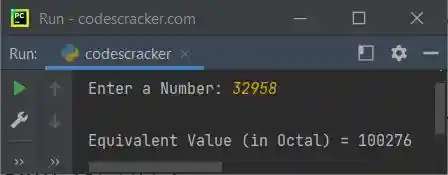
Here is an example of the oct() function in Python. This program allows the user to define the decimal number, convert it, and print the same number in the octal system:
print("Enter a Number: ", end="")
num = int(input())

res = oct(num)[2:]
print("\nEquivalent Value (in Octal) =", res)
The sample run with user input 32958 is shown in the snapshot given below:
Advantages of the oct() function in Python
- Because the "oct()" function is built into Python, it is readily available to all Python programmers.
- The "oct()" function quickly converts an integer to its octal representation without the need for a complicated algorithm or conversion formula.
- The octal representation of numbers is a compact way of representing numbers. In comparison to decimal representation, which requires 10 bits to represent each digit, it only requires 3 bits to represent each digit.
Disadvantages of the oct() function in Python
- In programming, octal representation is not commonly used. Primarily employed in computer hardware and low-level programming.
- Unfamiliar beginners may find the octal numbering system to be perplexing. They may make mistakes while utilizing the "oct()" function, resulting in code errors.
- The function "oct()" can only convert integers within a certain range. If the input value is excessively large, the function may return an error or an unanticipated result.
« Previous Function Next Function »
Liked this post? Share it!