Also found in: Dictionary, Thesaurus, Acronyms, Encyclopedia.
For other uses, see Dinar (disambiguation).
"Denar" redirects here. For other uses, see Denar (disambiguation).
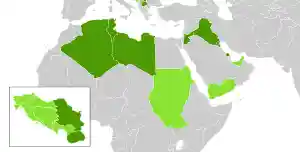
Nations in dark green currently use the dinar. Nations in light green previously used the dinar. Yugoslav states appear in the inset to the lower left.
The dinar () is the principal currency unit in several countries near the Mediterranean Sea, and its historical use is even more widespread.
The modern dinar's historical antecedents are the gold dinar, the main coin of the medieval Islamic empires, first issued in AH 77 (696–697 CE) by Caliph Abd al-Malik ibn Marwan. The word "dinar" derives from the silver "denarius" coin of ancient Rome, first minted about 211 BCE.
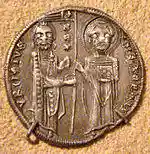
Silver dinar from the reign of Serbian king Stefan Uroš I (1243–1276).
The English word "dinar" is the transliteration of the Arabic دينار (dīnār), which was borrowed via the Syriac dīnarā from the Greek δηνάριον (dēnárion), itself from the Latin dēnārius.[1][2]
The Kushan Empire introduced a gold coin known as the dīnāra into India in the 1st century AD; the Gupta Empire and its successors up to the 6th century adopted the coin.[3][4] The modern gold dinar is a projected bullion gold coin, as of 2019 not issued as official currency by any state.
Legal tender
Countries currently using a currency called "dinar" or similar
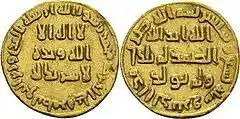
Umayyad Caliphate golden dinar.
| Countries | Currency | ISO 4217 code |
|---|---|---|
 Algeria Algeria | Algerian dinar | DZD |
 Bahrain Bahrain | Bahraini dinar | BHD |
 Iraq Iraq | Iraqi dinar | IQD |
 Jordan Jordan | Jordanian dinar | JOD |
 Kuwait Kuwait | Kuwaiti dinar | KWD |
 Libya Libya | Libyan dinar | LYD |
 North Macedonia North Macedonia | Macedonian denar | MKN (1992–1993) MKD (1993−present) |
 Serbia Serbia | Serbian dinar | RSD CSD (2003–2006) |
 Tunisia Tunisia | Tunisian dinar | TND |
Countries and regions which have previously used a currency called "dinar" in the 20th century

A mancus or gold dinar of the English king Offa of Mercia (757–796), a copy of the dinars of the Abbasid Caliphate (774). It combines the Latin legend OFFA REX with Arabic legends. (British Museum)
| Countries | Currency | ISO 4217 code | Used | Replaced by |
|---|---|---|---|---|
 Abu Dhabi Abu Dhabi | Bahraini dinar | BHD | 1966–1973 | United Arab Emirates Dirham |
.svg.png) Republic of Bosnia and Herzegovina Republic of Bosnia and Herzegovina | Bosnia and Herzegovina dinar | BAD | 1992–1998 | Bosnia and Herzegovina convertible mark |
 Croatia Croatia | Croatian dinar | HRD | 1991–1994 | Croatian kuna |
 Iran Iran | Iranian rial was divided into at first 1250 and then 100 dinars | |||
 South Yemen South Yemen | South Yemeni dinar | YDD | 1965–1990 | Yemeni rial |
 Sudan Sudan | Sudanese dinar | SDD | 1992–2007 | Sudanese pound |
.svg.png) Kingdom of Yugoslavia Kingdom of Yugoslavia.svg.png) SFR Yugoslavia SFR Yugoslavia%253b_Flag_of_Serbia_and_Montenegro_(2003%25e2%2580%25932006).svg.png) FR Yugoslavia FR Yugoslavia | Yugoslav dinar | YUD (1965–1989) YUN (1990–1992) YUR (1992–1993) YUO (1993) YUG (1994) YUM (1994–2003) | 1918–2003 | n/a |
The 8th century English king Offa of Mercia minted copies of Abbasid dinars struck in 774 by Caliph Al-Mansur with "Offa Rex" centered on the reverse.[5][6] The moneyer visibly had no understanding of Arabic as the Arabic text contains many errors. Such coins may have been produced for trade with Islamic Spain.
See also
- Economy of the Organisation of Islamic Cooperation
- Kelantanese dinar
- List of circulating currencies
- Middle East economic integration
References
- ^ Oxford English Dictionary, Second edition, 1989, s.v. "dinar"; online version November 2010
- ^ Versteegh, C. H. M.; Versteegh, Kees (2001). The Arabic Language. Edinburgh University Press. p. 60. ISBN 978-0-7486-1436-3.
- ^ Friedberg, Arthur L.; Friedberg, Ira S. (2009). Gold Coins of the World: From Ancient Times to the Present. Coin & Currency Institute. p. 457. ISBN 978-0-87184-308-1.
- ^ Mookerji, Radhakumud (2007). The Gupta Empire. Motilal Banarsidass. pp. 30–31. ISBN 978-81-208-0440-1.
- ^ https://www.britishmuseum.org/research/collection_online/collection_object_details.aspx?assetId=31108001&objectId=1093298&partId=1
- ^ Medieval European Coinage by Philip Grierson, p. 330.
External links
- Krause, Chester L.; Clifford Mishler (2003). 2004 Standard Catalog of World Coins: 1901–Present. Colin R. Bruce II (senior editor) (31st ed.). Krause Publications. ISBN 0873495934.
- Malaysia: Kelantan collects Zakat in Shariah money
This article is copied from an article on Wikipedia® - the free encyclopedia created and edited by its online user community. The text was not checked or edited by anyone on our staff. Although the vast majority of Wikipedia® encyclopedia articles provide accurate and timely information, please do not assume the accuracy of any particular article. This article is distributed under the terms of GNU Free Documentation License.