Also found in: Dictionary.
For other uses, see Drivetrain (disambiguation).
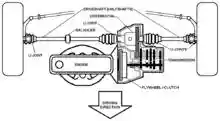
Engine and drivetrain of a transverse-engined front-wheel drive car
The drivetrain, also frequently spelled as drive train, or sometimes drive-train, is the group of components of a motor vehicle that deliver power to the driving wheels.[1] This excludes the engine or motor that generates the power. In contrast, the powertrain is considered to include both the engine and/or motor(s), as well as the drivetrain.
Function
The function of the drivetrain is to couple the engine that produces the power to the driving wheels that use this mechanical power to rotate the axle. This connection involves physically linking the two components, which may be at opposite ends of the vehicle and so requiring a long propeller shaft or drive shaft. The operating speed of the engine and wheels are also different and must be matched by the correct gear ratio. As the vehicle speed changes, the ideal engine speed must remain approximately constant for efficient operation and so this gearbox ratio must also be changed, either manually, automatically or by an automatic continuous variation.
Components
The precise components of the drivetrain vary, according to the type of vehicle.
Some typical examples:
Manual transmission car
.jpg)
Rear axle with hypoid bevel gear final drive
- Flywheel
- Dual mass flywheel still rare
- Clutch
- Gearbox
- Overdrive Since the adoption of 5 speeds has become standard
- Propeller shaft
- Rear axle
- Final drive
- Differential
Automatic transmission car
- Torque converter
- Transmission
- Propeller shaft
- Rear axle
- spool
- Differential
Front-wheel drive car
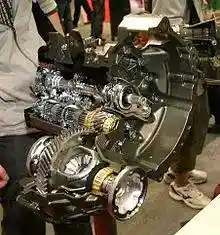
Front wheel drive manual transaxle, showing the gearbox and final drive incorporated in the same housing
- Clutch
- Transaxle
- Gearbox
- Final drive
- Differential
- Drive shafts and constant-velocity joints to each wheel
Four-wheel drive off-road vehicle
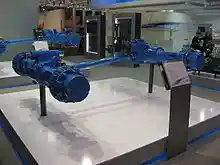
Construction vehicle drivetrain, with permanent all-wheel drive
- Clutch
- Gearbox
- Transfer box
- Transmission brake
- Propeller shafts, to front and rear
- Front and rear axles
- Final drive
- Locking differential
- Portal gear
Final drive
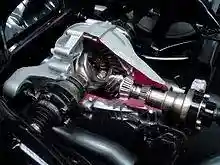
A cutaway view of an automotive final drive unit, which contains the differential
The final drive is the last in the set of components which delivers torque to the drive wheels. In a road vehicle, it incorporates the differential. In a railway vehicle, it sometimes incorporates the reversing gear. Examples include the Self-Changing Gears RF 28 (used in many first-generation diesel multiple units of British Railways)[2] and RF 11 used in the British Rail Class 03 and British Rail Class 04 diesel shunting locomotives.
See also
- Two-wheel drive
- Four-wheel drive
- 6×4 (drivetrain)
- Six-wheel drive
- Eight-wheel drive
- H-drive
- Continuous track
- Hybrid vehicle drivetrain, the drivetrain of hybrid vehicles
- Powertrain, the drivetrain plus engine
4 speed manual transmission
References
This article is copied from an article on Wikipedia® - the free encyclopedia created and edited by its online user community. The text was not checked or edited by anyone on our staff. Although the vast majority of Wikipedia® encyclopedia articles provide accurate and timely information, please do not assume the accuracy of any particular article. This article is distributed under the terms of GNU Free Documentation License.