Generating function (physics)
This article is about generating functions in physics. For generating functions in mathematics, see Generating function.
In physics, and more specifically in Hamiltonian mechanics, a generating function is, loosely, a function whose partial derivatives generate the differential equations that determine a system's dynamics. Common examples are the partition function of statistical mechanics, the Hamiltonian, and the function which acts as a bridge between two sets of canonical variables when performing a canonical transformation.
In canonical transformations
There are four basic generating functions, summarized by the following table:
| Generating function | Its derivatives |
|---|---|
| and | |
| and | |
| and | |
| and |












Example
Sometimes a given Hamiltonian can be turned into one that looks like the harmonic oscillator Hamiltonian, which is

For example, with the Hamiltonian
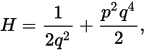
where p is the generalized momentum and q is the generalized coordinate, a good canonical transformation to choose would be
-
(1)
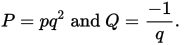
This turns the Hamiltonian into
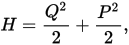
which is in the form of the harmonic oscillator Hamiltonian.
The generating function F for this transformation is of the third kind,
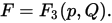
To find F explicitly, use the equation for its derivative from the table above,

and substitute the expression for P from equation (1), expressed in terms of p and Q:
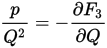
Integrating this with respect to Q results in an equation for the generating function of the transformation given by equation (1):
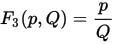
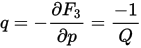
To confirm that this is the correct generating function, verify that it matches (1):
See also
- Hamilton–Jacobi equation
- Poisson bracket
References
- Goldstein, Herbert (2002). Classical Mechanics. Addison Wesley. ISBN 978-0-201-65702-9.
This article is copied from an article on Wikipedia® - the free encyclopedia created and edited by its online user community. The text was not checked or edited by anyone on our staff. Although the vast majority of Wikipedia® encyclopedia articles provide accurate and timely information, please do not assume the accuracy of any particular article. This article is distributed under the terms of GNU Free Documentation License.