Also found in: Dictionary, Thesaurus, Medical, Encyclopedia.
In botanical terminology, a phyllary, also known an involucral bract or tegule, is a single bract of the involucre of a composite flower.[1][2][3] The involucre is the grouping of bracts together. Phyllaries are reduced leaf-like structures that form one or more whorls immediately below a flower head.[1]
Function
Phyllaries provide protection to developing flowers and fruits.[4] In the dandelion hybrid Taraxacum japonicum × officinale, recurved phyllaries help defend the flowers from herbivory by slugs.[5]
They sometimes assist in the dispersal of fruits.[4] The hooked phyllaries of burdock species (Arctium) cling to the fur and feathers of animals, dispersing the seeds away from the parent plant (exozoochory).[6][7]
Structure and arrangement
Phyllary morphology is useful in plant identification as between species, they may vary in number, shape, width, length, hairiness, presence of glands, or texture.[3]
.jpg)
Balsamorhiza hookeri phyllaries are widely separated, hairy, stiff, and point away from the stem.
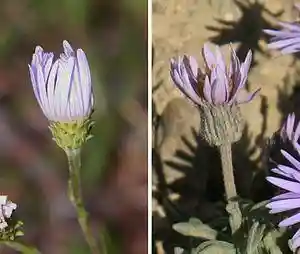
The aster phyllaries (left) are short, curl away from the plant, and are in several layers. The daisy phyllaries (right) are long, hairy, and clasp the base of the flower head.
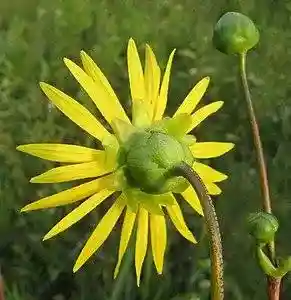
These Silphium pinnatifidum phyllaries are graduated, with those closer to the flower longer than the outer layers.
References
- ^ a b "Jepson Herbarium: Jepson Flora Project: Jepson eFlora: Glossary". ucjeps.berkeley.edu. Retrieved 26 May 2019.
- ^ "NYGB Steele Herbarium Glossary". Retrieved May 23, 2019.
- ^ a b Reznicek, A.A.; Voss, E.G.; Walters, B.S. "Asteraceae". michiganflora.net. Michigan Flora. Retrieved 26 May 2019.
- ^ a b "Glossary of botanical terms for Compositae". www.kew.org. Retrieved 26 May 2019.
- ^ Wu, Fu-Yu; Yahara, Tetsukazu (1 May 2017). "Recurved Taraxacum phyllaries function as a floral defense: experimental evidence and its implication for Taraxacum evolutionary history". Ecological Research. 32 (3): 313–329. doi:10.1007/s11284-017-1444-5. ISSN 1440-1703. S2CID 46343283.
- ^ Hawthorn, Wayne R.; Hayne, P. D. (1 January 1978). "Seed production and predispersal seed predation in the biennial composite species, Arctium minus (Hill) Bernh. and A. lappa L.". Oecologia. 34 (3): 283–295. Bibcode:1978Oecol..34..283H. doi:10.1007/BF00344907. ISSN 1432-1939. PMID 28309875. S2CID 6102531.
- ^ Clark, Patterson. "Burdock: Sowing seeds with fur and bur". The Washington Post. Retrieved 26 May 2019.
This article is copied from an article on Wikipedia® - the free encyclopedia created and edited by its online user community. The text was not checked or edited by anyone on our staff. Although the vast majority of Wikipedia® encyclopedia articles provide accurate and timely information, please do not assume the accuracy of any particular article. This article is distributed under the terms of GNU Free Documentation License.