Also found in: Dictionary, Thesaurus, Medical, Acronyms, Idioms, Encyclopedia.
This article is about the defensive device. For other uses, see Shield (disambiguation) and Shields (disambiguation).
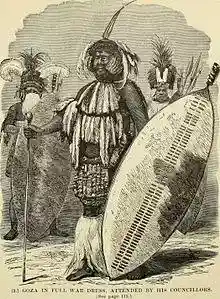
Zulu chief Goza and two of his councillors in war-dress, all with Nguni shields, c.1870. The size of the shield on the chief's left arm denotes his status, and the white colour that he is a married man.[1]
A shield is a piece of personal armour held in the hand, which may or may not be strapped to the wrist or forearm. Shields are used to intercept specific attacks, whether from close-ranged weaponry or projectiles such as arrows, by means of active blocks, as well as to provide passive protection by closing one or more lines of engagement during combat.
Gallery
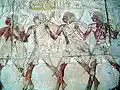
Image from Hatshepsut's expedition to Punt showing Egyptians soldiers with shields (wood/animal skin). 15th century BC. Temple of Hathor Deir el-Bahari

A hoplite by painter Alkimachos, on an Attic red-figure vase, c. 460 BC. Shield has a curtain which serves as a protection from arrows.
.jpg)
Drawing from the Codex Manesse showing jousting knights on horseback carrying shields.
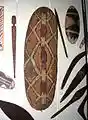
Australian Aboriginal shield, Royal Albert Memorial Museum.

Nias ceremonial shield.
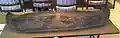
Hippopotamus Hide Shield from Sudan. Currently housed at Westminster College in New Wilmington, Pennsylvania.
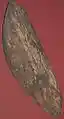
Aboriginal bark shield collected in Botany Bay, New South Wales, during Captain Cook's first voyage in 1770 (British Museum)
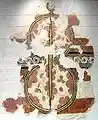
Wall painting depicting a Mycenaean Greek "figure eight" shield with a suspension strap at the middle, 15th century BC, National Archaeological Museum, Athens -The faces of figure eight shields were quite convex. The cited "strap" may be the ridge on the front (so denoted by the visible pattern of the ox hide) of the shield.
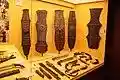
Elaborate and sophisticated shields from the Philippines.

Ballistic shield, NIJ Level IIIA
%252c_Special_Boat_Team_22_conducts_training_16_AUG_09.jpg)
U.S. Navy Special Warfare Combatant-craft Crewmen (SWCC) fire a shield-equipped Minigun
.jpg)
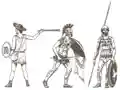
See also
- Aspis
- Ballistic shield
- Battersea Shield
- Buckler
- Enarmes
- Escutcheon (heraldic shield)
- Firing port
- Glagwa
- Guige
- Heater shield
- Kite shield
- Nguni shield
- Pavise
- Qauata
- Riot shield
- Roromaraugi
- Scutum (shield)
- Shield boss
- Shield wall
- Targe
- Viking Age arms and armour
- Yetholm-type shields
References
- ^ Wood, J. G. (1870). The uncivilized races of men in all countries of the world. Рипол Классик. p. 115. ISBN 9785878634595.
Bibliography
- Drummond, James (1890). "Notes on Ancient Shields and Highland Targets". Archaeologia Scotica. 5.
- Schulze, André(Hrsg.): Mittelalterliche Kampfesweisen. Band 2: Kriegshammer, Schild und Kolben. – Mainz am Rhein. : Zabern, 2007. – ISBN 3-8053-3736-1
- Snodgrass, A.M. "Arms and Armour of the Greeks." Cornell University Press, 1967
- "The Hoplite." The Classical Review, 61. 2011.
- Hellwag, Ursula. "Shield(s)." Encyclopaedia Aethiopica, Siegbert Uhllig (ed.), vol. 4, 650-651. Wiesbaden: Harrassowitz.
External links
This article is copied from an article on Wikipedia® - the free encyclopedia created and edited by its online user community. The text was not checked or edited by anyone on our staff. Although the vast majority of Wikipedia® encyclopedia articles provide accurate and timely information, please do not assume the accuracy of any particular article. This article is distributed under the terms of GNU Free Documentation License.