Also found in: Encyclopedia.
A stanitsa (Russian: станица, IPA: [stɐˈnʲitsə]; Ukrainian: станиця, stanytsia) is a village inside a Cossack host (Ukrainian: військо, romanized: viysko; Russian: казачье войско, romanized: kazachye voysko, sometimes translated as "Cossack Army"). Stanitsas (Russian: станицы) - Cossack military settlements - were the primary unit of Cossack hosts.
While the word stanitsa survives in modern usage, the stanitsa as a social system in its historic context was effectively destroyed in the aftermath of the 1917 Russian revolution, when the Russian Civil War (1917-1922) and subsequent collectivisation (1928-1940) of the land by the state in the Stalinist period and the Holodomor (1932-1933) destroyed the culture and the economic foundations of stanitsas.
Historical definition
Historically, the stanitsa was a unit of economic and political organisation of the Cossack peoples - primarily in the southern regions of the Russian Empire.
Each stanitsa held much of the local land in common, subject to annual allocation to Cossack families by the Ataman, the appointed leader of the community. This was a fully democratic, unique process, characteristic of Russia's South only. (A similar democratic system operated only in the Novgorod Republic, prior to its annexation by the Grand Duchy of Moscow in 1478.)
Modern usage
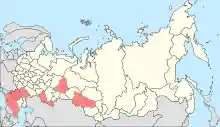
Regions of Russia where stanitsas are a type of settlement
In modern Russia, the administration classifies a stanitsa as a type of rural locality. Stanitsas mostly predominate in the southern regions of Rostov Oblast, Krasnodar and Stavropol Krais and most of the Republics of the Northern Caucasus.
See also
- Yurt, or Cossack stanitsa
This article is copied from an article on Wikipedia® - the free encyclopedia created and edited by its online user community. The text was not checked or edited by anyone on our staff. Although the vast majority of Wikipedia® encyclopedia articles provide accurate and timely information, please do not assume the accuracy of any particular article. This article is distributed under the terms of GNU Free Documentation License.