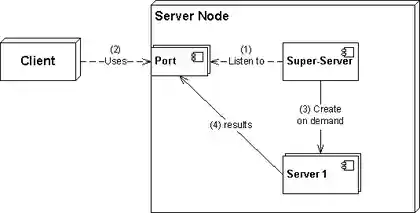
Principle of Super-server
Example
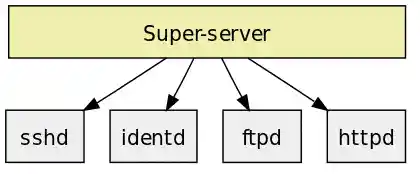
A super-server or sometimes called a service dispatcher is a type of daemon run generally on Unix-like systems.
Usage
A super-server starts other servers when needed, normally with access to them checked by a TCP wrapper. It uses very few resources when in idle state. This can be ideal for workstations used for local web development, client/server development or low-traffic daemons with occasional usage (such as ident and SSH).
Performance
There is a slight delay in connecting to the sub-daemons. Thus, when compared to standalone servers, a super-server setup may perform worse, especially when under high load. Some servers, such as tftpd-hpa, therefore take over the internet socket and listen on it themselves for some specified interval, anticipating more connections to come.
Implementations
This article is copied from an article on Wikipedia® - the free encyclopedia created and edited by its online user community. The text was not checked or edited by anyone on our staff. Although the vast majority of Wikipedia® encyclopedia articles provide accurate and timely information, please do not assume the accuracy of any particular article. This article is distributed under the terms of GNU Free Documentation License.