computer graphics
computer graphics
[kəm′pyüd·ər ′graf·iks](computer science)
The process of pictorial communication between humans and computers, in which the computer input and output have the form of charts, drawings, or appropriate pictorial representation; such devices as cathode-ray tubes, mechanical plotting boards, curve tracers, coordinate digitizers, and light pens are employed.
McGraw-Hill Dictionary of Scientific & Technical Terms, 6E, Copyright © 2003 by The McGraw-Hill Companies, Inc.
Computer graphics
A branch of computer science that deals with the theory and techniques of computer image synthesis. Computers produce images by analyzing a collection of dots, or pixels (picture elements). Computer graphics is used to enhance the transfer and understanding of information in science, engineering, medicine, education, and business by facilitating the generation, production, and display of synthetic images of natural objects with realism almost indistinguishable from photographs. Computer graphics facilitates the production of images that range in complexity from simple line drawings to three-dimensional reconstructions of data obtained from computerized axial tomography (CAT) scans in medical applications. User interaction can be increased through animation, which conveys large amounts of information by seemingly bringing to life multiple related images. Animation is widely used in entertainment, education, industry, flight simulators, scientific research, and heads-up displays (devices which allow users to interact with a virtual world). Virtual-reality applications permit users to interact with a three-dimensional world, for example, by “grabbing” objects and manipulating objects in the world. Digital image processing is a companion field to computer graphics. However, image processing, unlike computer graphics, generally begins with some image in image space, and performs operations on the components (pixels) to produce new images.
Computers are equipped with special hardware to display images. Several types of image presentation or output devices convert digitally represented images into visually perceptible pictures. They include pen-and-ink plotters, dot-matrix plotters, electrostatic or laser-printer plotters, storage tubes, liquid-crystal displays (LCDs), active matrix panels, plasma panels, and cathode-ray-tube (CRT) displays. Images can be displayed by a computer on a cathode-ray tube in two different ways: raster scan and random (vector) scan. See Cathode-ray tube, Computer peripheral devices
Interaction with the object takes place via devices attached to the computer, starting with the keyboard and the mouse. Each type of device can be programmed to deliver various types of functionality. The quality and ease of use of the user interface often determines whether users enjoy a system and whether the system is successful. Interactive graphics aids the user in the creation and modification of graphical objects and the response to these objects in real-time. The most commonly used input device is the mouse. Other kinds of interaction devices include the joystick, trackball, light pen, and data tablet. Some of these two-dimensional (2D) devices can be modified to extend to three dimensions (3D). The data glove is a device capable of recording hand movements. The data glove is capable of a simple gesture recognition and general tracking of hand orientation.
In the production of a computer-generated image, the designer has to specify the objects in the image and their shapes, positions, orientations, and surface colors or textures. Further, the viewer's position and direction of view (camera orientation) must be specified. The software should calculate the parts of all objects that can be seen by the viewer (camera). Only the visible portions of the objects should be displayed (captured on the film). (This requirement is referred to as the hidden-surface problem.) The rendering software is then applied to compute the amount and color of light reaching the viewer eye (film) at any point in the image, and then to display that point. Some modern graphics work stations have special hardware to implement projections, hidden-surface elimination, and direct illumination. Everything else in image generation is done in software.
Solid modeling is a technique used to represent three-dimensional shapes in a computer. The importance of solid modeling in computer-aided design and manufacturing (CAD/CAM) systems has been increasing. Engineering applications ranging from drafting to the numerical control of machine tools increasingly rely on solid modeling techniques. Solid modeling uses three-dimensional solid primitives (the cube, sphere, cone, cylinder, and ellipsoid) to represent three-dimensional objects. Complex objects can be constructed by combining the primitives. See Computer-aided design and manufacturing, Computer-aided engineering
The creation of images by simulating a model of light propagation is often called image synthesis. The goal of image synthesis is often stated as photorealism, that is, the criterion that the image look as good as a photograph. Rendering is a term used for methods or techniques that are used to display realistic-looking three-dimensional images on a two-dimensional medium such as the cathode-ray-tube screen (see illustration). The display of a wire-frame image is one way of rendering the object. The most common method of rendering is shading. Generally, rendering includes addition of texture, shadows, and the color of light that reaches the observer's eye from any point in the image.
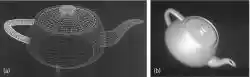

Image renderings of a teapot
Computer-generated images are used extensively in the entertainment world and other areas. Realistic images have become essential tools in research and education. Conveying realism in these images may depend on the convincing generation of natural phenomena. A fundamental difficulty is the complexity of the real world. Existing models are based on physical or biological concepts. The behavior of objects can be determined by physical properties or chemical and microphysical properties.
McGraw-Hill Concise Encyclopedia of Engineering. © 2002 by The McGraw-Hill Companies, Inc.