frequency
frequency
1. Physics the number of times that a periodic function or vibration repeats itself in a specified time, often 1 second. It is usually measured in hertz.
2. Ecology
a. the number of individuals of a species within a given area
b. the percentage of quadrats that contains individuals of a species
Collins Discovery Encyclopedia, 1st edition © HarperCollins Publishers 2005
Frequency (wave motion)
The number of times which sound pressure, electrical intensity, or other quantities specifying a wave vary from their equilibrium value through a complete cycle in unit time. The most common unit of frequency is the hertz (Hz), which is equal to 1 cycle per second. In one cycle there is a positive variation from equilibrium, a return to equilibrium, then a negative variation, and return to equilibrium. This relationship is often described in terms of the sine wave, and the frequency referred to is that of an equivalent sine-wave variation in the parameter under discussion. See Frequency measurement, Sine wave, Wave motion
McGraw-Hill Concise Encyclopedia of Physics. © 2002 by The McGraw-Hill Companies, Inc.
frequency
Symbol: f , ν. The number of oscillations per unit time of a vibrating system. Frequency is measured in hertz. The frequency of a wave is the number of wave crests passing a point per unit time. For light and other electromagnetic radiation, it is related to wavelength λ by ν = c /λ, where c is the speed of light.Collins Dictionary of Astronomy © Market House Books Ltd, 2006
frequency
[′frē·kwən·sē](physics)
The number of cycles completed by a periodic quantity in a unit time.
(statistics)
The number of times an event or item falls into or is expected to fall into a certain class or category.
McGraw-Hill Dictionary of Scientific & Technical Terms, 6E, Copyright © 2003 by The McGraw-Hill Companies, Inc.
frequency
The number of oscillations per second (a) of the current or voltage in an alternating-current electric circuit, or (b) of a sound wave, or (c) of a vibrating solid object; expressed in hertz (abbr. Hz) or in cycles per second (abbr. cps).
McGraw-Hill Dictionary of Architecture and Construction. Copyright © 2003 by McGraw-Hill Companies, Inc.
frequency
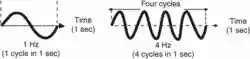

i. The number of recurrences of a periodic phenomenon in a unit of time.
ii. The number of cycles completed in one second. One cycle per second is the basic unit of measurement of frequency and is called a hertz.
iii. The number of services operated by an airline per day or per week over a particular route.
An Illustrated Dictionary of Aviation Copyright © 2005 by The McGraw-Hill Companies, Inc. All rights reserved
The following article is from The Great Soviet Encyclopedia (1979). It might be outdated or ideologically biased.
Frequency
The frequency of an event A is the ratio m/n of the number m of occurrences of A in a given series of trials to the total number n of trials. If the trials are independent and there is a definite probability p of the occurrence of A in an individual trial, then, for arbitrarily small ∊ > 0, at sufficiently large m it is practically certain that the frequency m/n satisfies the inequality

(seeLARGE NUMBERS, LAW OF and PROBABILITY).
The term “frequency” is used in mathematical statistics to designate the number of elements of a set that have a specified attribute.
The Great Soviet Encyclopedia, 3rd Edition (1970-1979). © 2010 The Gale Group, Inc. All rights reserved.