norm
norm
1. Maths
a. the length of a vector expressed as the square root of the sum of the square of its components
b. another name for mode
2. Geology the theoretical standard mineral composition of an igneous rock
Collins Discovery Encyclopedia, 1st edition © HarperCollins Publishers 2005
norm
a standard or rule, regulating behaviour in a social setting. The idea that social life, as an ordered and continuous process, is dependent upon shared expectations and obligations, is commonly found in sociological approaches, although some place more emphasis on it than others. For DURKHEIM, society was theorized as a moral order. This perspective was influential in the development of modern FUNCTIONALISM, particularly in the work of PARSONS, where the concept of NORMATIVE ORDER is the central element of the SOCIAL SYSTEM. Here the idea of norms is related to SOCIALIZATION and ROLES. These prescriptions operate at every level of society, from individuals actions in daily life, e.g. in table manners or classroom behaviour, to the formulation of legal systems in advanced societies. The concept of norms also implies that of SOCIAL CONTROL, i.e. positive or negative means of ensuring conformity and applying sanctions to deviant behaviour (see DEVIANCE).Other sociological approaches deal with the issue of social order in rather different ways. In some, RULES are emphasized, rather than norms, whilst in others there is a greater emphasis on POWER and coercion.
Collins Dictionary of Sociology, 3rd ed. © HarperCollins Publishers 2000
norm
[nȯrm](mathematics)
A scalar valued function on a vector space with properties analogous to those of the modulus of a complex number; namely: the norm of the zero vector is zero, all other vectors have positive norm, the norm of a scalar times a vector equals the absolute value of the scalar times the norm of the vector, and the norm of a sum is less than or equal to the sum of the norms.
For a matrix, the square root of the sum of the squares of the moduli of the matrix entries.
For a quaternion, the product of the quaternion and its conjugate.
(petrology)
The theoretical mineral composition of a rock expressed in terms of standard mineral molecules as determined by means of chemical analyses.
(quantum mechanics)
The square of the modulus of a Schrödinger-Pauli wave function, integrated over the space coordinates and summed over the spin coordinates of the particles it describes.
The square root of this quantity.
McGraw-Hill Dictionary of Scientific & Technical Terms, 6E, Copyright © 2003 by The McGraw-Hill Companies, Inc.
norm
(mathematics)A real-valued function modelling the length of a vector. The norm must be homogeneous and symmetric and fulfil the following condition: the shortest way to reach a point is to go straight toward it. Every convex symmetric closed surface surrounding point 0 introduces a norm by means of Minkowski functional; all vectors that end on the surface have the same norm then.
The most popular norm is the Euclidean norm.
This article is provided by FOLDOC - Free Online Dictionary of Computing (foldoc.org)
The following article is from The Great Soviet Encyclopedia (1979). It might be outdated or ideologically biased.
Norm
(1) The minimum of something, as established by a rule or plan, for example, a time norm or sowing norm.
(2) A rule or viewpoint generally accepted in a particular social milieu; a rule of social conduct expressed in a law (legal norm).
(3) A rule or law in some branch of learning, for example, a linguistic norm.
(4) The average of something, such as a flow norm.
(5) Norm of representation, the number of deputies or delegates representing a preestablished number of voters in elective bodies or at congresses and conferences.
(6) Typographic norm, the title of a book or the name of its author, printed in small type on the first page of every printed sheet.
Norm
a mathematical concept that generalizes the concept of the absolute value of a number. For example, the norm of a vector x is the length of the vector and is denoted by ǀǀxǀǀ. The norm of a quaternion a + bi + cj + dk is the number a2 + b2 + c2 + d2; the norm of a matrix A is the number

and the norm of an algebraic number is the product of all the numbers conjugated with it, including the number itself. The norm is used extensively in the theory of linear spaces. We can find the norm for linear functionals in a given linear space according to the formula
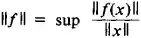
and for linear operators according to the formula
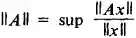
The Great Soviet Encyclopedia, 3rd Edition (1970-1979). © 2010 The Gale Group, Inc. All rights reserved.