SCXML - Commons SCXML Usecases - Stopwatch
Using SCXML documents to define behavior
SCXML documents (more generically, UML state chart diagrams) can be used to define stateful behavior of objects, and Commons SCXML enables developers to take this model directly into the corresponding code artifacts. The resulting artifacts tend to be much simpler, embody a useful separation of concerns and are easier to understand and maintain.
Sample walkthrough - From model to working code
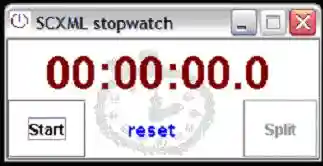
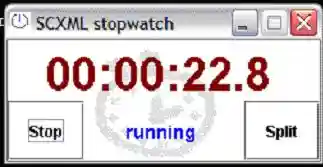
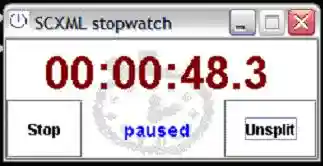
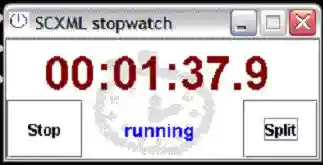
Here is a short exercise in modeling and implementing an object with stateful behavior. A stopwatch -- for anyone who may need an introduction -- is used to measure duration, with one button for starting and stopping the watch and another one for pausing the display (also known as "split", where the watch continues to keep time while the display is frozen, to measure, for example, "lap times" in races). Once the watch has been stopped, the start/stop button may be used to reset the display.
The Model - UML Diagram
Here is the state chart diagram that describes the behavior
of this particular stopwatch:

(Zoom out)
The SCXML document
The SCXML document is then, a simple serialization of the "model" above: stopwatch.xml.
The Stopwatch class
Here is the class that implements the stopwatch behavior, StopWatch.java. The class extends AbstractStateMachine.java, which provides one approach for providing the base functionality needed by classes representing stateful entities. Points to note in the StopWatch class are:
- The "lifecycle" is defined by the SCXML document, which is an artifact easily derived from the modeling layer.
- The code is much simpler, since the lifecycle management task has been assigned to Commons SCXML.
The Stopwatch UI
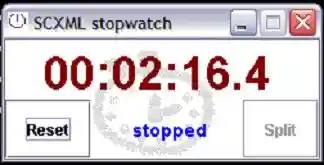
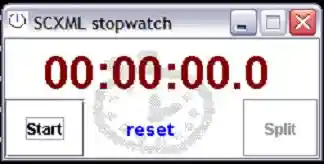
Here is the UI for our demonstration, StopWatchDisplay.java. Points to note here are:
- The UI is "backed" by a StopWatch instance.
- It merely relays the user initiated events (in this case, button clicks) to the Commons SCXML driven StopWatch instance by serving as an intermediary / proxy.
- The UI and application behavior separation is thus, and usefully, pronounced.