SOCIAL MEDIA TITLE TAG
Learning Image-Adaptive Codebooks for Class-Agnostic Image Restoration
1University of Washington, 2CUHK, 3SenseBrain Technology
ICCV, 2023

TL;DR: AdaCode learns image-adaptive codebooks for class-agnostic image reconstruction and restoration. Instead of learning a single codebook regardless of image content, we learn a set of basis codebooks and adaptively combine them to form a more flexible and expressive representation.
Abstract
Recent work on discrete generative priors, in the form of codebooks, has shown exciting performance for image reconstruction and restoration, as the discrete prior space spanned by the codebooks increases the robustness against diverse image degradations. Nevertheless, these methods require separate training of codebooks for different image categories, which limits their use to specific image categories only (e.g. face, architecture, etc.), and fail to handle arbitrary natural images. In this paper, we propose AdaCode for learning image-adaptive codebooks for class-agnostic image restoration. Instead of learning a single codebook for each image category, we learn a set of basis codebooks. Given an input image, AdaCode learns a weight map with and computes a weighted combination of these basis codebooks for adaptive image restoration. Intuitively, AdaCode is a more flexible and expressive discrete generative prior than previous work. Experimental results demonstrate that AdaCode achieves state-of-the-art performance on image reconstruction and restoration tasks, including image super-resolution and inpainting.
Results

Image Reconstruction
Method Overview
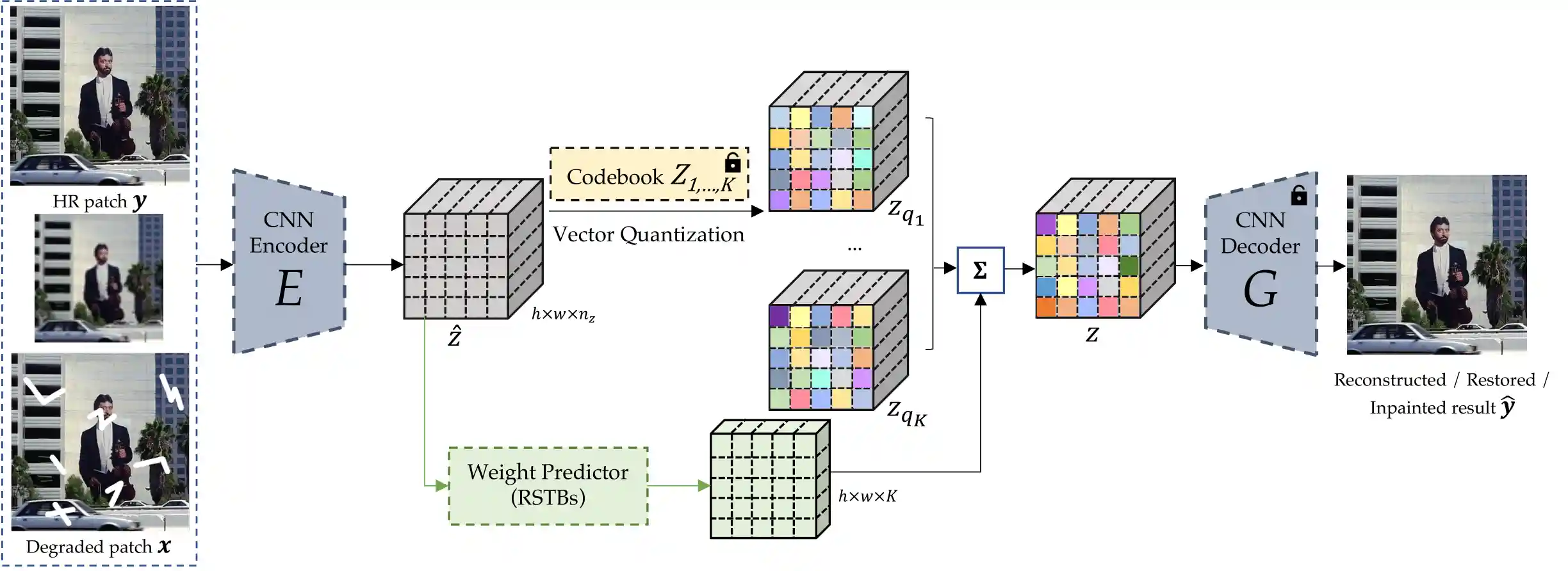
The training of AdaCode incorporates three stages:
1. Codebook Pretraining; 2. Representation Learning; 3. Restoration via AdaCode.
In the first stage, we divide our HQ dataset into multiple semantic subsets and train a class-specific VQGAN on each subset. In the second stage, using the fixed pretrained class-specific codebooks as bases, we leverage a transformer block to generate weight maps and train the AdaCode through the self-reconstruction task. In the last stage, we employ the AdaCode with fixed codebooks and fixed image decoder to address downstream restoration tasks, e.g. Super-Resolution and Image Inpainting.
Video
More results
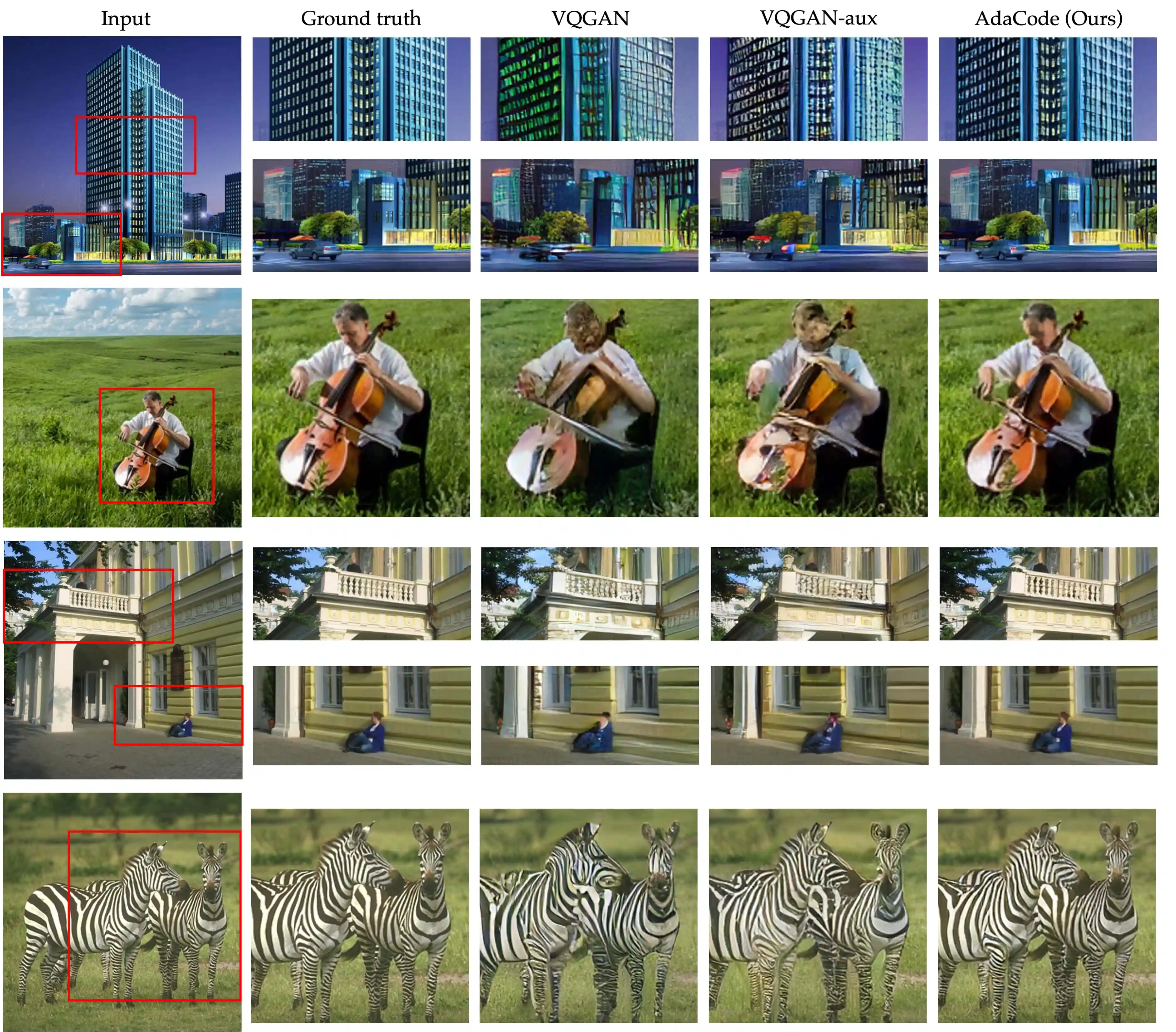
Reconstruction
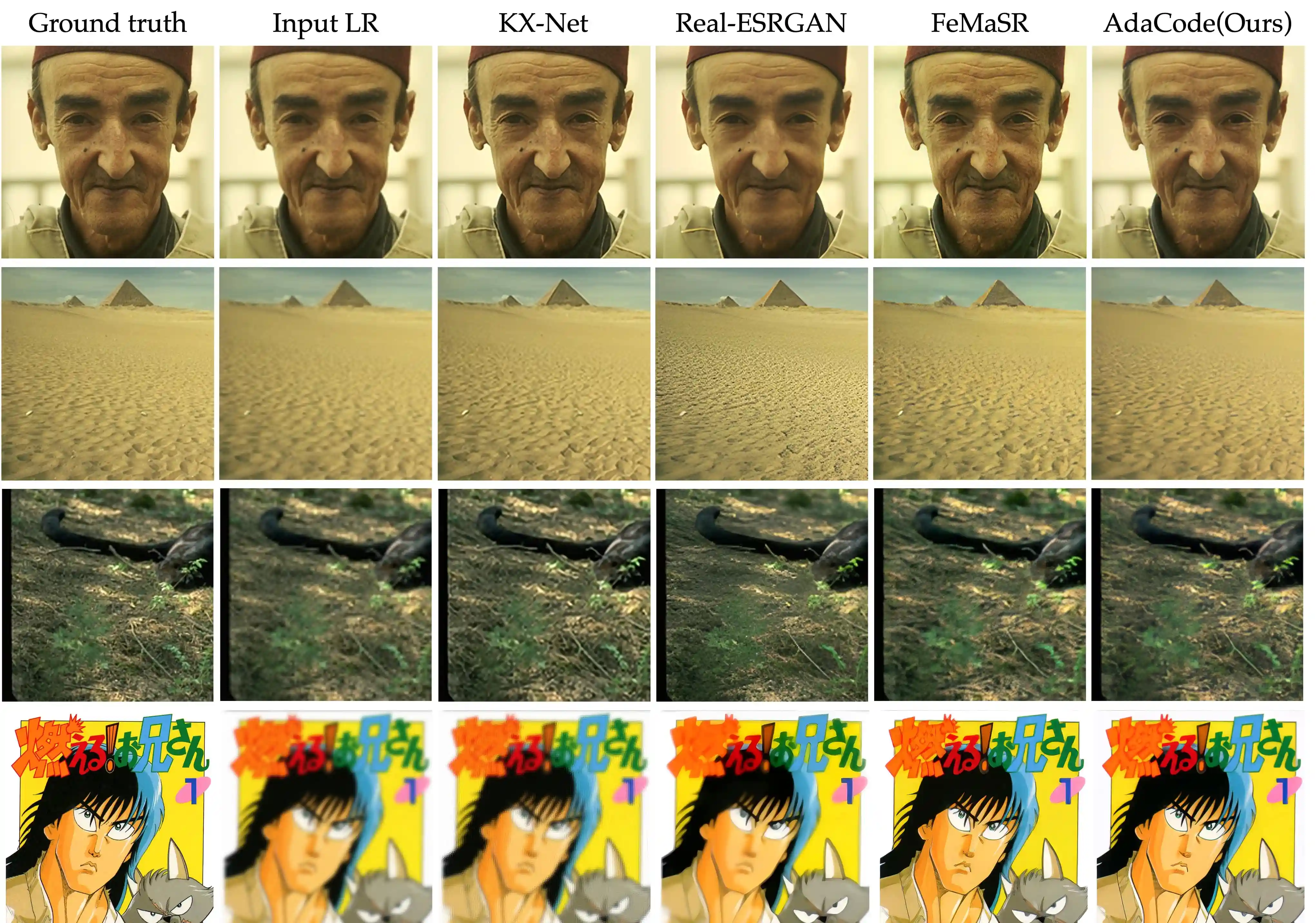
Super-Resolution (2x)
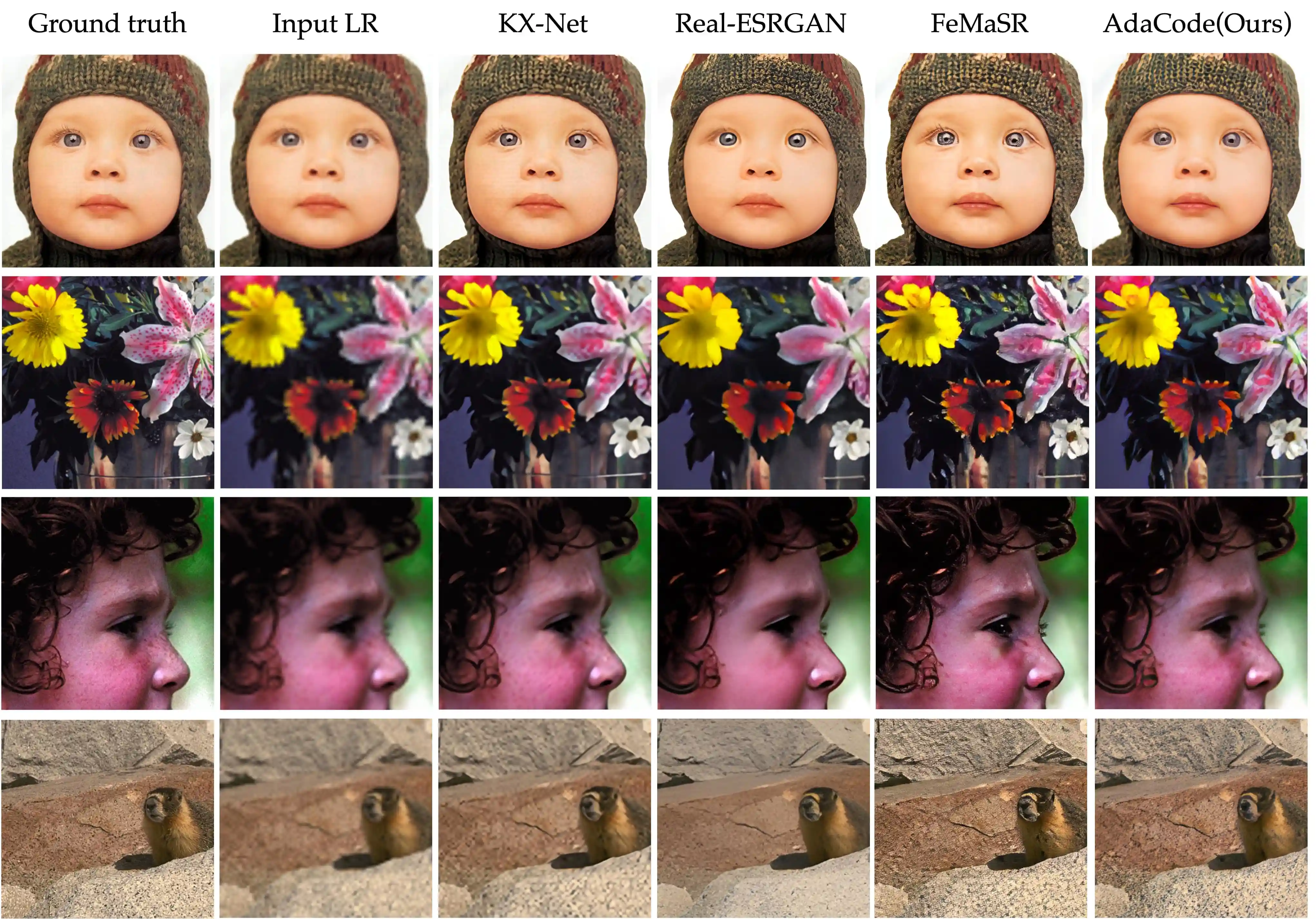
Super-Resolution (4x)

Inpainting
Poster
BibTeX
@InProceedings{Liu_2023_ICCV,
      author    = {Liu, Kechun and Jiang, Yitong and Choi, Inchang and Gu, Jinwei},
      title     = {Learning Image-Adaptive Codebooks for Class-Agnostic Image Restoration},
      booktitle = {Proceedings of the IEEE/CVF International Conference on Computer Vision (ICCV)},
      month     = {October},
      year      = {2023},
      pages     = {5373-5383}
  }
Contact
If you have any question, please contact Kechun Liu at kechun@cs.washington.edu