ReactPy-Django
Create user interfaces from components
ReactPy lets you build user interfaces out of individual pieces called components. Create your own ReactPy components like thumbnail, like_button, and video. Then combine them into entire screens, pages, and apps.
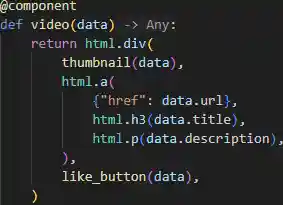
My video
Video description
Whether you work on your own or with thousands of other developers, using React feels the same. It is designed to let you seamlessly combine components written by independent people, teams, and organizations.
Add interactivity wherever you need it
ReactPy components receive data and return what should appear on the screen. You can pass them new data in response to an interaction, like when the user types into an input. ReactPy will then update the screen to match the new data.
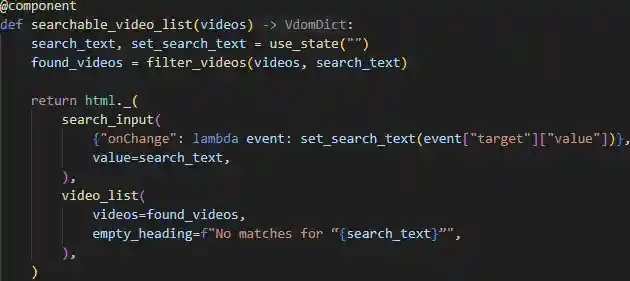
5 Videos
ReactPy: The Documentary
From web library to taco delivery service
Code using Worst Practices
Harriet Potter (2013)
Introducing ReactPy Foriegn
Tim Cooker (2015)
Introducing ReactPy Cooks
Soap Boat and Dinosaur Dan (2018)
Introducing Quantum Components
Isaac Asimov and Lauren-kun (2020)
You don't have to build your whole page in ReactPy. Add React to your existing HTML page, and render interactive ReactPy components anywhere on it.
Go full-stack with the Django framework
ReactPy is a library. It lets you put components together, but it doesn't prescribe how to do routing and data fetching. To build an entire app with ReactPy, we recommend a backend framework like Django.