Lecture VII - Vol. 236. Karmic Relationships II (1974) — Rudolf Steiner Archive
Siebenter Vortrag
Es soll heute damit begonnen werden, die inneren Verrichtungen der Seele zu besprechen, die den Menschen dazu führen können, allmählich Anschauungen zu bekommen, Gedanken zu bekommen über das Karma. Diese Gedanken, diese Anschauungen können sich nur so ergeben, daß der Mensch Erlebnisse, welche eine karmische Verursachung haben, auch im Lichte des Karma sehen kann.
Nun sehen wir ja, wenn wir uns in unserer menschlichen Umgebung umsehen, eigentlich nur dasjenige, was in der physischen Welt auf physische Art durch physische Kraft verursacht ist. Und wenn wir doch etwas in der physischen Welt sehen, das nicht durch physische Kräfte verursacht ist, so sehen wir es durch äußere physische Substanzen, äußere physische Wahrnehmungsobjekte. Gewiß, wenn ein Mensch aus seinem Willen heraus etwas tut, so ist das ja nicht verursacht durch physische Kräfte, durch physische Ursachen, denn es kommt eben in vieler Beziehung aus dem freien Willen des Menschen heraus. Aber alles das, was wir äußerlich sehen, geht ja restlos auf in physisch-sinnlichen Erscheinungen innerhalb der Welt, die wir so beobachten. Im ganzen Umkreis dessen, was wir so beobachten können, kann uns der karmische Zusammenhang eines Erlebnisses, das wir selbst durchmachen, nicht aufgehen. Denn das ganze Bild dieses karmischen Zusarnmenhanges steht eben in der geistigen Welt, ist eigentlich eingeschrieben in demjenigen, was Ätherwelt ist, was der Ätherwelt dann als die astralische Außenwelt zugrunde liegt, oder als die Welt der geistigen Wesenheiten, die in dieser astralischen Außenwelt wohnen. Das alles wird ja nicht gesehen, wenn wir bloß unsere Sinne hinrichten auf die physische Welt.
Alles, was wir in der physischen Welt wahrnehmen, wird ja durch unsere Sinne wahrgenommen. Diese Sinne wirken, ohne daß wir eben viel dazu tun können. Unser Auge empfängt die Lichteindrücke, die Farbeneindrücke, ohne daß wir viel dazu tun können. Wir können höchstens, und das auch halb unwillkürlich, unsere Augen in eine bestimmte Richtung einstellen, wir können hinschauen, wir können wegschauen. Da liegt auch schon viel Unbewußtes darinnen, aber immerhin wenigstens ein Stückchen Bewußtsein. Und gar erst das, was das Auge innerlich tun muß, um eine Farbe zu sehen, diese ungemein weisheitsvolle, großartige innere Tätigkeit, die ausgeübt wird, wenn wir irgend etwas sehen, die könnten wir als Mensch nicht zustande bringen, wenn wir sie bewußt zustande bringen sollten. Davon könnte gar keine Rede sein. Das alles muß zunächst unbewußt geschehen, weil es viel zu weise ist, als daß der Mensch irgendwie etwas dazu tun könnte.
Man muß sich einmal, um einen richtigen Gesichtspunkt gegenüber der Erkenntnis des Menschen zu gewinnen, durchdringen mit dem, was alles in der Welt da ist an weisheitsvollen Einrichtungen, die der Mensch nicht hervorbringen kann. Wenn der Mensch nur immer an dasjenige denkt, was er kann, so versperrt er sich eigentlich alle Wege zur Erkenntnis, Es beginnt im Grunde genommen der Erkenntnisweg damit, daß man in der bescheidensten Weise sich klarmacht, was man alles nicht kann und was doch geschehen muß im Weltendasein. Das Auge, das Ohr, sogar die anderen Sinnesorgane sind ja so weise, so grundweise Einrichtungen, daß die Menschen lange werden studieren müssen, um ein ganz Weniges davon zu ahnen während des Erdendaseins. Das muß man sich wirklich ganz bewußt vor Augen stellen. Aber so unbewußt kann die Beobachtung des Geistigen nicht erfolgen. In älteren Zeiten der Menschheitsentwickelung war das auch für die Beobachtung des Geistigen der Fall; da gab es ein instinktives Hellsehen. Das ist dasjenige, was verglommen ist in der Menschheitsentwickelung.
Es muß nunmehr von dem Menschen bewußt eine Stellung zum Weltenall errungen werden, durch die die Menschen das Geistige durchschauen können. Und ein Geistiges muß durchschaut werden, wenn die karmischen Zusammenhänge durchschaut werden sollen für irgendein Erlebnis, das wir haben.
Nun kommt es darauf an, daß wir wenigstens für die Beobachtung des Karma damit beginnen, daß wir aufmerksam werden auf dasjenige, was in uns geschehen kann zum Herausholen der Beobachtung über die karmischen Zusammenhänge. Wir müssen dann ein klein wenig dazu tun, um diese Beobachtungen zum Bewußtsein zu bringen. Mehr müssen wir dazu tun, als wir zum Beispiel für das Auge tun, um die Farbe zum Bewußtsein zu bringen. Meine lieben Freunde, was man da lernen muß zunächst, das schiebt sich zusammen in das eine Wort: warten. Man muß auf die inneren Erlebnisse warten können.
Ich habe schon einmal über dieses Warten-Können gesprochen. Es war etwa im Jahre 1889 - ich werde auch das noch in meinem «Lebensgang» zu erzählen haben —, da trat zuerst an mich das innere geistige, das spirituelle Gefüge von Goethes «Märchen von der grünen Schlange und der schönen Lilie» heran. Und da war es zuerst, wo gewissermaßen die Anschauung eines größeren Zusammenhanges, weiteren Zusammenhanges, als er in dem Märchen selbst gegeben ist, an mich herantrat. Aber ich wußte auch dazumal: Das, was ich einmal mit diesem Zusammenhang werde anfangen können, das kann ich jetzt noch nicht damit anfangen. Und so blieb dasjenige, was sich mir dazumal nur durch die Veranlassung des Märchens offenbarte, einfach in der Seele liegen.
Dann trat es noch einmal hervor, 1896, sieben Jahre darnach, aber auch noch nicht so, daß es gestaltet werden konnte. Dann wiederum sieben Jahre darnach, 1903 etwa. Auch da, trotzdem es in großer Bestimmtheit und in Zusammenhängen auftrat, konnte es noch nicht gestaltet werden. So verwandelt, daß es in ganz plastischer Weise gestaltet werden konnte, trat es erst dann auf, als ich meine erste Mysteriendichtung, «Die Pforte der Einweihung», wiederum sieben Jahre darnach, konzipierte.
Solche Dinge erfordern also ein wirkliches Warten, ein Reifenlassen. Man muß da mit seinen eigenen Erlebnissen zu dem übergehen, was sonst auch in der Welt da ist. Man kann einfach nicht, wenn erst der Keim einer Pflanze vorhanden ist, die Pflanze schon haben. Man muß den Keim in die entsprechenden Bedingungen bringen, man muß ihn zum Wachsen bringen, und man muß abwarten, bis aus dem Keime die Blüte und wiederum die Frucht wird. Und so muß man es auch mit den Erlebnissen, die man durchmacht, zustande bringen. Man darf nicht auf dem Standpunkte stehen: Weil man irgendein Erlebnis hat, weil es gerade da ist, hat man Sensation dafür, und dann vergißt man es. Wer überhaupt in dieser Weise mit Erlebnissen umgeht, daß er sie nur als gegenwärtige haben will, der wird wenig wirklich tun können, um in die geistige Welt zur Beobachtung hineinzukommen. Da muß man warten können, da muß man in der Seele die Erlebnisse reifen lassen können.
Nun ist ja eine Möglichkeit eines verhältnismäßig schnellen Reifens für die Auffassung karmischer Zusammenhänge vorhanden, wenn man in Geduld längere Zeit hindurch ganz innerlich energisch versucht, dasjenige im Bewußtsein und immer mehr und mehr im Bewußtsein sich abspielen zu lassen, was sich sonst so abspielt, daß es da ist, aber nicht ordentlich aufgefaßt wird und einfach verglimmt im Leben. So ist es ja schließlich mit den Ereignissen. Was tut denn der Mensch mit den Ereignissen, mit seinen Erlebnissen, die eben im Tageslauf an ihn herankommen? Er erlebt sie eigentlich halb beobachtend. Sie können sich ein Bild davon machen, wie die Erlebnisse halb beobachtet werden, wenn Sie sich einmal — und ich rate dazu, es zu tun — nachmittags oder abends hinsetzen und sich fragen: Was habe ich eigentlich heute um halb zehn Uhr am Morgen erlebt? — Aber nun versuchen Sie einmal, in allen Einzelheiten, mit allen Details sich ein solches Erlebnis vor die Seele zu rufen, als ob es nun wiederum, meinetwillen um halb acht Uhr abends, einfach da wäre, als ob es dastünde, als ob Sie es geistig-künstlerisch darstellten vor sich. Sie werden sehen, wieviel Ihnen fehlt, wieviel Sie nicht beobachtet haben, wie schwer das wird. Sie werden, wenn Sie sich eine Feder oder einen Bleistift nehmen, um das aufzuschreiben, sehr bald anfangen, in den Bleistift oder in die Feder hineinzubeißen, weil Ihnen eben die Details nicht einfallen und Sie sie schließlich herausbeißen wollen aus dem Bleistift.
Ja, darauf kommt es aber zunächst an, sich die Aufgabe zu stellen, ein Erlebnis, das man gehabt hat, mit aller Schärfe sich — nicht wenn es dasteht, sondern hinterher — vor die Seele zu stellen, wie wenn man geistig es malen wollte, es so vor die Seele zu stellen, daß, wenn zum Beispiel in dem Erlebnisse etwas ist, wo jemand gesprochen hat, Sie sich das ganz gegenständlich machen: den Klang seiner Stimme, die Art und Weise, wie er geschickt oder ungeschickt die Worte gesetzt hat und so weiter, stark, energisch, kurz, das zum Bilde zu bringen, was man erlebt hat. Wenn man in dieser Weise ein solches Erlebnis des Tages zum Bilde bringt, dann beschäftigt sich in der nächsten Nacht, wenn der astralische Leib aus dem Ätherleib und dem physischen Leib heraus ist, der astralische Leib mit diesem Bilde. Er ist eigentlich selber der Träger dieses Bildes, er gestaltet dieses Bild jetzt draußen außer dem Leibe aus. Er nimmt es mit, wenn er hinausgeht in der ersten Nacht. Er gestaltet es da draußen außer dem physischen und dem Ätherleib aus.
So haben wir das erste, wir wollen diese Etappen ganz genau nehmen: Der schlafende Astralleib gestaltet außer dem physischen und dem Ätherleib das Bild des Erlebnisses. Wo tut er das? Das tut er im äußeren Äther. Er ist ja jetzt in der äußeren Ätherwelt.
Stellen Sie sich jetzt den Menschen vor: Sein physischer Leib und sein Ätherleib liegen im Bette, draußen ist der astralische Leib. Von dem Ich wollen wir absehen. Da draußen ist der astralische Leib, dieses Bild, das man sich gemacht hat, nachbildend; aber er tut das im äußeren Äther. Dadurch geschieht folgendes.
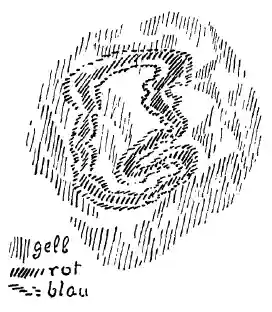
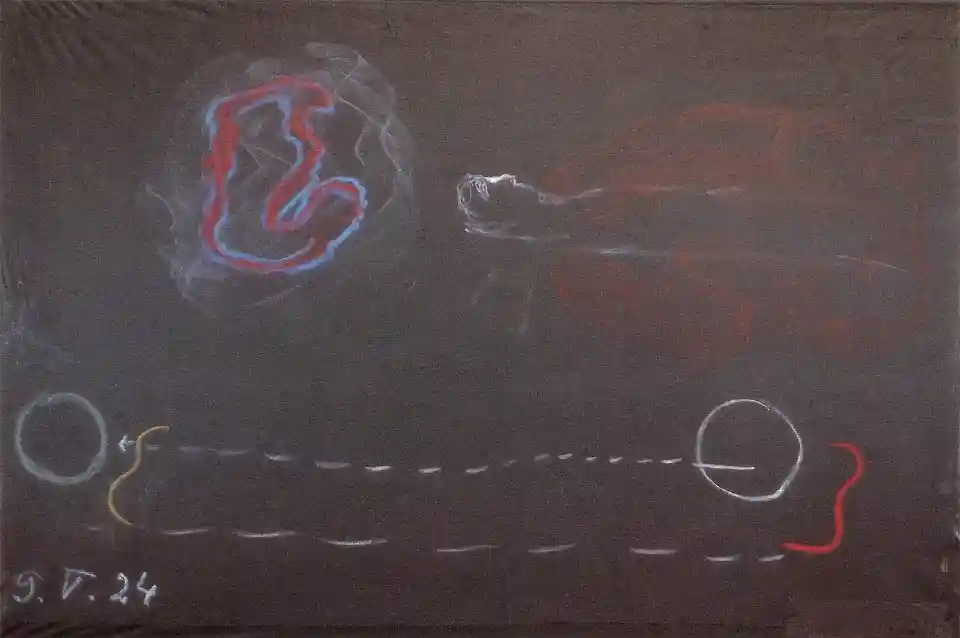
Stellen Sie sich vor, der astralische Leib ist da draußen (siehe Zeichnung, gelb). Jetzt gestaltet er da draußen dieses Bild, das ich rot zeichnen will — es ist natürlich alles schematisch. Dieses Bild gestaltet er. Das alles geschieht im äußeren Äther; der äußere Äther, der inkrustiert gewissermaßen mit seiner eigenen Substanz dasjenige, was da im Astralleib als Bild geformt ist. Also der äußere Äther bildet hier überall die Ätherform (blau) als ein so scharf ins geistige Auge gefaßtes Bild.
Jetzt kommen Sie am Morgen in den physischen und in den Ätherleib zurück, tragen das hinein, was vom äußeren Äther hineinsubstantiiert ist. Also: der schlafende Astralleib gestaltet außer dem physischen und dem Ätherleib das Bild des Erlebnisses; der äußere Äther bildet die eigene Substanz dem Bilde ein.
Sie können sich vorstellen, daß dadurch das Bild stärker wird und daß jetzt, wenn am Morgen der astralische Leib zurückkommt mit diesem stärker Substantiierten, er einen Eindruck machen kann auf den Ätherleib im Menschen. Mit dem, was als Kräfte vom äußeren Äther stammt, macht er jetzt einen Eindruck in den Ätherleib des Menschen. So daß das zweite ist: Vom Astralleib wird das Bild dem Ätherleib des Menschen eingeprägt.
Das sind die Ereignisse: erster Tag, erste Nacht (siehe Schema Seite 124). Jetzt kommen wir an den zweiten Tag heran. Während des zweiten Tages, während Sie sich da mit den anderen Kinkerlitzchen des Lebens im vollen Wachbewußtsein beschäftigen, da geschieht unter dem Bewußtsein, im Unbewußten dieses, daß das Bild sich in den Ätherleib hinuntersetzt. Und in der nächsten Nacht arbeitet der Ätherleib, wenn er ungestört ist, wenn der astralische Leib wieder draußen ist, dieses Bild aus. So wird also in der zweiten Nacht das Bild von dem eigenen Ätherleib des Menschen ausgearbeitet. Also zweitens: Vom Astralleib wird das Bild dem Ätherleib des Menschen eingeprägt, und der Ätherleib arbeitet in der nächsten Nacht das Bild aus.
Damit haben wir: Zweiter Tag und zweite Nacht (siehe Schema).
Nun werden Sie, wenn Sie dies durchmachen, wenn Sie wirklich es nicht verschmähen, sich so fortzubeschäftigen mit dem Bilde, das Sie sich am vorhergehenden Tag geformt haben — und Sie können sich fortbeschäftigen aus einem Grunde, den ich gleich angeben werde -, wenn Sie es nicht verschmähen, sich so fortzubeschäftigen mit diesem Bilde, dann werden Sie mit diesem Bilde eben weiterleben.
Was heißt, sich damit fortbeschäftigen? Sehen Sie, wenn Sie sich wirklich Mühe geben, solch ein Bild stramm zu bilden, mit charakteristischen, starken Linien ganz plastisch auszuarbeiten am ersten Tag, nachdem Sie das Erlebnis gehabt haben, dann haben Sie sich schon geistig angestrengt. So etwas kostet geistige Anstrengung. Verzeihen Sie, es soll nicht eine Anspielung sein — die Anwesenden sind ja immer bei allen diesen Dingen ausgenommen -, aber gesagt werden muß doch: Die meisten Menschen kennen nämlich gar nicht das, was geistige Anstrengung ist, denn die geistige Anstrengung, die wirkliche geistige Anstrengung geht erst durch Aktivität der Seele vor sich. Wenn man so die Welt auf sich wirken läßt, die Gedanken ablaufen läßt, ohne diese Gedanken in die Hand zu nehmen, dann hat man keine geistige Anstrengung. Müde werden, das bedeutet nicht, geistige Anstrengung gehabt haben. Man darf nicht sich einbilden, wenn man von irgend etwas müde wird, daß man sich geistig angestrengt hat. Müde kann man zum Beispiel auch beim Lesen werden. Aber wenn man nicht selber irgendwie mitproduzierend tätig ist beim Lesen, wenn man nur die Gedanken des Buches auf sich wirken läßt, strengt man sich ja nicht an. Im Gegenteil, derjenige, der sich wirklich geistig angestrengt hat, der aus der inneren Aktivität der Seele heraus sich angestrengt hat, der greift dann zu einem Buch, und zwar zu einem sehr interessanten; dann schläft er gerade die geistige Anstrengung im Lesen am allerbesten aus. Aber einschlafen kann man natürlich über einem Buche, wenn man müde geworden ist. Dieses Müde-Werden ist gar nicht ein Zeichen für die geistige Anstrengung.
Ein Zeichen aber für die geistige Anstrengung ist dieses, daß man spürt, das Gehirn ist abgenutzt, so wie man spürt, wenn man oftmals gehoben hat: der Armmuskel ist in Anspruch genommen gewesen. Durch das gewöhnliche Denken wird das Gehirn nicht in solche Mitleidenschaft gezogen. Nun, das geht einem nämlich nach, und Sie werden sogar bemerken, wenn Sie das Ding zum ersten Mal machen und wenn Sie das Ding zum zweiten Mal, zum dritten Mal, zum zehnten Mal machen: da bekommen Sie einen leisen Kopfschmerz. Nicht daß Sie müde werden oder einschlafen, im Gegenteil: Sie können nicht einschlafen, Sie bekommen viel eher einen leisen Kopfschmerz davon. Diesen Kopfschmerz müssen Sie nur nicht als einen solchen betrachten, den Sie verabscheuen, sondern im Gegenteil als einen solchen, der eigentlich ein Zeugnis dafür ist, daß Sie den Kopf angestrengt haben.
Nun, das geht Ihnen nach, das geht Ihnen so lange nach, bis Sie eingeschlafen sind. Am Morgen werden Sie, wenn Sie das wirklich gemacht haben am vorhergehenden Tage, schon aufwachen mit dem Gefühl: Da ist etwas in mir! Ich weiß nicht recht, was, aber da ist etwas in mir, da will etwas von mir etwas haben. Ja, das ist doch nicht so gleichgültig, daß ich gestern mir dieses Bild gemacht habe, das hat doch eigentlich etwas zu bedeuten: Dieses Bild hat sich verwandelt. Dieses Bild verursacht, daß ich heute ganz andere Gefühle habe, als ich bisher eigentlich gehabt habe; das Bild macht mir ganz bestimmte Gefühle.
Das bleibt Ihnen für den nächsten Tag als das restierende innere Erlebnis für das Bild, das Sie sich gemacht haben. Und dieses, was Sie da fühlen, was Sie den ganzen Tag nicht loskriegen, das ist ein Zeugnis dafür, daß das Bild nun hinuntergeht, wie ich es hier beschrieben habe, in den Ätherleib und daß der Ätherleib es aufnimmt.
Nun werden Sie wahrscheinlich nach der nächsten Nacht beim Aufwachen — wenn Sie also wiederum nach diesen zwei Tagen hier (siehe Schema) in den Leib hineinschlüpfen — erleben, daß Sie da drinnen dieses Bild etwas umgestaltet, etwas verwandelt wiederfinden. Sie finden es wieder, gerade im Aufwachen des dritten "Tages finden Sie es wieder in sich; es scheint Ihnen wie ein sehr realer Traum. Aber eine Veränderung hat es durchgemacht, es ist nicht so geblieben, es ist etwas anderes. Es wird sich in mannigfaltige Bilder kleiden, bis es anders ist. Es wird sich Ihnen in das Bild kleiden, als ob da irgendwie geistige Wesen wären, die Ihnen dieses Erlebnis nunmehr bringen. Und Sie bekommen förmlich den Eindruck: Ja, dieses Erlebnis, das ich da gehabt habe, das ich mir so ins Bild gebracht habe, das ist mir eigentlich zugetragen worden. — Wenn es ein Erlebnis mit einem Menschen war, so hat man das Gefühl, nachdem dies alles geschehen ist: Eigentlich hat man nicht nur durch den Menschen das erlebt, sondern es ist einem zugetragen worden. Da sind andere, da sind geistige Mächte mit im Spiel, die haben einem das zugetragen.
Nun kommt der folgende Tag. Am folgenden Tag wird das Bild vom Ätherleib in den physischen Leib hinuntergetragen. Der Ätherleib prägt am folgenden Tag dieses Bild dem physischen Leib ein, wirklich den Nervenvorgängen, den Blutvorgängen ein. Am dritten Tag wird das Bild in den physischen Leib hinunter eingeprägt. Also wir müssen sagen, drittens: Vom Ätherleib wird das Bild dem physischen Leib des Menschen eingeprägt.
Und nun kommt die nächste Nacht, nachdem also am Tage - während Sie wiederum die gewöhnlichen Kinkerlitzchen des Lebens absolvieren — da unten dieses Wichtige vorgeht, daß dieses Bild Ihnen hinuntergetragen wird in den physischen Leib. Es geht das im Unterbewußten vor. Da wird dann, wenn nun wiederum die nächste Nacht kommt, im phyischen Leib dieses Bild verarbeitet. Es wird nämlich das Bild im physischen Leibe vergeistigt. Zunächst wird während des Tages dieses Bild in Blut-, in Nervenvorgänge hinuntergebracht, aber in der Nacht wird es vergeistigt. Wer da sehen kann, sieht, wie dieses Bild nun vom physischen Leib verarbeitet wird, aber als geistig ganz verändertes Bild erscheint. Man kann sagen: Der physische Leib arbeitet in der nächsten Nacht das Bild aus.
Erster Tag
Erste Nacht
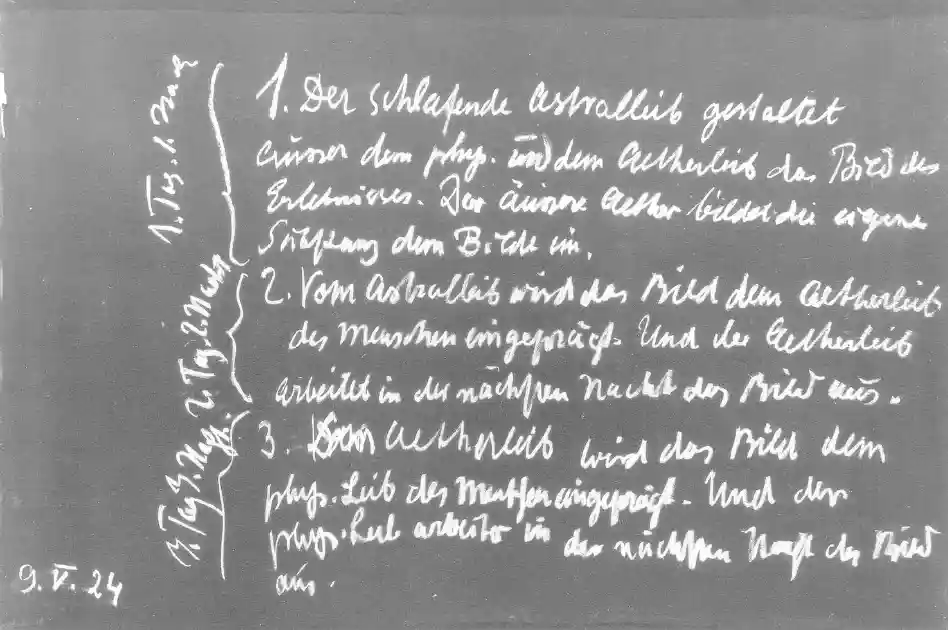
(1. Der schlafende Astralleib gestaltet außer dem physischen und dem Ätherleib das Bild des Erlebnisses. Der äußere Äther bildet die eigene Substanz dem Bilde ein.
Zweiter Tag
Zweite Nacht
2. Vom Astralleib wird das Bild dem Ätherleib des Menschen eingeprägt. Und der Ätherleib arbeitet in der nächsten Nacht das Bild aus.
Dritter Tag
Dritte Nacht
3. Vom Ätherleib wird das Bild dem physischen Leib Menschen eingeprägt. Und der physische Leib des Menschen eingeprägt. Und der physische Leib arbeitet in der nächsten Nacht das Bild aus.
Das ist nun etwas, was Sie sich nur ganz richtig vorstellen müssen. Der physische Leib arbeitet wirklich dieses Bild geistig aus. Er vergeistigt es. So daß, wenn Sie wirklich das alles durchgemacht haben, dann das eintritt, daß einfach, wenn der Mensch nun schäft, der physische Leib das Ganze ausarbeitet, aber nicht so, daß es im physischen Leibe drinnenbleibt. Es entsteht überall aus dem physischen Leibe heraus eine Umgestaltung, eine mächtige, vergrößerte Umgestaltung des Bildes. Und wenn Sie nun aufstehen, dann steht dieses Bild da, in dem Sie eigentlich drinnen schweben, das eigentlich wie eine Art Wolke ist, in der Sie drinnen sind. Mit diesem Bilde stehen sie auf.

Das ist also der dritte Tag und die dritte Nacht. Mit diesem Bilde, das ganz verwandelt ist, mit dem kriechen Sie an dem vierten Tag aus dem Bette heraus. In dieser Wolke (siehe Zeichnung, rot) eingeschlossen, stehen Sie auf. Und haben Sie tatsächlich mit der nötigen Stärke am ersten Tage das Bild gebildet, sind Sie aufmerksam darauf gewesen, was Ihnen Ihr Gefühl gegeben hat am zweiten Tag, so werden Sie jetzt bemerken: Da in diesem jetzigen Bilde sitzt Ihr Wille drinnen. Da sitzt der Wille darinnen, aber dieser Wille, der kann sich nicht ausleben, der ist wie gefesselt. Es ist tatsächlich so, etwas extrem ausgedrückt, wie wenn man sich vorgenommen hätte — wie ein unglaublich kühner Schnelläufer irgendein Bravourlaufstückchen auszuführen sich vornimmt —: Ich renne, ich renne jetzt hinunter nach Oberdornach, ich stelle mir es schon vor, habe das in mir. Mein Wille ist es, aber in diesem Augenblick, wo ich ansetzen will, wo der Wille am stärksten ist, da fesselt mich jemand, so daß ich steif dastehe, daß der ganze Wille entwickelt ist, aber ich den Willen nicht zur Ausführung bringen kann. So ungefähr ist der Vorgang.
Wenn sich dieses Erlebnis dann entwickelt, daß man sich so wie im Schraubstock fühlt - denn es ist ein Sich-Fühlen wie im Schraubstock nach der dritten Nacht -, wenn man wieder aufwacht und sich so fühlt wie im Schraubstock, der Wille ganz durch und durch gefesselt ist, dann, wenn man darauf aufmerksam werden kann, verwandelt sich dieser Wille: dieser Wille wird zum Sehen. Er kann nichts, aber er führt dazu, daß man etwas sieht. Er wird zum seelischen Auge, und das Bild, mit dem man da aufgestanden ist, dieses Bild wird gegenständlich. Und das ist dann das Ereignis des vorigen Erdenlebens, oder eines vorigen Erdenlebens, welches das, was man am ersten Tag im Bilde entworfen hat, wiederum verursacht hat. Man bekommt durch diese Verwandlung durch Gefühl und Wille hindurch das Bild des verursachenden Ereignisses aus einem früheren Erdenleben.
Alle die Dinge nehmen sich, wenn man sie schildert, ein wenig gewaltsam aus. Das ist ja nicht zu verwundern, denn sie sind dem heutigen Menschen ganz und gar nicht bekannt.
Aber nicht so unbekannt damit waren Menschen in früheren Kulturepochen. Nur waren diese in ihrem ganzen Leben — nach der Ansicht der gegenwärtigen Menschen, die gescheit sind - dumm. Aber diese Erlebnisse haben diese dummen Menschen in früheren Kulturepochen schon gehabt. Der heutige Mensch verdunkelt nur das alles durch seinen Intellekt, der ihn gescheit macht, aber nicht gerade weise.
Nun, ich sage, es nimmt sich etwas tumultuarisch aus, wenn man die Sache so erzählt. Aber man muß ja solche Worte gebrauchen. Weil die Dinge heute ganz unbekannt sind, würden sie, wenn man sie sanfter erzählen würde, sich ja gar nicht so charakteristisch ausnehmen. Sie müssen sich charakteristisch ausnehmen. Aber das ganze Erlebnis, vom Anfang bis zum Ende, wie ich es da durch die drei Tage dargestellt habe, dieses ganze Erlebnis, das muß innerlich-intim, das muß in aller Ruhe und Gelassenheit verlaufen. Denn sogenannte okkulte Erlebnisse — und das sind ja solche -, die verlaufen nicht so, daß man damit renommieren kann. Wenn man anfängt zu renommieren damit, dann hören sie sogleich auf. Sie müssen wirklich in innerer Ruhe und Gelassenheit verlaufen. Und am besten ist es, wenn überhaupt niemand zunächst von einer solchen Erlebnisfolge etwas bemerkt als derjenige, der sie hat.
Nun dürfen Sie auch nicht glauben, daß die Sache gleich auf den ersten Anhub gelingt. Das erfährt man ja immer: Wenn so etwas geschildert wird, da gefällt es den Leuten. Das ist ja ganz begreiflich es ist ja schön! Was kann man da alles erfahren! Und mit einem riesigen Fleiße machen sich die Leute darüber her. Sie fangen an: es geht nicht. Nun werden Sie schon ganz kleinmütig. Dann probieren sie es vielleicht noch ein paarmal — es geht wieder nicht. Aber tatsächlich, wenn man es neunundvierzigmal ungefähr, oder ein anderer neunundsechzigmal probiert hat, das fünfzigste oder siebzigste Mal geht es dann. Denn worum es sich bei all diesen Dingen handelt, das ist ja, daß man sich zuerst eine Art Seelengewohnheit aneignet. Zunächst muß man sich hineinleben in diese Dinge. Seelengewohnheiten sich aneignen. Das ist aber überhaupt etwas, was in der Anthroposophischen Gesellschaft, die ja jetzt ein voller Ausdruck der anthroposophischen Bewegung sein soll seit der Weihnachtstagung, sorgfältig beobachtet werden sollte. In der Anthroposophischen Gesellschaft ist ja wirklich sehr vieles gegeben worden. Man kann schon einen leisen Schwindel kriegen, wenn man hintereinander alle diese Zyklen stehen sieht, die gedruckt worden sind. Aber trotzdem, immer wieder und wiederum kommen einzelne Menschen, die über das einzelne fragen. In den meisten Fällen ist das gar nicht notwendig, denn wenn tatsächlich das verarbeitet wird, was in den Zyklen steht, so beantworten sich die meisten Fragen auf eine viel sicherere Weise von selber. Man muß nur die Geduld dazu
haben, wirklich nur die Geduld dazu haben. Es ist ja auch so, daß schon einmal in vielen Dingen der anthroposophischen Literatur vieles vorliegt, was arbeiten kann in der Seele. Und wir werden schon ein Herz haben von diesem jetzt bestehenden esoterischen Vorstand aus für das, was geschehen soll, und es wird die Zeit schon mit Geschehen-Sollendem ausgefüllt werden. Aber auf der anderen Seite muß für vieles, was die Leute wissen wollen, darauf hingewiesen werden, daß ja alte Zyklen da sind, alte Kurse da sind, die liegengeblieben sind, um die sich, nachdem sie gehalten waren, manche nur insoweit noch kümmern, als sie nun einen «neuen» haben wollen. Den alten lassen sie einfach liegen. Diese Dinge sind so, daß sie durchaus mit dem zusammenhängen, was ich gerade heute erörtern muß.
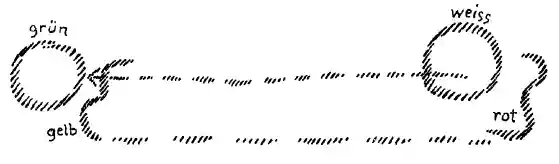
Man bekommt nicht die innere Stetigkeit im Verfolgen dessen, was in der Seele keimt und fruchtet, wenn man so eilen will von Neuem zu immer Neuerem, sondern es handelt sich wirklich darum, daß die Dinge reifen müssen in der Seele. Da muß man sich ganz abgewöhnen, was heute eigentlich in vieler Beziehung üblich ist. Da muß man sich gewöhnen an ein inneres aktives Arbeiten der Seele, an ein Arbeiten im Geiste. Das ist dasjenige, was einem dann hilft, um solche Dinge zustande zu bringen, wie ich sie gerade heute auseinandergesetzt habe, um überhaupt die innere Seelenverfassung nach dem dritten Tage für irgendein Erlebnis zu haben, das man karmisch durchschauen will. Und so muß man überhaupt vorgehen, wenn man Geistiges erkennen will. Man muß sich von vorneherein sagen: In dem ersten Momente, wo man an dieses Geistige irgendwie gedanklich herantritt, da ist ja erst der Anfang gemacht. Und will man da sogleich irgendein Resultat, ein Ergebnis haben, so ist das ganz unmöglich - man muß warten können. Nicht wahr, wenn ich heute ein Erlebnis habe, das karmisch verursacht ist in einem vorhergehenden Erdenleben, so können wir das schematisch so zeichnen: Das bin ich, das ist mein Erlebnis, das Erlebnis von heute (siehe Zeichnung, weiß, rot). Das dort ist verursacht von der ganz andersartigen Persönlichkeit mit demselben Ich in einem vorigen Erdenleben (grün, gelb). Da steht es. Da hat es längst aufgehört, meiner Persönlichkeit anzugehören, aber es ist eingetragen in die Ätherwelt, respektive in die astralische Welt, die hinter der Ätherwelt steht. Nun muß ich erst zurückgehen, den Weg zurückmachen.
Ich habe Ihnen gesagt: Zunächst erscheint mir die Sache so, als ob irgend jemand mir eigentlich das Erlebnis zutrüge. So ist es namentlich am zweiten Tag. Aber nach dem dritten Tag wird es so, daß diejenigen, die mir es zugetragen haben, diese geistigen Wesen, sich zurückziehen, und dann werde ich es gewahr als mein Eigenes, das ich in einem vorigen Erdenleben als Ursache gelegt habe. Und deshalb, weil ja das nicht mehr in der Gegenwart darinnensteht, weil das etwas ist, was ich anschauen muß im vorigen Erdenleben, deshalb erscheine ich mir selber, indem ich darinnenstehe, wie gefesselt. Das Fesseln hört ja erst wiederum auf, wenn ich nun die Sache angeschaut, ein Bild habe von dem, was im vorigen Erdenleben war, und dann wieder zurückschaue auf das Ereignis, das ich ja die drei Tage hindurch nicht aus den Augen verloren habe, dann wieder zurückschaue, da werde ich wieder frei, indem ich zurückkomme, denn jetzt kann ich mich mit der Wirkung bewegen. Wenn ich bloß in der Ursache drinnenstehe, kann ich mich mit der Ursache nicht bewegen. Ich trete also zurück in ein voriges Erdenleben, werde von der Ursache wie gefesselt, und erst, wenn ich nun in dieses Erdenleben hineingehe, dann wird die Sache wieder aufgelöst.
Nehmen wir ein Beispiel. Nehmen wir an, jemand erlebt in einer bestimmten Zeit an einem bestimmten Tage, daß ihm ein Freund etwas nicht ganz Angenehmes sagt; vielleicht hatte er es nicht erwartet. Er sagt ihm also etwas nicht ganz Angenehmes. Nun, er versetzt sich in das, was er da durchmacht im Anhören dessen, was der Freund sagt, er macht sich ein lebendiges Bild von dem, was er da durchgemacht hat: wie er einen leisen Schock bekommen hat, wie er sich etwas geärgert hat, vielleicht auch gekränkt gefühlt hat und so weiter. Da ist ein innerliches Wirken, und ein innerliches Wirken muß da ins Bild gebracht werden.
Jetzt läßt man die drei Tage verlaufen. Am zweiten Tage geht man herum und sagt: Dies Bild, das ich mir da gestern gemacht habe, hat merkwürdig auf mich gewirkt. Ich habe heute den ganzen Tag so etwas in mir wie ein Säuerliches, wie etwas, was mich verstimmt innerlich — so etwas, wie es von diesem Bilde ausgeht, war noch nicht da. Am Ende des ganzen Prozesses, nach dem dritten Tag morgens, da stehe ich auf, und dieses, wovon ich genau spüre, es kommt von diesem Bilde, das fesselt mich. Jetzt bleibe ich in dieser Fesselung drinnen. Dann wird mir dieses Ereignis aus dem vorigen Erdenleben kund: ich sehe es vor mir. Ich gehe über zu dem Erlebnis, das noch ganz frisch ist, noch ganz da ist. Da hört die Fesselung wieder auf und ich sage mir: Aha, so war das im vorigen Erdenleben! Das hat das verursacht: jetzt lebt die Wirkung. Mit der kann ich wieder leben, jetzt ist die Sache wieder da.
Das alles muß oft und oft geübt werden, denn gewöhnlich reißt der Faden auf den ersten Anhub schon am allerersten Tage ab. Dann kommt nichts.
Besonders gut ist es, wenn man die Dinge nebeneinander ablaufen läßt, wenn man nicht bei einem Ereignis bleibt, sondern eine Anzahl von Erlebnissen des Tages in dieser Weise ins Bild bringt. Sie werden sagen: Dann muß ich mit den mannigfaltigsten Gefühlen am nächsten Tage leben. — Das können Sie aber auch. Das schadet gar nichts. Probieren Sie es nur, die gehen ganz gut zusammen. Und dann muß ich so und so oft gefesselt sein nach dem dritten Tag? — Das schadet auch nichts. Das tut alles nichts. Die Dinge lösen sich schon wieder auseinander. Dasjenige, was von einem früheren Erdendasein zu dem gegenwärtigen gehört, das geht schon zu ihm hinzu.
Aber es wird eben nicht gleich beim ersten Anhub erreicht, der Faden reißt ab. Man muß Geduld haben, die Sache immer wieder und wiederum zu machen. Dann fühlt man in sich auch etwas in der Seele erstarken. Dann fühlt man, daß etwas in der Seele erwacht, daß man sich eigentlich sagt: Bisher warst du nur mit Blut ausgefüllt, du hast das Blut und den Atem in dir pulsieren gefühlt. Jetzt ist noch etwas darinnen, noch etwas außer dem Blut, du bist ausgefüllt mit irgend etwas.
Sie können sogar das Gefühl bekommen, Sie seien ausgefüllt mit etwas, wovon Sie sich ganz deutlich sagen: Es ist wie ein luftförmig gewordenes Metall. Sie spüren tatsächlich so etwas wie Metall, fühlen das in sich. Man kann es nicht anders beschreiben, es ist so. Sie fühlen sich metallisch durchdrungen, den ganzen Körper durchdrungen, wie man von gewissen Wassern, die man trinkt, sagen kann, sie schmecken metallisch, so schmeckt sich eigentlich da der ganze Körper wie innerlich metallisch durchdrungen, wie wenn er durchdrungen würde von irgend etwas fein Substantiellem, was aber eigentlich ein Geistiges ist.
Das spüren Sie, wenn Sie auf etwas kommen, was ja natürlich immer da war in Ihnen, worauf Sie aber jetzt erst aufmerksam werden. Und dann bekommen Sie wieder Mut, wenn Sie so etwas spüren. Denn wenn der Faden immer abreißt und es wiederum so ist wie früher — Sie möchten gern irgendwo einen karmischen Zusammenhang anfassen, aber er reißt ab -, da könnten Sie den Mut verlieren. Aber wenn Sie dieses Innerlich-Erfülltsein verspüren, dann bekommen Sie wieder Mut und Sie sagen sich: Es wird schon werden.
Aber, meine lieben Freunde, die Dinge müssen in aller Gelassenheit und Ruhe erlebt werden. Wer sie nicht gelassen und ruhig erleben kann, wer aufgeregt wird, wer emotionell wird, der breitet sich einen inneren Nebel über die Sache, die eigentlich geschehen sollte, und es wird nichts daraus.
Man könnte ja folgendes sagen: Es gibt heute gewisse Leute draußen in der Welt, die die Anthroposophie nur vom Hörensagen kennen, vielleicht gar nichts gelesen haben oder nur das, was die Gegner geschrieben haben. Es ist ja jetzt furchtbar drollig: Manche gegnerische Schriften — sie erscheinen, ja sie kommen wirklich aus der Erde heraus wie die Pilze -, die führen Literatur an, aber unter der Literatur, die sie anführen, sind gar keine Schriften von mir, sondern nur gegnerische Literatur. Die Leute gestehen, daß sie gar nicht wirklich an die Quellen herangehen, sondern daß sie nur die Gegnerliteratur kennen. Solche Dinge gibt es heute. Also solche Leute, die da draußen sind, die reden darüber und sagen: Ach, die Anthroposophen sind verrückt! — Nun, was man am wenigsten sein darf, um überhaupt zu etwas zu kommen in der geistigen Welt, das ist gerade das Verrücktsein. Man darf nämlich nicht ein bißchen verrückt sein, wenn man zu etwas kommen will in der geistigen Welt. Und selbst ein bißchen verrückt sein, ist schon ein Hindernis, um zu etwas zu kommen. Das muß man eben vermeiden. Man muß selbst ein leises «Mucken-kriegen», ein leises Launenhaftsein sogar vermeiden. Denn das alles, dieses Sich-Hingeben an die Stimmungen des Tages, an die Launen, an die Mucken des Tages, all das bildet lauter Hindernisse und Hemmnisse auf dem Wege, irgendwie weiterzukommen in der geistigen Welt. Es bleibt einem nichts anderes übrig, als einen ganz unverrückten Kopf und ein ganz unverrücktes Herz zu haben, wenn man auf anthroposophischem Gebiete weiterkommen will. Mit Schwärmerei, die ja schon der Anfang der Verrücktheit ist, läßt sich da gar nichts machen.
Alle die Dinge, so sonderbar sie klingen, wie ich sie zum Beispiel heute wieder erzählt habe, müssen in dem Lichte der absoluten Besonnenheit, des absoluten Unverrücktseins von Kopf und Herz erlebt werden. Und wenn sie richtig erlebt werden, ja wirklich, man wird durch nichts sicherer selbst aus der leisesten täglichen Verrücktheit herausgerissen als gerade durch Anthroposophie. Es würden alle Verrücktheiten geheilt werden durch Anthroposophie, wenn man sich ihr wirklich intensiv hingeben würde. Wenn also jemand es sogar darauf anlegen wollte, just durch Anthroposophie verrückt zu sein, so wäre das ganz gewiß ein Versuch mit untauglichen Mitteln.
Aber das sage ich nicht, um einen Scherz zu machen, sondern das sage ich, weil es auch ein Bestandteil der Gesinnung des geisteswissenschaftlichen Strebens sein muß. Man muß sich so zur Sache stellen, wie ich es jetzt halb ironisch auseinandergesetzt habe, wenn man in der richtigen Weise mit der richtigen Orientierung an die Sache herantreten wird. Man muß sich so unverrückt wie möglich finden, dann kommt man mit der richtigen Gesinnung heran. Aber das muß man mindestens anstreben, und namentlich anstreben gegenüber den kleinen Verrücktheiten des Lebens.
Ich war einmal mit einem nun lang verstorbenen, sehr gescheiten Philosophieprofessor befreundet, der hat bei jeder Gelegenheit das Wort gebraucht: Ein bißchen einen Spleen haben wir ja alle! — Er meinte, alle Menschen haben ja ein bißchen einen Spleen. Aber er war ein sehr gescheiter Mensch - ich habe immer geglaubt, daß bei ihm doch so etwas dahinter ist: daß er nicht ganz unbegründet diese Behauptung tut! Anthroposoph ist er nicht geworden.
Nun, wir wollen morgen diese Betrachtung fortsetzen.
Seventh Lecture
Today we shall begin by discussing the inner workings of the soul which can lead the human being to gradually gain insights, to gain thoughts about karma. These thoughts, these views can only arise in such a way that the human being can also see experiences which have a karmic cause in the light of karma.
Now, when we look around us in our human environment, we actually only see that which is caused in the physical world in a physical way through physical power. And if we do see something in the physical world that is not caused by physical forces, we see it through external physical substances, external physical objects of perception. Certainly, if a person does something out of his will, it is not caused by physical forces, by physical causes, because in many respects it comes out of the free will of the person. But everything that we see externally is completely absorbed in physical-sensual phenomena within the world that we observe. The karmic context of an experience that we ourselves go through cannot be revealed to us in the whole context of what we can observe in this way. For the whole picture of this karmic connection is in the spiritual world, is actually inscribed in that which is the etheric world, which then underlies the etheric world as the astral outer world, or as the world of the spiritual beings who dwell in this astral outer world. All this is not seen when we merely focus our senses on the physical world.
Everything we perceive in the physical world is perceived through our senses. These senses work without us being able to do much about it. Our eyes receive the impressions of light, the impressions of color, without us being able to do much about it. The most we can do is to adjust our eyes in a certain direction, we can look at them, we can look away. There is already a lot of unconsciousness in it, but at least a little bit of consciousness. And even what the eye has to do inwardly in order to see a color, this immensely wise, magnificent inner activity that is carried out when we see something, we as human beings could not bring it about if we were to bring it about consciously. There could be no question of it. It all has to happen unconsciously at first, because it is far too wise for man to be able to do anything about it.
In order to gain a correct point of view with regard to the knowledge of man, one must penetrate oneself with all the wisdom in the world that man cannot produce. If man only ever thinks of what he can do, he actually blocks all paths to knowledge. Basically, the path of knowledge begins with realizing in the most modest way what one cannot do and yet what must happen in the existence of the world. The eye, the ear, even the other sensory organs are so wise, so fundamentally equipped, that people will have to study for a long time in order to suspect a very little of them during their earthly existence. You really have to realize this quite consciously. But the observation of the spiritual cannot take place so unconsciously. In older times of human development this was also the case for the observation of the spiritual; there was an instinctive clairvoyance. That is what has faded away in the development of mankind.
Now man must consciously attain a position in relation to the universe through which he can see through the spiritual. And a spiritual must be seen through if the karmic connections are to be seen through for any experience we have.
Now it is important that we at least begin with the observation of karma, that we become attentive to what can happen in us to bring out the observation of the karmic connections. We must then do a little something to bring these observations to consciousness. We have to do more than we do for the eye, for example, to bring color to consciousness. My dear friends, what we have to learn first of all is summed up in one word: wait. You have to be able to wait for the inner experiences.
I have already spoken once about this ability to wait. It was about the year 1889 - I will also have to tell you about this in my “Lebensgang” - when the inner spiritual structure of Goethe's “Fairy Tale of the Green Snake and the Beautiful Lily” first came to me. And it was there that I was first confronted, so to speak, with the perception of a greater context, a wider context than that given in the fairy tale itself. But I also knew at that time that what I would one day be able to do with this connection, I could not yet do with it. And so that which was only revealed to me at that time through the occasion of the fairy tale simply remained in my soul.
Then it emerged again in 1896, seven years later, but not yet in such a way that it could be shaped. Then again seven years later, in 1903 or thereabouts. Even then, although it emerged with great definiteness and coherence, it could not yet be formed. It only appeared so transformed that it could be shaped in a completely plastic way when I conceived my first mystery poem, “The Gate of Initiation”, again seven years later.
Such things require a real waiting, a maturing. You have to move on from your own experiences to what else is there in the world. You simply cannot have the plant when the germ of a plant is already present. You have to bring the germ into the appropriate conditions, you have to make it grow, and you have to wait until the germ becomes the blossom and in turn the fruit. And this is also how you have to deal with the experiences you go through. One must not stand on the point of view: Because one has some experience, because it is just there, one has sensation for it, and then one forgets it. Whoever deals with experiences in this way, that he only wants to have them as present, will be able to do little really to enter the spiritual world for observation. One must be able to wait, one must be able to allow the experiences to mature in the soul.
Now there is a possibility of a relatively quick maturing for the understanding of karmic connections if one patiently and energetically tries for a long time to let that play itself out in the consciousness and more and more in the consciousness which otherwise takes place in such a way that it is there but is not properly grasped and simply fades away in life. After all, that's how it is with events. What does a person do with the events, with his experiences, which come to him in the course of the day? He actually experiences them half observing them. You can get an idea of how the experiences are half-observed if you sit down once - and I advise you to do so - in the afternoon or evening and ask yourself: What did I actually experience today at half past nine in the morning? - But now try to recall such an experience to your mind in all its details, as if it were simply there, for my sake, at half past seven in the evening, as if it were there, as if you were depicting it mentally and artistically in front of you. You will see how much you are missing, how much you have not observed, how difficult it will be. If you take a pen or pencil to write it down, you will very soon start biting into the pen or pencil because you can't think of the details and want to bite them out of the pencil.
Yes, but first of all it is important to set yourself the task of placing an experience that you have had in front of your soul with all sharpness - not when it is there, but afterwards - as if you wanted to paint it mentally, to place it in front of your soul in such a way that, for example, if there is something in the experience where someone has spoken, you make it completely representational: the sound of his voice, the way he has skillfully or clumsily put the words and so on, strongly, energetically, in short, to bring to the picture what you have experienced. If one visualizes such an experience of the day in this way, then the next night, when the astral body is out of the etheric body and the physical body, the astral body occupies itself with this image. It is actually itself the bearer of this image, it now forms this image outside the body. It takes it with it when it goes out on the first night. He forms it out there outside the physical and the etheric body.
So we have the first, we want to take these stages very precisely: The sleeping astral body forms the image of the experience apart from the physical and the etheric body. Where does it do this? It does so in the outer ether. It is now in the outer etheric world.
Imagine the human being now: His physical body and his etheric body lie in bed, outside is the astral body. Let us disregard the ego. The astral body is out there, reproducing this image that you have made for yourself; but it does this in the outer ether. This is what happens.
Imagine that the astral body is out there (see drawing, yellow). Now it forms this image out there, which I want to draw in red - of course it is all schematic. It forms this image. All this happens in the outer ether; the outer ether incrusts with its own substance, so to speak, that which is formed as an image in the astral body. So the outer ether forms the etheric form (blue) everywhere here as an image so sharply captured in the spiritual eye.
Now you come back in the morning into the physical and into the etheric body, carry into it what has been substantiated by the outer ether. Thus: the sleeping astral body forms the image of the experience in addition to the physical and etheric body; the outer ether forms its own substance into the image.
You can imagine that this makes the image stronger and that now, when the astral body comes back in the morning with this stronger substance, it can make an impression on the etheric body in the human being. With that which comes from the outer ether as forces, it now makes an impression on the etheric body of the human being. So that the second is: From the astral body the image is impressed into the etheric body of the human being.
These are the events: first day, first night (see diagram page 124). Now we come to the second day. During the second day, while you are busy with the other odds and ends of life in full waking consciousness, this happens under the consciousness, in the unconscious, that the image descends into the etheric body. And the next night the etheric body, when it is undisturbed, when the astral body is outside again, works out this image. So in the second night the image of the human being's own etheric body is worked out. So secondly, the image is imprinted on the etheric body of the human being by the astral body, and the etheric body works out the image the next night.
Thus we have: Second day and second night (see diagram).
Now, if you go through this, if you really do not disdain to continue to occupy yourself in this way with the image that you formed the previous day - and you can continue to occupy yourself for a reason that I will give shortly - if you do not disdain to continue to occupy yourself in this way with this image, then you will continue to live with this image.
What do you mean, continue to occupy yourself with it? You see, if you really make an effort to form such a picture tightly, to work it out quite vividly with characteristic, strong lines on the first day after you have had the experience, then you have already exerted yourself mentally. Something like that takes mental effort. Forgive me, it is not meant to be an allusion - those present are always excluded from all these things - but it must be said that most people do not even know what spiritual effort is, because spiritual effort, real spiritual effort, only occurs through the activity of the soul. If you let the world work on you, let your thoughts run their course without taking these thoughts into your own hands, then you have no mental effort. Getting tired does not mean having made mental effort. One must not imagine that one has exerted oneself mentally when one becomes tired of something. You can get tired from reading, for example. But if you are not somehow involved in the process of reading, if you just let the thoughts of the book work on you, you are not exerting yourself. On the contrary, the person who has really exerted himself mentally, who has exerted himself out of the inner activity of the soul, then picks up a book, and a very interesting one at that; then he sleeps off the mental exertion in reading in the very best way. But of course you can fall asleep over a book when you are tired. This getting tired is not a sign of mental effort at all.
A sign of mental exertion, however, is that one feels that the brain is worn out, just as one feels when one has often lifted: the arm muscle has been used. The brain is not affected in this way by ordinary thinking. Well, it follows you, and you will even notice when you do it for the first time and when you do it for the second time, the third time, the tenth time: you get a slight headache. Not that you get tired or fall asleep, on the contrary: you can't fall asleep, you get a slight headache. You just don't have to regard this headache as one that you detest, but on the contrary as one that is actually a testimony to the fact that you have strained your head.
Well, it will stay with you, it will stay with you until you fall asleep. In the morning, if you really did this the day before, you will wake up with the feeling: "There is something in me! I don't quite know what, but there is something inside me, something wants something from me. Yes, it's not so indifferent that I made this picture yesterday, it actually means something: This picture has changed. This picture causes me to have completely different feelings today than I actually had before; the picture makes me feel certain things.
This remains with you for the next day as the residual inner experience of the picture you have made for yourself. And what you feel there, what you cannot get rid of the whole day, is a testimony to the fact that the image now goes down into the etheric body, as I have described it here, and that the etheric body absorbs it.
When you wake up the next night - when you slip into the body again after these two days here (see diagram) - you will probably experience that you find this image in there somewhat reshaped, somewhat transformed. You find it again, just as you wake up on the third "day you find it again in yourself; it seems to you like a very real dream. But it has undergone a change, it has not stayed the same, it is something else. It will clothe itself in a variety of images until it is different. It will clothe itself in the image as if there were somehow spiritual beings who are now bringing this experience to you. And you will literally get the impression: Yes, this experience that I have had, that I have visualized in this way, has actually been brought to me. - If it was an experience with a person, you have the feeling after all this has happened that you have actually not only experienced it through the person, but that it has been brought to you. There are others, there are spiritual powers involved, they have brought this to you.
Now comes the next day. On the following day the image is carried down from the etheric body into the physical body. On the following day the etheric body imprints this image on the physical body, really on the nerve processes, on the blood processes. On the third day the image is impressed down into the physical body. So we must say, thirdly, that the image is impressed from the etheric body into the physical body of the human being.
And now comes the next night, after therefore during the day - while you again go through the usual odds and ends of life - this important thing takes place down there, that this image is carried down into the physical body. It happens in the subconscious. Then, when the next night comes, this image is processed in the physical body. The image is spiritualized in the physical body. At first, during the day, this image is brought down into blood and nerve processes, but at night it is spiritualized. Anyone who can see there can see how this image is now processed by the physical body, but appears as a spiritually completely changed image. You can say that the physical body works out the image the next night.
First day
First night
(1) The sleeping astral body forms the image of the experience in addition to the physical and etheric bodies. The outer ether forms its own substance into the image.
Second day
Second night
2. the image is imprinted on the etheric body of the human being by the astral body. And the etheric body works out the image the next night.
Third day
Third night
3. the image is impressed from the etheric body into the physical body of the human being. And the physical body of the human being is imprinted. And the physical body works out the image the next night.
Now this is something you just have to imagine correctly. The physical body really works out this image spiritually. It spiritualizes it. So that, when you have really gone through all this, then it occurs that simply when the human being now works, the physical body works out the whole thing, but not in such a way that it remains inside the physical body. A transformation, a powerful, enlarged transformation of the image arises everywhere out of the physical body. And when you now stand up, this image is there, in which you are actually floating inside, which is actually like a kind of cloud in which you are inside. You stand up with this image.
So this is the third day and the third night. With this image, which is completely transformed, you crawl out of bed on the fourth day. Enclosed in this cloud (see drawing, red), you get up. And if you actually formed the image with the necessary strength on the first day, if you were attentive to what your feeling gave you on the second day, you will now notice: Your will is in this present picture. The will is there, but this will cannot live itself out, it is bound. It really is like this, to put it in somewhat extreme terms, as if one had resolved - like an unbelievably bold speed runner who sets out to perform some bravura run -: I am running, I am now running down to Oberdornach, I am already imagining it, I have it in me. It is my will, but at that moment when I want to start, when the will is strongest, someone ties me up so that I stand there stiffly, so that the whole will is developed, but I cannot bring the will to execution. That is roughly the process.
When this experience then develops, that one feels as if in a vice - for it is a feeling as if in a vice after the third night - when one wakes up again and feels as if in a vice, the will is completely bound through and through, then, if one can become aware of it, this will is transformed: this will becomes seeing. It can do nothing, but it makes you see something. It becomes the eye of the soul, and the image with which one has stood up, this image becomes objective. And that is then the event of the previous life on earth, or of a previous life on earth, which in turn has caused what one has sketched in the picture on the first day. Through this transformation, one receives the image of the causative event from a previous earth life through feeling and will.
All things, when described, appear somewhat violent. That is not surprising, because they are not at all familiar to people today.
But people in earlier cultural epochs were not so unfamiliar with them. It's just that they were stupid throughout their lives - in the opinion of today's clever people. But these stupid people already had these experiences in earlier cultural epochs. Today's man only obscures all this through his intellect, which makes him clever, but not exactly wise.
Well, I say, it seems a bit tumultuous to put it like that. But one has to use such words. Because things are quite unknown today, if they were told more gently, they wouldn't seem so characteristic. They must be characteristic. But the whole experience, from the beginning to the end, as I have described it over the three days, this whole experience, it must be inward and intimate, it must be calm and serene. Because so-called occult experiences - and they are such experiences - do not take place in such a way that you can make a name for yourself. If you start to make a name for yourself, they stop immediately. They really have to take place in inner peace and serenity. And it is best if no one notices such a sequence of experiences at first except the person who has them.
Now you must not believe that things will work right from the start. One always experiences that when something like this is described, people like it. That's quite understandable - it's nice! What you can experience there! And people get all excited about it. They start: it doesn't work. Now they're getting very faint-hearted. Then maybe they try it a few more times - it doesn't work again. But actually, if you've tried it forty-nine times, or someone else has tried it sixty-nine times, the fiftieth or seventieth time it works. Because what all these things are about is that you first acquire a kind of soul habit. First you have to live into these things. Acquire habits of the soul. But this is something that should be carefully observed in the Anthroposophical Society, which is now to be a full expression of the anthroposophical movement since the Christmas Conference. The Anthroposophical Society has really given a great deal. You can get a little dizzy when you see all the cycles that have been printed, one after the other. But still, again and again, individual people come and ask about the individual cycles. In most cases this is not even necessary, because if you actually process what is written in the cycles, most questions will answer themselves in a much more certain way. You just have to have the patience
have the patience, really just the patience. It is also the case that there is already much in the anthroposophical literature that can work in the soul. And we will already have a heart from this now existing esoteric board for what is to happen, and time will already be filled with what is to happen. But on the other hand, for much of what people want to know, it must be pointed out that there are old cycles, old courses that have been left behind, which, after they have been held, some people only care about insofar as they now want a “new” one. They simply leave the old one behind. These things are such that they are definitely connected to what I have to discuss today.
You don't get the inner steadiness in the pursuit of what germinates and bears fruit in the soul if you want to rush from new to ever newer, but it is really a matter of things having to mature in the soul. You have to get completely out of the habit of what is actually customary in many respects today. You have to get used to an inner active work of the soul, to a work in the spirit. This is what helps you to achieve the things I have just described today, to have the inner state of soul after the third day for any experience that you want to see through karmically. And this is how you have to proceed if you want to recognize spiritual things. One must say to oneself from the outset: In the first moment when one somehow approaches this spiritual in thought, only the beginning has been made. And if you want to have a result, a result right away, that is quite impossible - you have to be able to wait. Not true, if I have an experience today that is karmically caused in a previous life on earth, we can draw it schematically like this: This is me, this is my experience, the experience of today (see drawing, white, red). This is caused by the completely different personality with the same ego in a previous earth life (green, yellow). There it is. It has long since ceased to belong to my personality, but it has entered the etheric world, or rather the astral world, which stands behind the etheric world. Now I have to go back first, make my way back.
I have told you: At first the matter appears to me as if someone is actually bringing the experience to me. This is especially true on the second day. But after the third day it becomes so that those who have brought it to me, these spiritual beings, withdraw, and then I become aware of it as my own, which I have placed as a cause in a previous life on earth. And therefore, because it is no longer there in the present, because it is something that I have to look at in the previous earthly life, I appear to myself, standing there, as if bound. The bondage only ceases again when I have now looked at the thing, have a picture of what was in the previous earth life, and then look back again at the event, which I have not lost sight of during the three days, then look back again, then I become free again by coming back, because now I can move with the effect. If I'm just standing inside the cause, I can't move with the cause. So I step back into a previous earthly life, am bound by the cause, and only when I now enter this earthly life is the cause dissolved again.
Let's take an example. Suppose someone experiences at a certain time on a certain day that a friend says something not quite pleasant to him; perhaps he had not expected it. So he tells him something not quite pleasant. Well, he puts himself in the place of what he is going through in listening to what the friend says, he forms a vivid picture of what he has gone through: how he has received a slight shock, how he has become somewhat annoyed, perhaps also felt offended and so on. There is an inner work, and an inner work must be brought into the picture.
Now you let the three days pass. On the second day you go around and say: "This picture that I made for myself yesterday had a strange effect on me. All day today I have something in me like a sourness, like something that makes me upset inside - something like what emanates from this picture has never been there before. At the end of the whole process, after the third day in the morning, I get up, and this thing, which I can exactly sense comes from this image, captivates me. Now I remain in this bondage. Then this event from the previous life on earth becomes known to me: I see it before me. I move on to the experience that is still very fresh, still completely there. Then the bondage ends again and I say to myself: Aha, that's how it was in the previous life on earth! That's what caused it: now the effect is alive. I can live with it again, now the thing is there again.
This all has to be practiced often and often, because usually the thread breaks at the very first stroke on the very first day. Then nothing comes.
It is particularly good if you let things happen side by side, if you don't stay with one event, but bring a number of experiences of the day into the picture in this way. You will say: Then I will have to live with the most varied feelings the next day. - But you can do that too. There is no harm in that. Just try it, they go together quite well. And then I have to be tied up so and so often after the third day? - That won't do any harm either. It doesn't do any harm. Things will come apart again. That which belongs to the present from a previous earthly existence is already added to it.
But it is not achieved at the first stroke, the thread breaks. You have to be patient and do it again and again. Then you also feel something strengthening in your soul. Then you feel that something is awakening in your soul, that you are actually saying to yourself: Until now you were only filled with blood, you felt the blood and the breath pulsating within you. Now there is something else inside, something besides the blood, you are filled with something.
You can even get the feeling that you are filled with something, of which you say to yourself quite clearly: it is like a metal that has become airy. You actually sense something like metal, feel it inside you. There's no other way to describe it, it's like that. You feel metal permeating you, permeating your whole body, just as you can say of certain waters that you drink that they taste metallic, so the whole body actually tastes as if it is permeated internally with metal, as if it were permeated by something subtly substantial, but which is actually spiritual.
You feel this when you come across something that has always been there in you, of course, but which you are only now becoming aware of. And then you regain courage when you sense something like this. Because if the thread always breaks and it's the same as before - you would like to touch a karmic connection somewhere, but it breaks - you could lose courage. But when you feel this inner fulfillment, then you regain your courage and you say to yourself: It will work out.
But, my dear friends, things must be experienced calmly and calmly. If you can't experience them calmly and serenely, if you get excited, if you get emotional, you spread an inner fog over the thing that should actually happen, and nothing comes of it.
You could say the following: there are certain people out there in the world today who only know anthroposophy from hearsay, perhaps haven't read anything at all or only what the opponents have written. It's terribly funny now: some of the opponents' writings - they appear, they really do spring up like mushrooms - they cite literature, but among the literature they cite there are no writings by me at all, only opponents' literature. People confess that they don't really go to the sources, but that they only know the opponents' literature. Such things exist today. So those people who are out there talk about it and say: Oh, the anthroposophists are crazy! - Well, what one must be least of all in order to achieve anything at all in the spiritual world is precisely being crazy. You can't be a little crazy if you want to get anywhere in the spiritual world. And even being a little crazy is an obstacle to getting anywhere. You have to avoid that. You have to avoid even a slight “getting a bit mad”, a slight moodiness. For all this, this surrendering to the moods of the day, to the moods, to the moods of the day, all this forms nothing but obstacles and hindrances on the way to somehow making progress in the spiritual world. If you want to make progress in the anthroposophical field, you have no choice but to have a completely immovable head and a completely immovable heart. Enthusiasm, which is already the beginning of madness, is no help at all.
All these things, as strange as they sound, as I have told you again today for example, must be experienced in the light of absolute prudence, of the absolute immovability of head and heart. And if they are experienced correctly, indeed, there is nothing more certain to pull you out of even the slightest daily madness than anthroposophy. All madnesses would be cured by anthroposophy if one really devoted oneself to it intensively. So if someone even wanted to set out to be crazy through anthroposophy, that would certainly be an attempt with unsuitable means.
But I am not saying this to make a joke, I am saying it because it must also be part of the attitude of spiritual scientific endeavor. You have to approach the matter in the way I have now half-ironically described if you want to approach it in the right way with the right orientation. You have to find yourself as unwavering as possible, then you will approach it with the right attitude. But you have to at least strive for that, especially in the face of life's little follies.
I was once friends with a very clever philosophy professor, now long deceased, who used to say at every opportunity: We all have a little bit of a quirk! - He meant that everyone has a bit of a quirk. But he was a very clever person - I always believed that there was something behind it: that he was not making this claim without good reason! He did not become an anthroposophist.
Now, let's continue this reflection tomorrow.