Python Operators
Python Operators with Types and Examples:
Python Data Types were explained in detail along with their classification in our previous tutorial.
In this tutorial, we learn all about Python Operators along with their types. Simple examples pertaining to each type of Python operator are included in this tutorial.
This Python Training Tutorial Series will be a perfect guide for any beginner to enhance their knowledge on Python concepts.

Watch the VIDEO Tutorials
Overview of Operators in Python (Part 1):
An In-Depth Look at Operators in Python (Part 2):
Python Operators
What are Python Operators?
Operators are used for carrying out operations on values and variables.
Python has 7 types of Operators as stated below:
- Arithmetic Operator
- Comparison operators
- Logical operators
- Bitwise operators
- Assignment Operator
- Identity operators
- Membership operators
#1) Arithmetic Operators
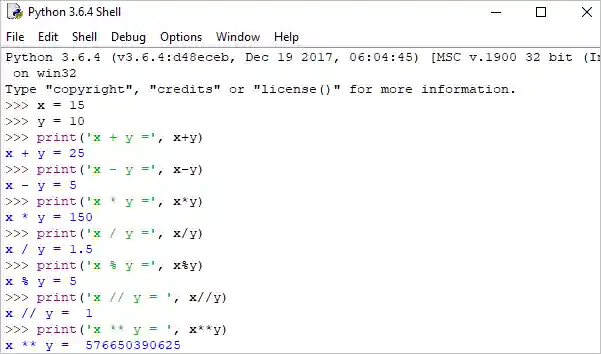
Python programming language supports different kinds of arithmetic operators for both integer and floating point like addition, subtraction, multiplication, division and so on.
Example:
x = 15
y = 10
print('x + y =', x+y)
Output: x + y = 25
print('x - y =', x-y)
Output: x – y = 5
print('x * y =', x*y)
Output: x * y = 150
print('x / y =', x/y)
Output: x / y = 1.5
print('x % y =', x%y)
Output: x % y = 5
print('x // y =', x//y)
Output: x // y = 1
print('x ** y =', x**y)
Output: x ** y = 576650390625
#2) Comparison Operators
Comparison operators are used for comparing values. It either returns True or False according to the condition.
Example:
x = 8
y = 15
('x>y is',x>y)
Output: x > y is False
print('x< y is', x<y)
Output: x < y is True
print('x == y is', x==y)
Output: x == y is False
print('x != y is', x!=y)
Output: x != y is True
print('x >= y is', x>=y)
Output: x >= y is False
print('x<= y is', x<=y)
Output: x <= y is True

#3) Logical Operators
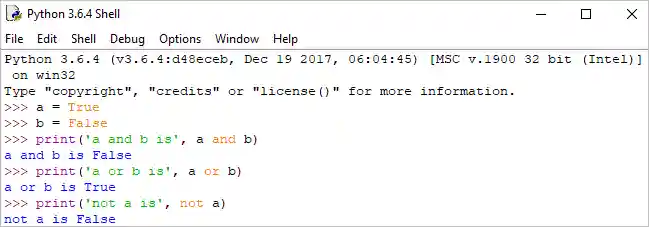
Logical operators are used for performing AND, OR and NOT operations. It either returns True or False according to the condition.
Example:
a = True
b = False
print(‘a and b is’, a and b)
Output: a and b is False
print(‘a or b is’, a or b)
Output: a or b is True
print(‘not a is’, not a)
Output: not a is False
#4) Bitwise Operators
Bitwise operators operate on bits and perform bit by bit operation.
#5) Assignment Operator
An assignment operator is used to assign a value to a variable.
#6) Identity Operators
Python offers 2 types of identity operators i.e is and is not.
Both are used to compare if two values are located on the same part of the memory. Two variables that are equal does not imply that they are identical.
Example:
a1 = 3
b1 = 3
a2 = "Python"
b2 = "Python"

a3 = [4,5,6]
b3 = [4,5,6]

print(a1 is not b1)
Output: False
print(a2 is b2)
Output: True
print(a3 is b3)
Output: False
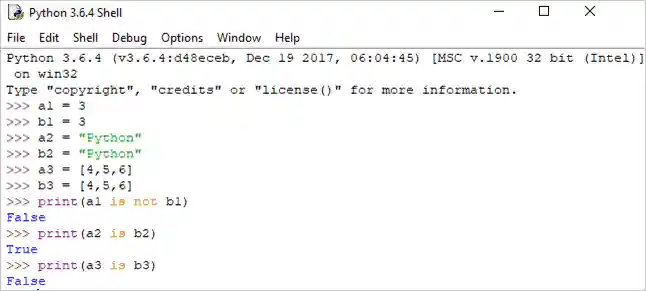
Here a3 and b3 are listed, interpreter allocates memory separately and even though they are equal, it returns False.
#7) Membership Operators
Python offers 2 types of membership operators i.e in and not in.
Both are used to test whether a value or variable is in a sequence.
Example:
a = “Python operators”
b = {1:'x',2:'y'}

print(“P” in a)
Output: True
print(“python” not in a)
Output: False
print(1 in b)
Output: True
print('y' in b)
Output: False
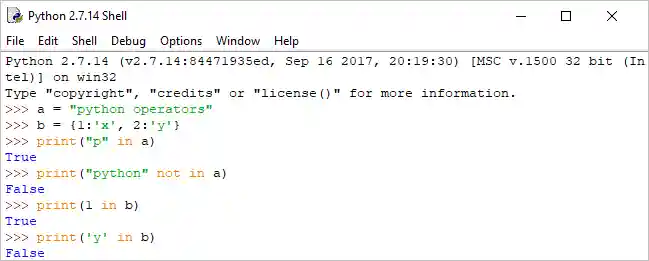
1 is key and ‘x’ is the value in dictionary b. Hence, ‘y’ in b returns False.
Hope you are clear about Python operators and their various types.
Watch out our upcoming to know more about Python Conditional Statements!!
Was this helpful?
Thanks for your feedback!