braining


brain
the human brain and its contiguous structures
A. pituitary gland
B. cerebrum
C. skull
D. corpus callosum
E. thalamus
F. hypothalamus
G. pons
H. cerebellum
I. medulla
J. spinal cord
brain
(brān)n.
1.
a. The portion of the vertebrate central nervous system that is enclosed within the cranium, continuous with the spinal cord, and composed of gray matter and white matter. It is the primary center for the regulation and control of bodily activities, receiving and interpreting sensory impulses, and transmitting information to the muscles and body organs. It is also the seat of consciousness, thought, memory, and emotion.
b. A functionally similar portion of the invertebrate nervous system.
2.
a. Intellectual ability; intellect: an actor not known for his quick brain.
b. often brains Exceptional intellectual ability; intelligence: has brains and good looks.
c. Informal A highly intelligent person: We knew the new kid was a brain as soon as she started talking.
3. often brains The primary director or planner, as of an organization or movement.
4. The control center, as of a ship, aircraft, or spacecraft.
tr.v. brained, brain·ing, brains
To hit on the head or kill by hitting on the head.
beat (one's) brains (out)
Informal To exert or expend great mental effort: She beat her brains out during the examination.
on the brain
Obsessively in mind: The coach has winning on the brain.
pick (someone's) brain/brains
To explore another's ideas through questioning.
rack (one's) brain Informal
To think long and hard: I racked my brain for hours trying to recall her name.
[Middle English, from Old English brægen.]
American Heritage® Dictionary of the English Language, Fifth Edition. Copyright © 2016 by Houghton Mifflin Harcourt Publishing Company. Published by Houghton Mifflin Harcourt Publishing Company. All rights reserved.
brain
(breɪn)n
1. (Anatomy) the soft convoluted mass of nervous tissue within the skull of vertebrates that is the controlling and coordinating centre of the nervous system and the seat of thought, memory, and emotion. It includes the cerebrum, brainstem, and cerebellum. Technical name: encephalon
2. (Zoology) the main neural bundle or ganglion of certain invertebrates
3. (often plural) informal intellectual ability: he's got brains.
4. informal shrewdness or cunning
5. informal an intellectual or intelligent person
6. (usually plural; functioning as singular) informal a person who plans and organizes an undertaking or is in overall control of an organization, etc
7. an electronic device, such as a computer, that performs apparently similar functions to the human brain
8. on the brain constantly in mind: I had that song on the brain.
9. pick someone's brain to obtain information or ideas from someone
vb (tr)
10. to smash the skull of
11. slang to hit hard on the head
[Old English brægen; related to Old Frisian brein, Middle Low German bregen, Greek brekhmos forehead]
Collins English Dictionary – Complete and Unabridged, 12th Edition 2014 © HarperCollins Publishers 1991, 1994, 1998, 2000, 2003, 2006, 2007, 2009, 2011, 2014
brain
(breɪn)n.
1. the anterior part of the central nervous system enclosed in the cranium of vertebrates, consisting of a mass of nerve tissue organized for the perception of sensory impulses, the regulation of motor impulses, and the production of memory, learning, and consciousness.
2. (in many invertebrates) a part of the nervous system comparable to the brain of vertebrates.
3. Sometimes, brains. understanding; intellectual power; intelligence.
4. the brain as the center of thought, understanding, etc.; mind; intellect.
5. brains, Slang. a member of a group who is regarded as its intellectual leader or planner.
6. Informal. an extremely intelligent person.
7.
a. the controlling or guiding mechanism in a computer, robot, pacemaker, etc.
b. the part of a computer system for coordination or guidance, as of a missile.
8. to smash the skull of.
9. Slang. to hit or bang on the head.
Idioms:have on the brain, to think about constantly.
[before 1000; Middle English; Old English bræg(e)n, bregen; c. Middle Low German bragen, Middle Dutch brein]
Random House Kernerman Webster's College Dictionary, © 2010 K Dictionaries Ltd. Copyright 2005, 1997, 1991 by Random House, Inc. All rights reserved.

brain
brain
(brān)1. The part of the nervous system in vertebrates that is enclosed within the skull, is connected with the spinal cord, and is composed of gray matter and white matter. It receives and interprets impulses from sense organs, and it coordinates and controls body functions and activities, such as walking and talking. The brain is also the center of memory, thought, and feeling.
2. A bundle of nerves in many invertebrate animals that is similar to the vertebrate brain in function and position.
Did You Know? At this very moment, these words are being scanned and interpreted by perhaps the most complex object in the world: the human brain. The bulbous organ that sits right behind your forehead is a collection of different parts that work together. For example, the two sides of the brain, called hemispheres, perform different tasks. The right hemisphere is responsible for musical and artistic ability and the ability to recognize faces. The left is where mathematical and logical analysis takes place, as well as most speech and language processing. Furthermore, each hemisphere is divided into four separate regions called lobes, which have their own jobs. Here's how specific the responsibilities of a particular brain area can be: in 2001 researchers discovered that there's a definite part of the brain (the medial ventral prefrontal cortex) where you make the connection that we call "getting" a joke. Got it?
The American Heritage® Student Science Dictionary, Second Edition. Copyright © 2014 by Houghton Mifflin Harcourt Publishing Company. Published by Houghton Mifflin Harcourt Publishing Company. All rights reserved.
Brain
the process of providing a person with visual or auditory evidence of the quality of an autonomie physiological function so that he may attempt to exercise conscious control over it.
1. Obsolete, the branch of psychology that studies the brain.
2. Medicine. the total knowledge concerning the brain.
the surgical operation of opening the skull, as for an operation on the brain.
the comparative study of complex electronic devices and the nervous system in an attempt to understand better the nature of the human brain. — cyberneticist, n. — cybernetic, adj.
an inflamed condition of the brain.
a condition in which normal tissue is misplaced, especially in the brain, so that masses of gray matter are found in the white matter. See also biology.. — heterotopous, adj.
surgical severing of certain nerve fibers in the frontal lobe of the brain, once commonly performed to treat intractable depression. Also called prefrontal lobotomy.
the process of systematically altering beliefs and attitudes, especially through the use of drugs, torture, or psychological stress techniques; brainwashing.
brain stimulation by hypnosis or magnetism.
the forebrain. — prosencephalies, adj.
a form of extreme or violent cerebral activity caused by defective inhibition. — psychokinetic, adj.
the use of brain surgery to treat mental disorders. — psychosurgeon, n.
the sensory apparatus of the body as a whole; the seat of physical sensation, imagined to be in the gray matter of the brain.
a procedure for the stating and solving of problems based upon creative thinking in figurative terms by a small, carefully chosen, and diversely specialized group.
the anterior section of the forebrain, containing the cerebrum and related structures. — telencephalic, adj.
the influence one brain is thought to exercise over another, from a distance, by means of some hypothetical mental energy.
surgical excision of part of the cerebral cortex, as to provide relief for pain or treat certain mental disorders.
-Ologies & -Isms. Copyright 2008 The Gale Group, Inc. All rights reserved.
brain
Past participle: brained
Gerund: braining
| Imperative |
|---|
| brain |
| brain |
| Present |
|---|
| I brain |
| you brain |
| he/she/it brains |
| we brain |
| you brain |
| they brain |
| Preterite |
|---|
| I brained |
| you brained |
| he/she/it brained |
| we brained |
| you brained |
| they brained |
| Present Continuous |
|---|
| I am braining |
| you are braining |
| he/she/it is braining |
| we are braining |
| you are braining |
| they are braining |
| Present Perfect |
|---|
| I have brained |
| you have brained |
| he/she/it has brained |
| we have brained |
| you have brained |
| they have brained |
| Past Continuous |
|---|
| I was braining |
| you were braining |
| he/she/it was braining |
| we were braining |
| you were braining |
| they were braining |
| Past Perfect |
|---|
| I had brained |
| you had brained |
| he/she/it had brained |
| we had brained |
| you had brained |
| they had brained |
| Future |
|---|
| I will brain |
| you will brain |
| he/she/it will brain |
| we will brain |
| you will brain |
| they will brain |
| Future Perfect |
|---|
| I will have brained |
| you will have brained |
| he/she/it will have brained |
| we will have brained |
| you will have brained |
| they will have brained |
| Future Continuous |
|---|
| I will be braining |
| you will be braining |
| he/she/it will be braining |
| we will be braining |
| you will be braining |
| they will be braining |
| Present Perfect Continuous |
|---|
| I have been braining |
| you have been braining |
| he/she/it has been braining |
| we have been braining |
| you have been braining |
| they have been braining |
| Future Perfect Continuous |
|---|
| I will have been braining |
| you will have been braining |
| he/she/it will have been braining |
| we will have been braining |
| you will have been braining |
| they will have been braining |
| Past Perfect Continuous |
|---|
| I had been braining |
| you had been braining |
| he/she/it had been braining |
| we had been braining |
| you had been braining |
| they had been braining |
| Conditional |
|---|
| I would brain |
| you would brain |
| he/she/it would brain |
| we would brain |
| you would brain |
| they would brain |
| Past Conditional |
|---|
| I would have brained |
| you would have brained |
| he/she/it would have brained |
| we would have brained |
| you would have brained |
| they would have brained |
Collins English Verb Tables © HarperCollins Publishers 2011
brain
The body’s chief control center, containing billions of interconnected nerve cells.
Dictionary of Unfamiliar Words by Diagram Group Copyright © 2008 by Diagram Visual Information Limited
ThesaurusAntonymsRelated WordsSynonymsLegend:
| Noun | 1. | 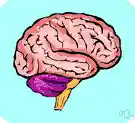 brain - that part of the central nervous system that includes all the higher nervous centers; enclosed within the skull; continuous with the spinal cord brain - that part of the central nervous system that includes all the higher nervous centers; enclosed within the skull; continuous with the spinal cordcircle of Willis - a ring of arteries at the base of the brain arteria communicans, communicating artery - any of three arteries in the brain that make up the circle of Willis neural structure - a structure that is part of the nervous system brain cell - a nerve cell in the brain central nervous system, CNS, systema nervosum centrale - the portion of the vertebrate nervous system consisting of the brain and spinal cord neencephalon, neoencephalon - the part of the brain having the most recent phylogenetic origin; the cerebral cortex and related parts forebrain, prosencephalon - the anterior portion of the brain; the part of the brain that develops from the anterior part of the neural tube mesencephalon, midbrain - the middle portion of the brain hindbrain, rhombencephalon - the posterior portion of the brain including cerebellum and brainstem brain stem, brainstem, brain-stem - the part of the brain continuous with the spinal cord and comprising the medulla oblongata and pons and midbrain and parts of the hypothalamus ventricle - one of four connected cavities in the brain; is continuous with the central canal of the spinal cord and contains cerebrospinal fluid head, caput - the upper part of the human body or the front part of the body in animals; contains the face and brains; "he stuck his head out the window" |
| 2. |  brain - mental ability; "he's got plenty of brains but no common sense" brain - mental ability; "he's got plenty of brains but no common sense"intelligence - the ability to comprehend; to understand and profit from experience | |
| 3. |  brain - that which is responsible for one's thoughts and feelings; the seat of the faculty of reason; "his mind wandered"; "I couldn't get his words out of my head" brain - that which is responsible for one's thoughts and feelings; the seat of the faculty of reason; "his mind wandered"; "I couldn't get his words out of my head"noddle - an informal British expression for head or mind; "use your noddle" tabula rasa - a young mind not yet affected by experience (according to John Locke) ego - (psychoanalysis) the conscious mind unconscious, unconscious mind - that part of the mind wherein psychic activity takes place of which the person is unaware subconscious, subconscious mind - psychic activity just below the level of awareness | |
| 4. |  brain - someone who has exceptional intellectual ability and originality; "Mozart was a child genius"; "he's smart but he's no Einstein" brain - someone who has exceptional intellectual ability and originality; "Mozart was a child genius"; "he's smart but he's no Einstein"intellectual, intellect - a person who uses the mind creatively prodigy - an unusually gifted or intelligent (young) person; someone whose talents excite wonder and admiration; "she is a chess prodigy" | |
| 5. | brain - the brain of certain animals used as meat organs, variety meat - edible viscera of a butchered animal calf's brain - the brain of a calf eaten as meat | |
| Verb | 1. | brain - hit on the head hit - deal a blow to, either with the hand or with an instrument; "He hit her hard in the face" |
| 2. | brain - kill by smashing someone's skull kill - cause to die; put to death, usually intentionally or knowingly; "This man killed several people when he tried to rob a bank"; "The farmer killed a pig for the holidays" |
Based on WordNet 3.0, Farlex clipart collection. © 2003-2012 Princeton University, Farlex Inc.
brain
noun
2. (Informal) intellectual, genius, scholar, sage, pundit, thinker, mastermind, intellect, prodigy, highbrow, rocket scientist (informal, chiefly U.S.), egghead (informal), brainbox, clever clogs, bluestocking (usually disparaging) I've never been much of a brain myself.
plural noun
1. intelligence, mind, reason, understanding, sense, capacity, smarts (slang, chiefly U.S.), wit, common sense, intellect, savvy (slang), nous (Brit. slang), suss (slang), shrewdness, sagacity They were not the only ones to have brains and ambition.
Quotations
"I was taught that the human brain was the crowning glory of evolution so far, but I think it's a very poor scheme for survival" [Kurt Vonnegut]
Parts of the brain
amygdala, brainstem, Broca's area, central sulcus, cerebellum, cerebral aqueduct, cerebral cortex or (nontechnical) grey matter, cerebrospinal fluid, cerebrum, choroid plexus, corpus callosum, diencephalon, fourth ventricle, frontal lobe, hippocampus, hypothalamus, infundibulum, limbic system, mamillary body, medulla oblongata, meninges, midbrain, myelencephalon or (nontechnical) afterbrain, occipital lobe, optic chiasma, parietal lobe, pineal body, pituitary gland, pons Varolli, substantia alba or (nontechnical) white matter, temporal lobe, thalamus, third ventricle, vermis, Wernicke's areaCollins Thesaurus of the English Language – Complete and Unabridged 2nd Edition. 2002 © HarperCollins Publishers 1995, 2002
brain
noun1. The seat of the faculty of intelligence and reason:
2. The faculty of thinking, reasoning, and acquiring and applying knowledge.Often used in plural:
Slang: smart (used in plural).
3. A person of great mental ability:
The American Heritage® Roget's Thesaurus. Copyright © 2013, 2014 by Houghton Mifflin Harcourt Publishing Company. Published by Houghton Mifflin Harcourt Publishing Company. All rights reserved.
Translations
دِمَاغدماغ، مُخذكاء، مقدرة عقليهشخص ذكي
мозък
mozekmozkovýinteligenceinteligent
hjerneforstandgodt hoved
aju
aivotälyälykköälykkyysjärki
mozak
agyakinek jó feje van
otak
heiligáfumaîurgáfur
脳
뇌
cerebrum
begalvisgalvagalvotasgalvotas žmogusgera mintis
garīgās spējasgudra galvagudrs cilvēksprātssaprāts
creierintelect
mozog
možganipamet
мозак
hjärnaförstånd
ubongo
สมอง
nãoóctrí óc
Collins Spanish Dictionary - Complete and Unabridged 8th Edition 2005 © William Collins Sons & Co. Ltd. 1971, 1988 © HarperCollins Publishers 1992, 1993, 1996, 1997, 2000, 2003, 2005
brain
[ˈbreɪn]
npl
(= intelligence) → intelligence f
He's got brains
BUT Il est intelligent.
to be the brains of sth → être le cerveau de qch
He's the brains of the organization → C'est le cerveau de l'organisation.
to be the brains behind sth → être le cerveau de qch
to pick sb's brains → faire appel aux lumières de qn
I'd like to pick your brains about something
BUT J'ai besoin de tes lumières sur quelque chose.
to rack one's brains (= think hard) → se creuser la cervelle
Collins English/French Electronic Resource. © HarperCollins Publishers 2005
brain
brain
:
brain activity
n → (Ge)hirntätigkeit f
brain-damaged
adj (lit) → hirngeschädigt; (fig inf) → (ge)hirnamputiert (hum inf)
braindead
adj (lit) → (ge)hirntot; (fig inf) → gehirnamputiert; (inf)
brain fart
n (inf) → Gedankenfurz m
brain fog
n (inf) → Gehirnnebel m (inf), eingeschränkte geistige Leistungsfähigkeit
brain gain
n → Brain Gain m or nt, Gewinn ausländischer Spitzenforscher und -manager
brain haemorrhage, brain hemorrhage (US)
brain
:
brain surgeon
n → Neurochirurg(in) m(f), → Hirnchirurg(in) m(f)
brain trust
n (US) → Braintrust m, → Expertenausschuss m
brain tumour, (US) brain tumor
brainwave
n
brainwaves pl (Physiol) → Gehirnströme pl
Collins German Dictionary – Complete and Unabridged 7th Edition 2005. © William Collins Sons & Co. Ltd. 1980 © HarperCollins Publishers 1991, 1997, 1999, 2004, 2005, 2007
Collins Italian Dictionary 1st Edition © HarperCollins Publishers 1995
brain
(brein) noun1. the centre of the nervous system. an injury to the brain; (also adjective) brain surgery; brain damage.
2. (often in plural) cleverness. a good brain; You've plenty of brains.
3. a clever person. He's one of the best brains in the country.
ˈbrainless adjectivestupid. a brainless idiot.
ˈbrainy adjectiveclever. She's a brainy child.
ˈbrainchild nouna favourite theory, invention etc thought up by a particular person. This entire process is Dr Smith's brainchild.
brain drainthe loss of experts to another country (usually in search of better salaries etc). As a result of the brain drain Britain does not have enough doctors.
ˈbrainwash verbto force (a person) to confess etc by putting great (psychological) pressure on him. The terrorists brainwashed him into believing in their ideals.
ˈbrainwashing nounˈbrainwave nouna sudden bright idea.
Kernerman English Multilingual Dictionary © 2006-2013 K Dictionaries Ltd.
brain
→ دِمَاغ mozek hjerne Gehirn εγκέφαλος cerebro aivot cerveau mozak cervello 脳 뇌 hersenen hjerne mózg cérebro мозг hjärna สมอง beyin não 头脑Multilingual Translator © HarperCollins Publishers 2009
brain
n. cerebro, parte del sistema nervioso central que se localiza en el cráneo y actúa como regulador principal de las funciones del cuerpo;
blood ___ barrier → barrera hematoencefálica;
___ abscess → absceso cerebral;
___ center → centro cerebral;
___ death → muerte cerebral;
___ edema → edema cerebral;
___ injuries → traumatismo cerebral;
___ or cerebral concussion → concusión o conmoción cerebral;
___ puncture → punción cerebral;
___ scan → escáner del ___;
___ tumor → tumor cerebral.
English-Spanish Medical Dictionary © Farlex 2012
brain
n cerebro; brain-dead con muerte f cerebral, que tiene muerte cerebral; — death muerte f cerebral
English-Spanish/Spanish-English Medical Dictionary Copyright © 2006 by The McGraw-Hill Companies, Inc. All rights reserved.