A widget that expands a child of a Row, Column, or Flex so that the child fills the available space.
Using an Expanded widget makes a child of a Row, Column, or Flex expand to fill the available space along the main axis (e.g., horizontally for a Row or vertically for a Column). If multiple children are expanded, the available space is divided among them according to the flex factor.
An Expanded widget must be a descendant of a Row, Column, or Flex, and the path from the Expanded widget to its enclosing Row, Column, or Flex must contain only StatelessWidgets or StatefulWidgets (not other kinds of widgets, like RenderObjectWidgets).
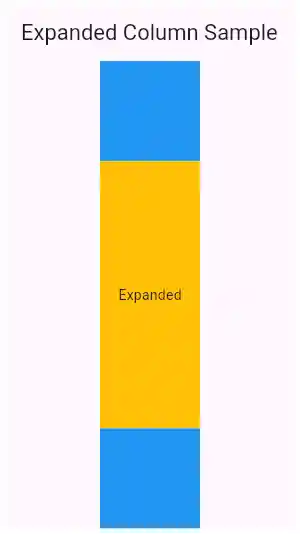
This example shows how to use an Expanded widget in a Column so that its middle child, a Container here, expands to fill the space.
To create a local project with this code sample, run:
flutter create --sample=widgets.Expanded.1 mysample
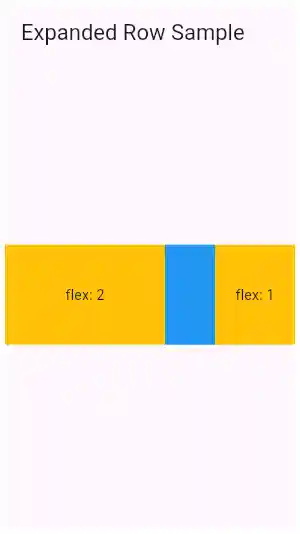
This example shows how to use an Expanded widget in a Row with multiple children expanded, utilizing the flex factor to prioritize available space.
To create a local project with this code sample, run:
flutter create --sample=widgets.Expanded.2 mysample
See also:
- Flexible, which does not force the child to fill the available space.
- Spacer, a widget that takes up space proportional to its flex value.
- The catalog of layout widgets.
- Inheritance
Constructors
Properties
- child → Widget
-
The widget below this widget in the tree.
finalinherited
- debugTypicalAncestorWidgetClass → Type
-
Describes the RenderObjectWidget that is typically used to set up the
ParentData that applyParentData will write to.
no setterinherited
- debugTypicalAncestorWidgetDescription → String
-
Describes the RenderObjectWidget that is typically used to set up the
ParentData that applyParentData will write to.
no setterinherited
- fit → FlexFit
-
How a flexible child is inscribed into the available space.
finalinherited
- flex → int
-
The flex factor to use for this child.
finalinherited
- hashCode → int
-
The hash code for this object.
no setterinherited
- key → Key?
-
Controls how one widget replaces another widget in the tree.
finalinherited
- runtimeType → Type
-
A representation of the runtime type of the object.
no setterinherited
Methods
-
applyParentData(
RenderObject renderObject) → void -
Write the data from this widget into the given render object's parent data.
inherited
-
createElement(
) → ParentDataElement< FlexParentData> -
Inflates this configuration to a concrete instance.
inherited
-
debugCanApplyOutOfTurn(
) → bool -
Whether the ParentDataElement.applyWidgetOutOfTurn method is allowed
with this widget.
inherited
-
debugDescribeChildren(
) → List< DiagnosticsNode> -
Returns a list of DiagnosticsNode objects describing this node's
children.
inherited
-
debugFillProperties(
DiagnosticPropertiesBuilder properties) → void -
Add additional properties associated with the node.
inherited
-
debugIsValidRenderObject(
RenderObject renderObject) → bool -
Checks if this widget can apply its parent data to the provided
renderObject.inherited
-
noSuchMethod(
Invocation invocation) → dynamic -
Invoked when a nonexistent method or property is accessed.
inherited
-
toDiagnosticsNode(
{String? name, DiagnosticsTreeStyle? style}) → DiagnosticsNode -
Returns a debug representation of the object that is used by debugging
tools and by DiagnosticsNode.toStringDeep.
inherited
-
toString(
{DiagnosticLevel minLevel = DiagnosticLevel.info}) → String -
A string representation of this object.
inherited
-
toStringDeep(
{String prefixLineOne = '', String? prefixOtherLines, DiagnosticLevel minLevel = DiagnosticLevel.debug, int wrapWidth = 65}) → String -
Returns a string representation of this node and its descendants.
inherited
-
toStringShallow(
{String joiner = ', ', DiagnosticLevel minLevel = DiagnosticLevel.debug}) → String -
Returns a one-line detailed description of the object.
inherited
-
toStringShort(
) → String -
A short, textual description of this widget.
inherited
Operators
-
operator ==(
Object other) → bool -
The equality operator.
inherited