Python Program to Reverse a Number
This article is created to cover some programs in Python, that find and prints reverse of a number entered by user. Here are the list of approaches used:
- Find reverse of a number using while loop
- Using for loop
- Using list
- Using function
- Using recursion
Reverse a Number using while Loop
To find reverse of a given number in Python, you have to ask from user to enter a number, then reverse and print like shown in the program given below. The question is, write a Python program to reverse a number. Here is its answer:
print("Enter a Number: ")
num = int(input())

rev = 0
while num!=0:
  rem = num%10
  rev = rem + (rev*10)
  num = int(num/10)

print("\nReverse =", rev)
Here is its sample run:
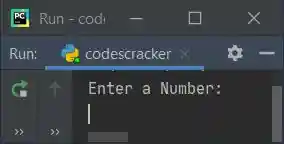
Now supply the input say 236 as number, press ENTER key to find and print its reverse like shown in the snapshot given below:
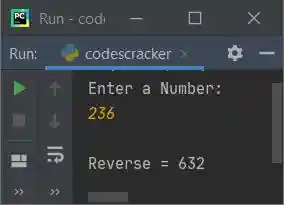
The dry run of above program with 236 as user input, goes like:
- When user enters the number say 236, it gets stored in num. So num=236
- The condition (of while loop) num!=0 or 236!=0 evaluates to be true, therefore program flow goes inside the loop and executes all the three statements present inside the block of this loop
- So num%10 or 236%10 or 6 gets initialized to rem
- Then rem + (rev*10) or 6 + (0*10) (rev=0 initially) or 6 gets initialized to rev
- Finally int(num/10) or int(236/10) or int(23.6) or 23 gets initialized to num. Now the condition of while loop again gets evaluated with new value of num
- That is, the condition num!=0 or 23!=0 again evaluates to be true, therefore program flow again goes inside the loop
- This process continues until the condition evaluates to be false
- In this way, after exiting from the loop, the variable rev holds the reverse of given number
- So print the value of rev on output, as reverse of a number, just after exiting from the loop
Modified Version of Previous Program
I've included try-except block in this program, to handle with invalid inputs. The end used here to skip insertion of an automatic newline. And the str() method converts into a string type value.
print("Enter a Number: ", end="")
try:
  num = int(input())
  rev = 0
  temp = num
  while num!=0:
    rev = (num%10) + (rev*10)
    num = int(num/10)
  print("\nReverse of " +str(temp)+ " is " +str(rev))
except ValueError:
  print("\nInvalid Input!")
Here is its sample run with user input 549:
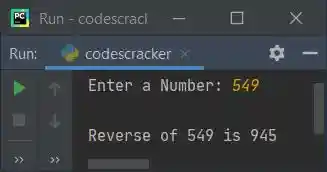
Reverse a Number using for Loop
This program uses for loop to do the same job, that is of reversing a number. Let's have a look at the program first:
print("Enter a Number: ", end="")
num = int(input())

rev = 0
numlen = len(str(num))
temp = num

for i in range(numlen):
  rev = (num%10) + (rev*10)
  num = int(num/10)

print("\nReverse of " +str(temp)+ " is " +str(rev))
Produces same output as of previous program. The following code (from above program):
is used to execute following statements (present inside the block of above for loop):
rev = (num%10) + (rev*10)
num = int(num/10)
numlen number of times. For example, if given number is 549, then using the following statement:
the length of str(549) or "549" gets initialized to numlen, that is 3. So numlen=3. Therefore both statements present inside for loop's block, executes 3 times.
Note - The statements inside for loop gets executed x number of times. The value of x indicates the total digit of given number.
Reverse a Number using List
Now this program uses list to reverse a given number. The append() is used to add or append new element (number here) at the end of list.
print("Enter a Number: ", end="")
num = int(input())

temp = num
nums = []
while num!=0:
  rem = num%10
  nums.append(rem)
  num = int(num/10)

print(end="\nReverse of " +str(temp)+ " is ")
for i in range(len(nums)):
  print(nums[i], end="")
print()
Reverse a Number using Function
This program uses a user-defined function named rev(), that returns reverse of a number passed as its argument.
def rev(n):
  r = 0
  while n!=0:
    r = (n%10) + (r*10)
    n = int(n/10)
  return r

print("Enter a Number: ", end="")
num = int(input())

print("\nReverse of " +str(num)+ " is " +str(rev(num)))
Reverse a Number using Recursion
This is the last program of this article, created using a recursive function. That is, a recursive function named rev() is implemented here to return reverse of a number. The second argument passed to this function is the argument corresponds to rev (as defined in previous programs), with its initial value as 0
def rev(n, r):
  if n==0:
    return r
  else:
    return rev(int(n/10), (n%10)+(r*10))

print("Enter a Number: ", end="")
num = int(input())

print("\nReverse of " +str(num)+ " is " +str(rev(num, 0)))
Same Program in Other Languages
« Previous Program Next Program »
Liked this post? Share it!