Python abs() Function
To find an absolute value of a number in Python programming, we need to use abs(). That is, the function abs() returns the absolute value of a number passed as its parameter.
Now the question is, what is an absolute number ?
The answer is, an absolute value is basically a modulus of a real number. Modulus in the sense, means a non-negative value.
Python abs() Function Example
The program given below uses abs() function, that returns an absolute value.
Here is the sample output produced by above program:

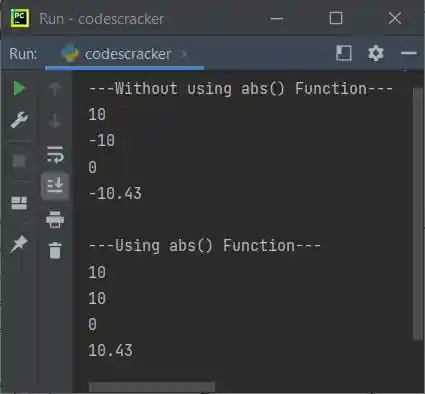
As you can see from the above program, the abs() function returns a non-negative equivalent of a value passed as its argument. Let's create another program:
a = 10
b = -10
c = 0
d = -10.43

print("---Without using abs() Function---")
print(a)
print(b)
print(c)
print(d)

print("\n---Using abs() Function---")
print(abs(a))
print(abs(b))
print(abs(c))
print(abs(d))
This time, the output produced by above program is:
Key Notes on abs() Function in Python
Important - The abs() returns non-negative value, if argument passed or given is a real number.
Important - The abs() returns the magnitude part, if argument given is a complex number.
Now the question is, what is magnitude part of a complex number ?
The answer is, the magnitude part of a complex number, is the distance, the point is from origin of the complex plane.
It is denoted by |a + bi|, is calculated by using the formula,
|a + bi| = √a2 + b2. For example, the magnitude part of complex number
3 - 4j is equal to:
√32 + 42
= √9 + 16
= √ 25
= 5
The example given below, shows the use of abs() function in complex number, or to find the magnitude part of a complex number.
abs() Function for Complex Number
Here is an example, uses abs() in Python uses complex number:
complex_number = (3-4j)
print(abs(complex_number))
produces 5.0 on output screen.
« Previous Function Next Function »
Liked this post? Share it!