Python map() Function
The map() function in Python is used when we need to execute a function for each item in an iterable, where item is passed as argument of the function. For example:
def cubes(n):
    return n*n*n

mylist = [2, 3, 4, 5]

res = map(cubes, mylist)
for x in res:
    print(x)
The output will be:
Python map() Function Syntax
The syntax of map() function in Python, is:
where fun refers to the function that needs to be executed for each items of specified iterable. Whereas iterables refers to a sequence, a collection or items, or an iterator object.
Note: Any number of iterables can be used.
Point to be Noted - The function has one parameter for each iterable.
Python map() Function Example
Here is an example of map() function in Python:
def add(x, y):
    return x + y

a = [1, 2, 3]
b = [4, 5, 6]
for x in map(add, a, b):
    print(x)

print("-----------")

a = ("codes", "python ")
b = ("cracker", "programming")
for x in map(add, a, b):
    print(x)

print("-----------")

for x in map(add, (10, 20), (30, 40, 80)):
    print(x)
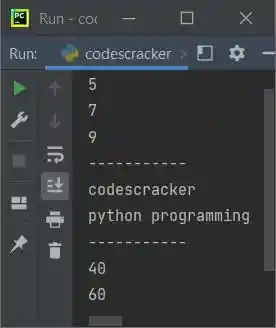
The snapshot given below shows the sample output produced by above program, demonstrating the map() function:
Let's create another program uses map() function to find squares and cubes of all numbers available in a list named mylist:
def square(x):
    return x*x
def cube(x):
    return x*x*x

mylist = [2, 3, 5, 8]
resSq = map(square, mylist)
resCu = map(cube, mylist)

print(list(resSq))
print(list(resCu))
The output will be:
[4, 9, 25, 64]
[8, 27, 125, 512]
Let's modify the above program to create an output that provides little good user-experience than previous one:
def square(x):
    return x*x
def cube(x):
    return x*x*x

mylist = [2, 3, 5, 8]
resSq = list(map(square, mylist))
resCu = list(map(cube, mylist))

for i in range(len(mylist)):
    print("Square of", mylist[i], "=", resSq[i])
    print("Cube of", mylist[i], "=", resCu[i])
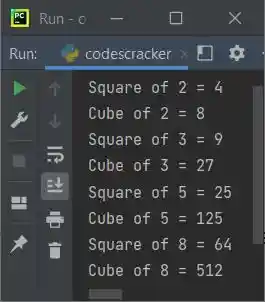
Now the output is like shown in the snapshot given below:
« Previous Function Next Function »
Liked this post? Share it!