Python repr() function
The repr() function in Python returns the canonical string representation of an object. For example:
x = 'Python Programming'
print(repr(x))
x = [1, 2, 34, 43]
print(repr(x))
The output will be:
'Python Programming'
[1, 2, 34, 43]
Python repr() function syntax
The syntax of the repr() function in Python is:
The repr() function basically returns the printable representation of an object.
Note: For many types of objects, including the most built-ins, eval(repr(obj)) gives obj.
Python repr() function example
Here is an example of the repr() function in Python:
print("Enter the string: ", end="")
str = input()

print("\n----The string is, without repr(str)----")
print(str)
print("\n----The string is, with repr(str)----")
print(repr(str))
The snapshot given below shows the sample run of the above program, with user input codes cracker dot com as a string:
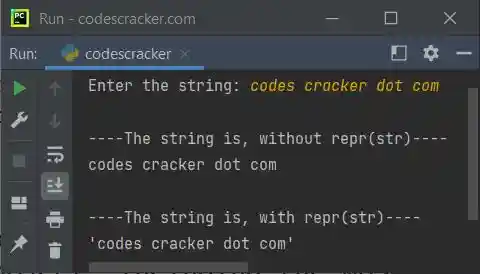
Note: The repr() method is used to print the official representation of an object.
Advantages of the repr() function in Python
- Gives you a string representation of an object that you can use to recreate it later.
- The repr() function represents an object in a clear and unambiguous manner, making it useful for debugging and testing.
- Some built-in Python functions, such as eval(), use it to recreate objects.
Disadvantages of the repr() function in Python
- The string representation returned by repr() is not always user-friendly and may contain a lot of technical detail that the user is not interested in.
- The string representation returned by repr() can be difficult to read and understand if the object being represented is large or complex.
- Some Python objects may lack a meaningful repr() representation or may have a repr() representation that is unsuitable for use in recreating the object.
« Previous Function Next Function »
Liked this post? Share it!