NVIDIA cuLitho
Accelerate computational lithography
NVIDIA cuLitho is a library with optimized tools and algorithms for GPU-accelerating computational lithography and the manufacturing process of semiconductors by orders of magnitude over current CPU-based methods.
Manufacturing computer chips requires a critical step called computational lithography – a complex computation – involving electromagnetic physics, photochemistry, computational geometry, iterative optimization, and distributed computing.
This computational lithography step is already one of the largest compute workloads in semiconductor production, necessitating massive data centers, and the silicon miniaturization evolution process exponentially amplifies the computation requirements over time.
The Challenge
As silicon feature sizes become smaller, and the impacts of optical diffraction have to be offset, there arises a need to proactively manipulate mask patterns with optical proximity correction (OPC) or inverse lithography technology (ILT) to accurately image wafers. This requires advanced computational lithography techniques and increased compute efficiency. Every industry needs to accelerate every workload, so that we can reclaim power and do more with less.
Benefits
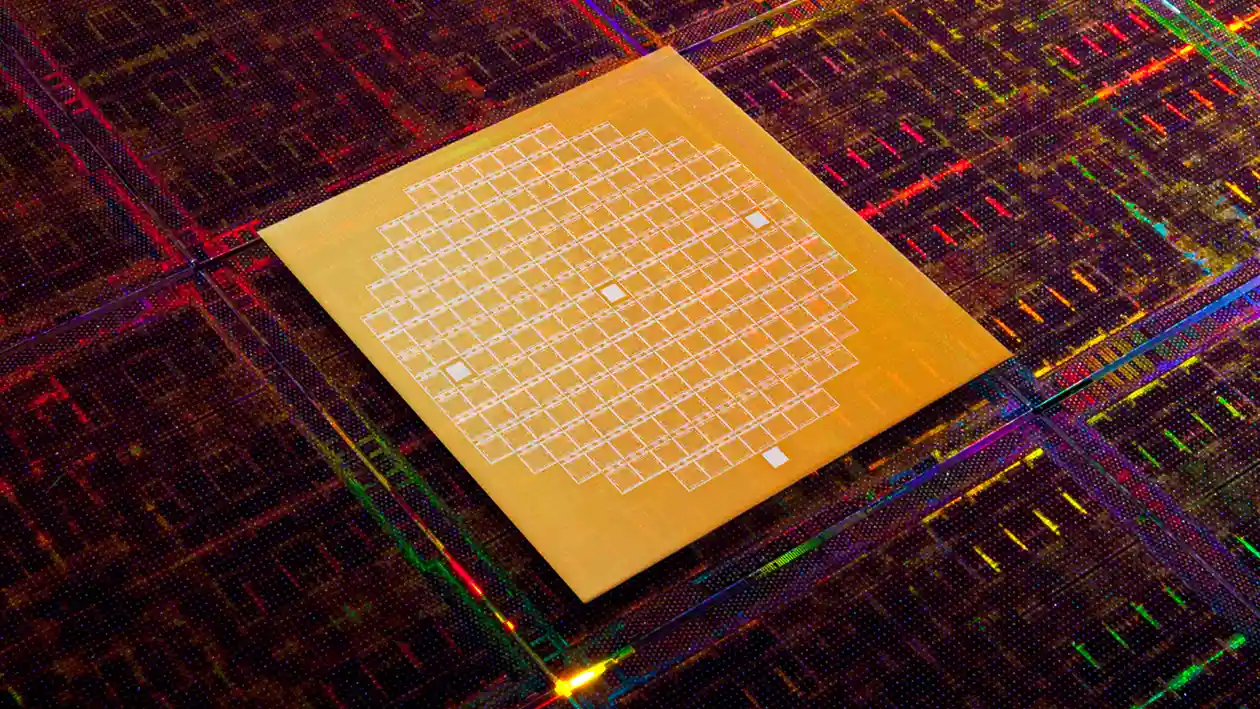
Acceleration libraries are at the core of accelerated computing. NVIDIA cuLitho is a library that targets the emerging challenges of nanoscale computational lithography. With GPUs, it accelerates inverse lithography by 40X, helping create new solutions to make future semiconductor technologies cheaper and more predictable. It introduces new innovations and leverages decades of investment in CUDA® infrastructure.

Performance
Faster inverse lithography technology (ILT) powers a 40X performance speedup, generating accurate photomasks faster.

Productivity
Photomasks that took two weeks can be processed overnight.
3X to 5X more masks can be generated per day.

Cost Savings
500 NVIDIA Hopper™ GPU systems running cuLitho can do the work of 40,000 CPU systems. That's 1/9 the power and 1/8 the space.

Future Silicon Scaling
Faster OPC enables new lithography innovations to address miniaturization of next-generation semiconductors, including subatomic modeling, curvilinear OPC, and high-numerical aperture extreme-ultraviolet (high-NA EUV) lithography.
Collaborators
Semiconductor and electronic design automation (EDA) industry leaders are leveraging NVIDIA cuLitho to drive silicon scaling and enable their end users to reduce costs and accelerate technology advancements.

“We are planning to integrate support for GPUs into all of our computational lithography software products. Our collaboration with NVIDIA on GPUs and cuLitho should result in tremendous benefit to computational lithography and therefore to semiconductor scaling. This will be especially true in the era of High-NA EUV lithography.”
— Peter Wennink, CEO, ASML
“For more than two decades Synopsys Proteus mask synthesis software products have been the production-proven choice for accelerating computational lithography — the most demanding workload in semiconductor manufacturing. With the move to advanced nodes, computational lithography has dramatically increased in complexity and compute cost. Our collaboration with TSMC and NVIDIA is critical to enabling angstrom-level scaling as we pioneer advanced technologies to reduce turnaround time by orders of magnitude through the power of accelerated computing.”
— Sassine Ghazi, President and CEO, Synopsys

“Our work with NVIDIA to integrate GPU-accelerated computing in the TSMC workflow has resulted in great leaps in performance, dramatic throughput improvement, shortened cycle time and reduced power requirements. We are moving NVIDIA cuLitho into production at TSMC, leveraging this computational lithography technology to drive a critical component of semiconductor scaling”
— Dr. C.C. Wei, CEO, TSMC
Press Release
Read 2023 Press Release
NVIDIA, ASML, TSMC, and Synopsys collaborate to advance next-generation chip manufacturing by adopting NVIDIA's groundbreaking computational lithography, thereby pushing the boundaries of physics in the industry.
Read the Press Release
Read 2024 Press Release
NVIDIA introduces Gen AI to computational lithography, and integration partners go into production with cuLitho.
Read the Press Release