JRootPane (Java Platform SE 6)
javax.swing
Class JRootPane
java.lang.Object
  java.awt.Component
      java.awt.Container
          javax.swing.JComponent
              javax.swing.JRootPane
- All Implemented Interfaces:
- ImageObserver, MenuContainer, Serializable, Accessible
public class JRootPane
- extends JComponent
- implements Accessible
A lightweight container used behind the scenes by
JFrame, JDialog, JWindow,
JApplet, and JInternalFrame.
For task-oriented information on functionality provided by root panes
see How to Use Root Panes,
a section in The Java Tutorial.
The following image shows the relationships between the classes that use root panes.

JFrame, JDialog,
JWindow, and JApplet) are
shown in relation to the AWT classes they extend.
These four components are the
only heavyweight containers in the Swing library. The lightweight container
JInternalFrame is also shown.
All five of these JFC/Swing containers implement the
RootPaneContainer interface,
and they all delegate their operations to a
JRootPane (shown with a little "handle" on top).
Note: TheJComponentmethodgetRootPanecan be used to obtain theJRootPanethat contains a given component.
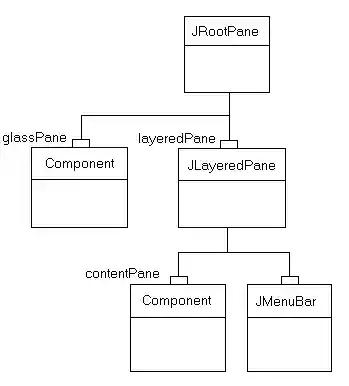
JRootPane.
A JRootpane is made up of a glassPane,
an optional menuBar, and a contentPane.
(The JLayeredPane manages the menuBar
and the contentPane.)
The glassPane sits over the top of everything,
where it is in a position to intercept mouse movements.
Since the glassPane (like the contentPane)
can be an arbitrary component, it is also possible to set up the
glassPane for drawing. Lines and images on the
glassPane can then range
over the frames underneath without being limited by their boundaries.
Although the menuBar component is optional,
the layeredPane, contentPane,
and glassPane always exist.
Attempting to set them to null generates an exception.
To add components to the JRootPane (other than the
optional menu bar), you add the object to the contentPane
of the JRootPane, like this:
rootPane.getContentPane().add(child);The same principle holds true for setting layout managers, removing components, listing children, etc. All these methods are invoked on the
contentPane instead of on the JRootPane.
Note: The default layout manager for theIf acontentPaneis aBorderLayoutmanager. However, theJRootPaneuses a customLayoutManager. So, when you want to change the layout manager for the components you added to aJRootPane, be sure to use code like this:rootPane.getContentPane().setLayout(new BoxLayout());
JMenuBar component is set on the JRootPane,
it is positioned along the upper edge of the frame.
The contentPane is adjusted in location and size to
fill the remaining area.
(The JMenuBar and the contentPane are added to the
layeredPane component at the
JLayeredPane.FRAME_CONTENT_LAYER layer.)
The layeredPane is the parent of all children in the
JRootPane -- both as the direct parent of the menu and
the grandparent of all components added to the contentPane.
It is an instance of JLayeredPane,
which provides the ability to add components at several layers.
This capability is very useful when working with menu popups,
dialog boxes, and dragging -- situations in which you need to place
a component on top of all other components in the pane.
The glassPane sits on top of all other components in the
JRootPane.
That provides a convenient place to draw above all other components,
and makes it possible to intercept mouse events,
which is useful both for dragging and for drawing.
Developers can use setVisible on the glassPane
to control when the glassPane displays over the other children.
By default the glassPane is not visible.
The custom LayoutManager used by JRootPane
ensures that:
- The
glassPanefills the entire viewable area of theJRootPane(bounds - insets). - The
layeredPanefills the entire viewable area of theJRootPane. (bounds - insets) - The
menuBaris positioned at the upper edge of thelayeredPane. - The
contentPanefills the entire viewable area, minus themenuBar, if present.
JRootPane view hierarchy are ignored.
If you replace the LayoutManager of the JRootPane,
you are responsible for managing all of these views.
So ordinarily you will want to be sure that you
change the layout manager for the contentPane rather than
for the JRootPane itself!
The painting architecture of Swing requires an opaque
JComponent
to exist in the containment hieararchy above all other components. This is
typically provided by way of the content pane. If you replace the content
pane, it is recommended that you make the content pane opaque
by way of setOpaque(true). Additionally, if the content pane
overrides paintComponent, it
will need to completely fill in the background in an opaque color in
paintComponent.
Warning: Swing is not thread safe. For more information see Swing's Threading Policy.
Warning:
Serialized objects of this class will not be compatible with
future Swing releases. The current serialization support is
appropriate for short term storage or RMI between applications running
the same version of Swing. As of 1.4, support for long term storage
of all JavaBeansTM
has been added to the java.beans package.
Please see XMLEncoder.
- See Also:
JLayeredPane,JMenuBar,JWindow,JFrame,JDialog,JApplet,JInternalFrame,JComponent,BoxLayout, Mixing Heavy and Light Components
| Nested Class Summary | |
|---|---|
protected class |
JRootPane.AccessibleJRootPane
This class implements accessibility support for the JRootPane class. |
protected class |
JRootPane.RootLayout
A custom layout manager that is responsible for the layout of layeredPane, glassPane, and menuBar. |
| Nested classes/interfaces inherited from class javax.swing.JComponent |
|---|
JComponent.AccessibleJComponent |
| Nested classes/interfaces inherited from class java.awt.Container |
|---|
Container.AccessibleAWTContainer |
| Nested classes/interfaces inherited from class java.awt.Component |
|---|
Component.AccessibleAWTComponent, Component.BaselineResizeBehavior, Component.BltBufferStrategy, Component.FlipBufferStrategy |
| Field Summary | |
|---|---|
static int |
COLOR_CHOOSER_DIALOG
Constant used for the windowDecorationStyle property. |
protected Container |
contentPane
The content pane. |
protected JButton |
defaultButton
The button that gets activated when the pane has the focus and a UI-specific action like pressing the Enter key occurs. |
protected javax.swing.JRootPane.DefaultAction |
defaultPressAction
Deprecated. As of Java 2 platform v1.3. |
protected javax.swing.JRootPane.DefaultAction |
defaultReleaseAction
Deprecated. As of Java 2 platform v1.3. |
static int |
ERROR_DIALOG
Constant used for the windowDecorationStyle property. |
static int |
FILE_CHOOSER_DIALOG
Constant used for the windowDecorationStyle property. |
static int |
FRAME
Constant used for the windowDecorationStyle property. |
protected Component |
glassPane
The glass pane that overlays the menu bar and content pane, so it can intercept mouse movements and such. |
static int |
INFORMATION_DIALOG
Constant used for the windowDecorationStyle property. |
protected JLayeredPane |
layeredPane
The layered pane that manages the menu bar and content pane. |
protected JMenuBar |
menuBar
The menu bar. |
static int |
NONE
Constant used for the windowDecorationStyle property. |
static int |
PLAIN_DIALOG
Constant used for the windowDecorationStyle property. |
static int |
QUESTION_DIALOG
Constant used for the windowDecorationStyle property. |
static int |
WARNING_DIALOG
Constant used for the windowDecorationStyle property. |
| Fields inherited from class javax.swing.JComponent |
|---|
accessibleContext, listenerList, TOOL_TIP_TEXT_KEY, ui, UNDEFINED_CONDITION, WHEN_ANCESTOR_OF_FOCUSED_COMPONENT, WHEN_FOCUSED, WHEN_IN_FOCUSED_WINDOW |
| Fields inherited from class java.awt.Component |
|---|
BOTTOM_ALIGNMENT, CENTER_ALIGNMENT, LEFT_ALIGNMENT, RIGHT_ALIGNMENT, TOP_ALIGNMENT |
| Fields inherited from interface java.awt.image.ImageObserver |
|---|
ABORT, ALLBITS, ERROR, FRAMEBITS, HEIGHT, PROPERTIES, SOMEBITS, WIDTH |
| Constructor Summary | |
|---|---|
JRootPane()
Creates a JRootPane, setting up its
glassPane, layeredPane,
and contentPane. |
|
| Method Summary | |
|---|---|
protected void |
addImpl(Component comp,
        Object constraints,
        int index)
Overridden to enforce the position of the glass component as the zero child. |
void |
addNotify()
Register ourselves with the SystemEventQueueUtils as a new
root pane. |
protected Container |
createContentPane()
Called by the constructor methods to create the default contentPane. |
protected Component |
createGlassPane()
Called by the constructor methods to create the default glassPane. |
protected JLayeredPane |
createLayeredPane()
Called by the constructor methods to create the default layeredPane. |
protected LayoutManager |
createRootLayout()
Called by the constructor methods to create the default layoutManager. |
AccessibleContext |
getAccessibleContext()
Gets the AccessibleContext associated with this
JRootPane. |
Container |
getContentPane()
Returns the content pane -- the container that holds the components parented by the root pane. |
JButton |
getDefaultButton()
Returns the value of the defaultButton property. |
Component |
getGlassPane()
Returns the current glass pane for this JRootPane. |
JMenuBar |
getJMenuBar()
Returns the menu bar from the layered pane. |
JLayeredPane |
getLayeredPane()
Gets the layered pane used by the root pane. |
JMenuBar |
getMenuBar()
Deprecated. As of Swing version 1.0.3 replaced by getJMenuBar(). |
RootPaneUI |
getUI()
Returns the L&F object that renders this component. |
String |
getUIClassID()
Returns a string that specifies the name of the L&F class that renders this component. |
int |
getWindowDecorationStyle()
Returns a constant identifying the type of Window decorations the JRootPane is providing. |
boolean |
isOptimizedDrawingEnabled()
The glassPane and contentPane
have the same bounds, which means JRootPane
does not tiles its children and this should return false. |
boolean |
isValidateRoot()
If a descendant of this JRootPane calls
revalidate, validate from here on down. |
protected String |
paramString()
Returns a string representation of this JRootPane. |
void |
removeNotify()
Unregister ourselves from SystemEventQueueUtils. |
void |
setContentPane(Container content)
Sets the content pane -- the container that holds the components parented by the root pane. |
void |
setDefaultButton(JButton defaultButton)
Sets the defaultButton property,
which determines the current default button for this JRootPane. |
void |
setDoubleBuffered(boolean aFlag)
Sets whether this component should use a buffer to paint. |
void |
setGlassPane(Component glass)
Sets a specified Component to be the glass pane for this
root pane. |
void |
setJMenuBar(JMenuBar menu)
Adds or changes the menu bar used in the layered pane. |
void |
setLayeredPane(JLayeredPane layered)
Sets the layered pane for the root pane. |
void |
setMenuBar(JMenuBar menu)
Deprecated. As of Swing version 1.0.3 replaced by setJMenuBar(JMenuBar menu). |
void |
setUI(RootPaneUI ui)
Sets the L&F object that renders this component. |
void |
setWindowDecorationStyle(int windowDecorationStyle)
Sets the type of Window decorations (such as borders, widgets for closing a Window, title ...) the JRootPane should
provide. |
void |
updateUI()
Resets the UI property to a value from the current look and feel. |
| Methods inherited from class java.lang.Object |
|---|
clone, equals, finalize, getClass, hashCode, notify, notifyAll, wait, wait, wait |
| Field Detail |
|---|
NONE
public static final int NONE
- Constant used for the windowDecorationStyle property. Indicates that
the
JRootPaneshould not provide any sort of Window decorations.- Since:
- 1.4
- See Also:
- Constant Field Values
FRAME
public static final int FRAME
- Constant used for the windowDecorationStyle property. Indicates that
the
JRootPaneshould provide decorations appropriate for a Frame.- Since:
- 1.4
- See Also:
- Constant Field Values
PLAIN_DIALOG
public static final int PLAIN_DIALOG
- Constant used for the windowDecorationStyle property. Indicates that
the
JRootPaneshould provide decorations appropriate for a Dialog.- Since:
- 1.4
- See Also:
- Constant Field Values
INFORMATION_DIALOG
public static final int INFORMATION_DIALOG
- Constant used for the windowDecorationStyle property. Indicates that
the
JRootPaneshould provide decorations appropriate for a Dialog used to display an informational message.- Since:
- 1.4
- See Also:
- Constant Field Values
ERROR_DIALOG
public static final int ERROR_DIALOG
- Constant used for the windowDecorationStyle property. Indicates that
the
JRootPaneshould provide decorations appropriate for a Dialog used to display an error message.- Since:
- 1.4
- See Also:
- Constant Field Values
COLOR_CHOOSER_DIALOG
public static final int COLOR_CHOOSER_DIALOG
- Constant used for the windowDecorationStyle property. Indicates that
the
JRootPaneshould provide decorations appropriate for a Dialog used to display aJColorChooser.- Since:
- 1.4
- See Also:
- Constant Field Values
FILE_CHOOSER_DIALOG
public static final int FILE_CHOOSER_DIALOG
- Constant used for the windowDecorationStyle property. Indicates that
the
JRootPaneshould provide decorations appropriate for a Dialog used to display aJFileChooser.- Since:
- 1.4
- See Also:
- Constant Field Values
QUESTION_DIALOG
public static final int QUESTION_DIALOG
- Constant used for the windowDecorationStyle property. Indicates that
the
JRootPaneshould provide decorations appropriate for a Dialog used to present a question to the user.- Since:
- 1.4
- See Also:
- Constant Field Values
WARNING_DIALOG
public static final int WARNING_DIALOG
- Constant used for the windowDecorationStyle property. Indicates that
the
JRootPaneshould provide decorations appropriate for a Dialog used to display a warning message.- Since:
- 1.4
- See Also:
- Constant Field Values
menuBar
protected JMenuBar menuBar
- The menu bar.
contentPane
protected Container contentPane
- The content pane.
layeredPane
protected JLayeredPane layeredPane
- The layered pane that manages the menu bar and content pane.
glassPane
protected Component glassPane
- The glass pane that overlays the menu bar and content pane,
so it can intercept mouse movements and such.
defaultButton
protected JButton defaultButton
- The button that gets activated when the pane has the focus and
a UI-specific action like pressing the Enter key occurs.
defaultPressAction
@Deprecated
protected javax.swing.JRootPane.DefaultAction defaultPressAction
- Deprecated. As of Java 2 platform v1.3.
- As of Java 2 platform v1.3 this unusable field is no longer used.
To override the default button you should replace the
Actionin theJRootPane'sActionMap. Please refer to the key bindings specification for further details.- See Also:
defaultButton
defaultReleaseAction
@Deprecated
protected javax.swing.JRootPane.DefaultAction defaultReleaseAction
- Deprecated. As of Java 2 platform v1.3.
- As of Java 2 platform v1.3 this unusable field is no longer used.
To override the default button you should replace the
Actionin theJRootPane'sActionMap. Please refer to the key bindings specification for further details.- See Also:
defaultButton
| Constructor Detail |
|---|
JRootPane
public JRootPane()
- Creates a
JRootPane, setting up itsglassPane,layeredPane, andcontentPane.
| Method Detail |
|---|
setDoubleBuffered
public void setDoubleBuffered(boolean aFlag)
- Sets whether this component should use a buffer to paint.
If set to true, all the drawing from this component will be done
in an offscreen painting buffer. The offscreen painting buffer will
the be copied onto the screen.
If a
Componentis buffered and one of its ancestor is also buffered, the ancestor buffer will be used. - Overrides:
setDoubleBufferedin classJComponent
- Parameters:
aFlag- if true, set this component to be double buffered- Since:
- 1.6
getWindowDecorationStyle
public int getWindowDecorationStyle()
- Returns a constant identifying the type of Window decorations the
JRootPaneis providing. - Returns:
- One of
NONE,FRAME,PLAIN_DIALOG,INFORMATION_DIALOG,ERROR_DIALOG,COLOR_CHOOSER_DIALOG,FILE_CHOOSER_DIALOG,QUESTION_DIALOGorWARNING_DIALOG. - Since:
- 1.4
- See Also:
setWindowDecorationStyle(int)
setWindowDecorationStyle
public void setWindowDecorationStyle(int windowDecorationStyle)
- Sets the type of Window decorations (such as borders, widgets for
closing a Window, title ...) the
JRootPaneshould provide. The default is to provide no Window decorations (NONE).This is only a hint, and some look and feels may not support this. This is a bound property.
- Parameters:
windowDecorationStyle- Constant identifying Window decorations to provide.- Throws:
IllegalArgumentException- ifstyleis not one of:NONE,FRAME,PLAIN_DIALOG,INFORMATION_DIALOG,ERROR_DIALOG,COLOR_CHOOSER_DIALOG,FILE_CHOOSER_DIALOG,QUESTION_DIALOG, orWARNING_DIALOG.- Since:
- 1.4
- See Also:
JDialog.setDefaultLookAndFeelDecorated(boolean),JFrame.setDefaultLookAndFeelDecorated(boolean),LookAndFeel.getSupportsWindowDecorations()
getUI
public RootPaneUI getUI()
- Returns the L&F object that renders this component.
- Returns:
LabelUIobject- Since:
- 1.3
setUI
public void setUI(RootPaneUI ui)
- Sets the L&F object that renders this component.
- Parameters:
ui- theLabelUIL&F object- Since:
- 1.3
- See Also:
UIDefaults.getUI(javax.swing.JComponent)
updateUI
public void updateUI()
- Resets the UI property to a value from the current look and feel.
- Overrides:
updateUIin classJComponent
- See Also:
JComponent.updateUI()
getUIClassID
public String getUIClassID()
- Returns a string that specifies the name of the L&F class
that renders this component.
- Overrides:
getUIClassIDin classJComponent
- Returns:
- the string "RootPaneUI"
- See Also:
JComponent.getUIClassID(),UIDefaults.getUI(javax.swing.JComponent)
createLayeredPane
protected JLayeredPane createLayeredPane()
- Called by the constructor methods to create the default
layeredPane. Bt default it creates a newJLayeredPane. - Returns:
- the default
layeredPane
createContentPane
protected Container createContentPane()
- Called by the constructor methods to create the default
contentPane. By default this method creates a newJComponentadd sets aBorderLayoutas itsLayoutManager. - Returns:
- the default
contentPane
createGlassPane
protected Component createGlassPane()
- Called by the constructor methods to create the default
glassPane. By default this method creates a newJComponentwith visibility set to false. - Returns:
- the default
glassPane
createRootLayout
protected LayoutManager createRootLayout()
- Called by the constructor methods to create the default
layoutManager. - Returns:
- the default
layoutManager.
setJMenuBar
public void setJMenuBar(JMenuBar menu)
- Adds or changes the menu bar used in the layered pane.
- Parameters:
menu- theJMenuBarto add
setMenuBar
@Deprecated
public void setMenuBar(JMenuBar menu)
- Deprecated. As of Swing version 1.0.3
replaced by
setJMenuBar(JMenuBar menu). - Specifies the menu bar value.
- Parameters:
menu- theJMenuBarto add.
getJMenuBar
public JMenuBar getJMenuBar()
- Returns the menu bar from the layered pane.
- Returns:
- the
JMenuBarused in the pane
getMenuBar
@Deprecated
public JMenuBar getMenuBar()
- Deprecated. As of Swing version 1.0.3
replaced by
getJMenuBar(). - Returns the menu bar value.
- Returns:
- the
JMenuBarused in the pane
setContentPane
public void setContentPane(Container content)
- Sets the content pane -- the container that holds the components
parented by the root pane.
Swing's painting architecture requires an opaque
JComponentin the containment hiearchy. This is typically provided by the content pane. If you replace the content pane it is recommended you replace it with an opaqueJComponent. - Parameters:
content- theContainerto use for component-contents- Throws:
IllegalComponentStateException- (a runtime exception) if the content pane parameter isnull
getContentPane
public Container getContentPane()
- Returns the content pane -- the container that holds the components
parented by the root pane.
- Returns:
- the
Containerthat holds the component-contents
setLayeredPane
public void setLayeredPane(JLayeredPane layered)
- Sets the layered pane for the root pane. The layered pane
typically holds a content pane and an optional
JMenuBar. - Parameters:
layered- theJLayeredPaneto use- Throws:
IllegalComponentStateException- (a runtime exception) if the layered pane parameter isnull
getLayeredPane
public JLayeredPane getLayeredPane()
- Gets the layered pane used by the root pane. The layered pane
typically holds a content pane and an optional
JMenuBar. - Returns:
- the
JLayeredPanecurrently in use
setGlassPane
public void setGlassPane(Component glass)
- Sets a specified
Componentto be the glass pane for this root pane. The glass pane should normally be a lightweight, transparent component, because it will be made visible when ever the root pane needs to grab input events.The new glass pane's visibility is changed to match that of the current glass pane. An implication of this is that care must be taken when you want to replace the glass pane and make it visible. Either of the following will work:
   root.setGlassPane(newGlassPane);
   newGlassPane.setVisible(true);
or:root.getGlassPane().setVisible(true); root.setGlassPane(newGlassPane);
- Parameters:
glass- theComponentto use as the glass pane for thisJRootPane- Throws:
NullPointerException- if theglassparameter isnull
getGlassPane
public Component getGlassPane()
- Returns the current glass pane for this
JRootPane. - Returns:
- the current glass pane
- See Also:
setGlassPane(java.awt.Component)
isValidateRoot
public boolean isValidateRoot()
- If a descendant of this
JRootPanecallsrevalidate, validate from here on down.Deferred requests to layout a component and its descendents again. For example, calls to
revalidate, are pushed upwards to either aJRootPaneor aJScrollPanebecause both classes overrideisValidateRootto return true. - Overrides:
isValidateRootin classJComponent
- Returns:
- true
- See Also:
JComponent.isValidateRoot()
isOptimizedDrawingEnabled
public boolean isOptimizedDrawingEnabled()
- The
glassPaneandcontentPanehave the same bounds, which meansJRootPanedoes not tiles its children and this should return false. On the other hand, theglassPaneis normally not visible, and so this can return true if theglassPaneisn't visible. Therefore, the return value here depends upon the visiblity of theglassPane. - Overrides:
isOptimizedDrawingEnabledin classJComponent
- Returns:
- true if this component's children don't overlap
addNotify
public void addNotify()
- Register ourselves with the
SystemEventQueueUtilsas a new root pane. - Overrides:
addNotifyin classJComponent
removeNotify
public void removeNotify()
- Unregister ourselves from
SystemEventQueueUtils. - Overrides:
removeNotifyin classJComponent
- See Also:
addNotify()
setDefaultButton
public void setDefaultButton(JButton defaultButton)
- Sets the
defaultButtonproperty, which determines the current default button for thisJRootPane. The default button is the button which will be activated when a UI-defined activation event (typically the Enter key) occurs in the root pane regardless of whether or not the button has keyboard focus (unless there is another component within the root pane which consumes the activation event, such as aJTextPane). For default activation to work, the button must be an enabled descendent of the root pane when activation occurs. To remove a default button from this root pane, set this property tonull. - Parameters:
defaultButton- theJButtonwhich is to be the default button- See Also:
JButton.isDefaultButton()
getDefaultButton
public JButton getDefaultButton()
- Returns the value of the
defaultButtonproperty. - Returns:
- the
JButtonwhich is currently the default button - See Also:
setDefaultButton(javax.swing.JButton)
addImpl
protected void addImpl(Component comp,
                       Object constraints,
                       int index)
- Overridden to enforce the position of the glass component as
the zero child.
- Parameters:
comp- the component to be enhancedconstraints- the constraints to be respectedindex- the index- See Also:
Container.add(Component),Container.add(Component, int),Container.add(Component, java.lang.Object),LayoutManager,LayoutManager2
paramString
protected String paramString()
- Returns a string representation of this
JRootPane. This method is intended to be used only for debugging purposes, and the content and format of the returned string may vary between implementations. The returned string may be empty but may not benull. - Overrides:
paramStringin classJComponent
- Returns:
- a string representation of this
JRootPane.
getAccessibleContext
public AccessibleContext getAccessibleContext()
- Gets the
AccessibleContextassociated with thisJRootPane. For root panes, theAccessibleContexttakes the form of anAccessibleJRootPane. A newAccessibleJRootPaneinstance is created if necessary. - Specified by:
getAccessibleContextin interfaceAccessible- Overrides:
getAccessibleContextin classJComponent
- Returns:
- an
AccessibleJRootPanethat serves as theAccessibleContextof thisJRootPane
Submit a bug or feature
For further API reference and developer documentation, see Java SE Developer Documentation. That documentation contains more detailed, developer-targeted descriptions, with conceptual overviews, definitions of terms, workarounds, and working code examples.
Copyright © 1993, 2015, Oracle and/or its affiliates. All rights reserved. Use is subject to license terms. Also see the documentation redistribution policy.