slides slides
Doing Math with Python 
Amit Saha
May 29, PyCon US 2016 Education Summit
Portland, Oregon
This talk - a proposal, a hypothesis, a statement
What? Python can lead to a more enriching learning and teaching experience in the classroom
How? Next slides
Python - a scientific calculator
Whose calculator looks like this?
>>> (131 + 21.5 + 100.2 + 88.7 + 99.5 + 100.5 + 200.5)/4
185.475
Python 3 is my favorite calculator (not Python 2 because 1/2 = 0)
Beyond basic operations:
fabs(),abs(),sin(),cos(),gcd(),log()and more (See math)Descriptive statistics (See statistics)
Python - a scientific calculator
Develop your own functions: unit conversion, finding correlation, .., anything really
Use PYTHONSTARTUP to extend the battery of readily available mathematical functions
$ PYTHONSTARTUP=~/work/dmwp/pycon-us-2016/startup_math.py idle3 -s
Unit conversion functions
>>> unit_conversion()
1. Kilometers to Miles
2. Miles to Kilometers
3. Kilograms to Pounds
4. Pounds to Kilograms
5. Celsius to Fahrenheit
6. Fahrenheit to Celsius
Which conversion would you like to do? 6
Enter temperature in fahrenheit: 98
Temperature in celsius: 36.66666666666667
>>>
Finding linear correlation
>>>
>>> x = [1, 2, 3, 4]
>>> y = [2, 4, 6.1, 7.9]
>>> find_corr_x_y(x, y)
0.9995411791453812
Python - a really fancy calculator
SymPy - a pure Python symbolic math library
from sympy import awesomeness - don't try that :)
In [5]:
# Create graphs from algebraic expressions

from sympy import Symbol, plot
x = Symbol('x')
p = plot(2*x**2 + 2*x + 2)
In [13]:
# Solve equations

from sympy import solve, Symbol
x = Symbol('x')
solve(2*x + 1)
In [24]:
# Limits

from sympy import Symbol, Limit, sin
x = Symbol('x')
Limit(sin(x)/x, x, 0).doit()
In [2]:
# Derivative

from sympy import Symbol, Derivative, sin, init_printing
x = Symbol('x')
init_printing()
Derivative(sin(x)**(2*x+1), x).doit()
Out[2]:
$$\left(\frac{\left(2 x + 1\right) \cos{\left (x \right )}}{\sin{\left (x \right )}} + 2 \log{\left (\sin{\left (x \right )} \right )}\right) \sin^{2 x + 1}{\left (x \right )}$$
In [16]:
# Indefinite integral

from sympy import Symbol, Integral, sqrt, sin, init_printing
x = Symbol('x')
init_printing()
Integral(sqrt(x)).doit()
Out[16]:
$$\frac{2 x^{\frac{3}{2}}}{3}$$
In [19]:
# Definite integral

from sympy import Symbol, Integral, sqrt
x = Symbol('x')
Integral(sqrt(x), (x, 0, 2)).doit()
Out[19]:
$$\frac{4 \sqrt{2}}{3}$$
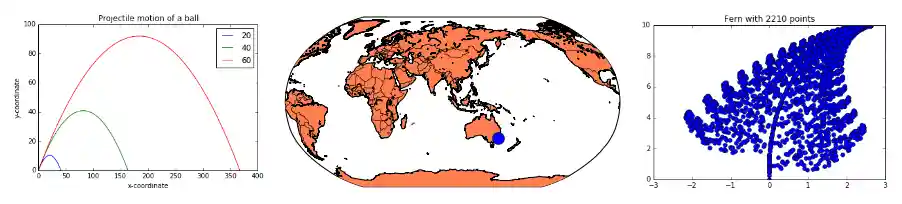
Can we do more than write smart calculators?
In [3]:
from IPython.display import YouTubeVideo
YouTubeVideo("8uWRVh58KdQ")
Out[3]:
The world is your graph paper
Showing places on a digital map (Notebook)
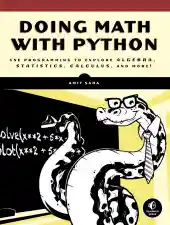
Book: Doing Math With Python
Overview
All of what I have discussed so far
In addition: Descriptive statistics, Sets and Probability, Random numbers
Published by No Starch Press in August, 2015.
Upcoming/In-progress translations: Simplified Chinese, Japanese, French and Korean.
Saha does an excellent job providing a clear link between Python and upper-level math concepts, and demonstrates how Python can be transformed into a mathematical stage. This book deserves a spot on every geometry teacher’s bookshelf.
Outstanding guide to using Python to do maths. Working back through my undergrad maths using Python.
Saha does an excellent job providing a clear link between Python and upper-level math concepts, and demonstrates how Python can be transformed into a mathematical stage.
This book is highly recommended for the high school or college student and anyone who is looking for a more natural way of programming math and scientific functions
As a teacher I highly recommend this book as a way to work with someone in learning both math and programming
Great base for the future
Statistics and Graphing data -> Data Science
Differential Calculus -> Machine learning
Application of differentiation
Use gradient descent to find a function's minimum value (Notebook)
Predict the college admission score based on high school math score
Use gradient descent as the optimizer for single variable linear regression model (Notebook)
Dialogue
Questions, Thoughts, comments, discussions?
Online
Twitter: @echorand
Email: amitsaha.in@gmail.com
PyCon Special!
Use PYCONMATH code to get 30% off "Doing Math with Python" from No Starch Press
(Valid from May 26th - June 8th)
Book Signing - May 31st - 2.00 PM - No Starch Press booth
Acknowledgements
PyCon US Education Summit team for inviting me
Thanks to PyCon US for reduced registration rates
Massive thanks to my employer, Freelancer.com for sponsoring my travel and stay