AC Power History
The
History of Alternating Current:
AC Power History and Timeline
Alternating current power drives our world today. AC power was the next logical step after DC power was established. The founders, developers, and visionaries of AC power are depicted below. Click on the pioneer to learn more, or see the list below.
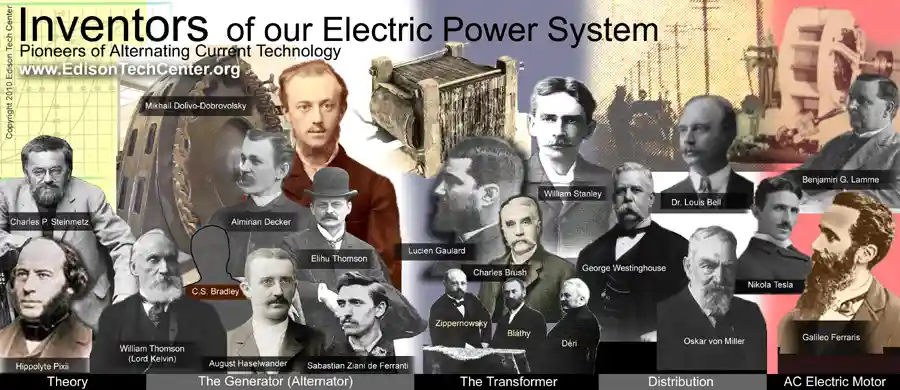
Below: The inventors, including the first year they developed the technology or improved the technology (most continued to improve the technology after that date, it was rarely a one time achievement)
Notes:
Stanley and Thomson had worked on motor, but it had a commutator.
Ferraris invented an AC three phase motor without commutator. Tesla
and Oliver Shallenberger also were working on the motor a couple of
months behind Ferraris.
To learn about important early sites and installations of AC power please see our History of Power Transmission and Electrification page:
AC Power Development Timeline:
1835 - Hippolyte Pixii builds the first alternator. Pixii builds a device with a rotating magnet. He doesn't know how to make his creation useful since all the other experimenters of the time were building DC devices. Others like Faraday and Henry were experimenting at the time with primitive electric motors using electromagnets.
1855
- Guillaume Duchenne uses alternating current in electrotherapeutic triggering of muscle contractions. (Paris, France) AC power is not viewed as useful for anything else at the time.1878
- Ganz Company starts working with single phase AC power systems in Budapest, Austro-Hungary1879 - London: Walter Baily makes a copper disc rotate using alternating current (this is a weak early AC motor) which was not effective for bearing any load.
The 1880s: This decade proved to be an exciting time for the development of electric power, read below to find out some of the major developments by year.
1882 - London, Sabastian Ferranti (Englishman with an Italian parent) works at Siemens Brothers firm in London with Lord Kelvin (William Thompson), and Ince. With the help of Lord Kelvin Ferranti pioneers early AC power technology, including an early transformer. Later on John Gibbs and Lucien Gaulard would base their designs off of Ferranti.
1884
1884 - Turin, Italy: Lucien Gaulard develops transformers
and the power transmission system from Lanzo to Turino. The demonstration
of AC power includes a 25 mile trolley with step down transformers
that allow low power Edison incandescent lights to light the path
along with arc lamps. Galileo Ferraris
was head of the Electrical Department. The next year Ferraris would
invent the polyphase motor.
1885
1885 - Ferraris conceives the idea of the first polyphase AC
motor: " In the summer of 1885 he conceived the idea that two
out-of-phase, but synchronized, currents might be used to produce
two magnetic fields that could be combined to produce a rotating field
without any need for switching or for moving parts. "
1885 - Elihu Thomson at Thomson-Houston starts experimenting with AC power (the first company in the US to start work on AC)
1885 - George Westinghouse is intrigued by AC power and buys North American rights to Gaulard and Gibbs system for $50,000
1885 - George Westinghouse orders a Siemens alternator (AC generator) and a Gaulard and Gibbs transformer. Stanley begin experimenting with this system.
1886
An important year for AC power
1886
- Great Barrington, Massachusetts
- the first full AC power system in the world is demonstrated
using step up and step down transformers. The system was built by
William Stanley and funded by Westinghouse.
1886 - November - Buffalo, New York receives the first commercial
AC power system in the USA. This system designed by George Westinghouse,
William Stanley, and Oliver
B. Shallenberger
1886 - William Stanley designs an improved version of the Siemens single phase alternator
1886 - Fall - Elihu Thomson's AC power system is rejected by the patent office. Westinghouse is already far ahead, having sold its system commercially already.
1886 - Nikola Tesla tries to sell his AC power system to investors in New York City, but it fails to be of interest in a city which is already heavily invested in DC power systems. Other inventors around the world also promoting AC power have similar problems. This is especially due to the fact that no one has yet to invent an AC electric motor which is efficient.
1886 - Otto Blathy comes to the USA and Thomas Edison buys options on the Z.B.D. Transformer. This would put him in the position to rival Westinghouse that controlled the Gaulard and Gibbs transformer patent. Later Edison decides that it is not worth going into AC and drops his options on the Z.B.D. Transformer.
1887
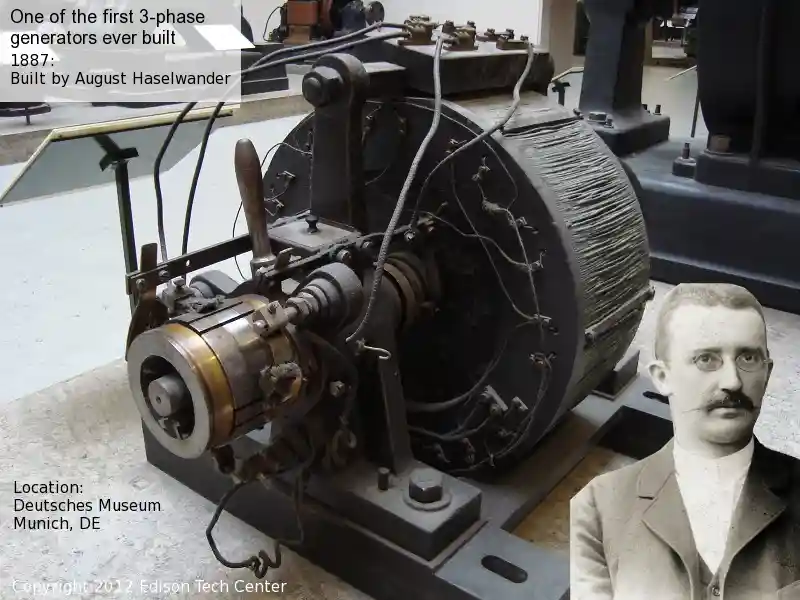
1887 - C.S. Bradley builds the first AC 3 phase generator. Up until this time Siemens and Westinghouse had been producing single phase AC generators. The 3 phase system would be a great improvement.
1887 - F. Augus Haselwander develops the first AC 3 phase generator in Europe. He is behind Bradley by a couple months and it is generally believed that he built his design independently of Bradley.
1887 - Sabastian Ferranti designs Depford Power Station in London. When it is completed in 1891 it would be an important early site in AC power history.
1888
1888
- Mikhail Dolivo-Dobrovsky in Germany builds his first AC polyphase
generator. He works for AEG. (Allgemeine Elektricitäts-Gesellschaft)l One
of the first three phase AC generators in the world. This one
was created for the Electrical Exposition in Frankfurt,Germany
in 1891. 1889 and Beyond
1888 - April - Galileo Ferraris
makes public his AC polyphase motor first conceived in 1885. His motor
works without a commutator, this development finally makes the AC
motor efficient, and therefore competitive with DC motors. The motor
report was first published at the Royal Academy of Sciences in Turin.
Westinghouse read the report of Ferraris and saw a chance for AC systems
to become much more marketable.
1888 - May 15 - Tesla
stands before the AIEE showing his polyphase motor. Elihu Thomson
was there and some in the group seemed to be impressed. Within
a week Westinghouse had agents meeting with Tesla and inspecting
his equipment, with an eye to forging an agreement about acquiring
patent rights.
Tesla's
progress on the motor is slightly ahead of Oliver Shallenberger's
3 phase electric motor. Shallenberger
was already working for Westinghouse.
Tesla claims he "dreamed up" the first polyphase motor before
Galileo Ferraris. Later
at a trial a US court sides
with Tesla despite the fact that Tesla has no proof besides witness
testimony.Read more here
William Stanley credits Tesla not with inventing the induction motor, but
taking Ferraris's work and fully realizing it's commercial potential. Tesla "neatly"
organized Ferraris's work into several patents and fully understood the invention.
He filed for copyright claiming the invention as his own.

1890 - December 17th Charles Proteus Steinmetz publishes introduces new mathematic solutions to solve puzzles of the behavior of AC power with his article: "Note on the Law of Hysteresis" in Electrical Engineer issue number 137.
1891 - Frankfurt, Germany: First distance power transmission (for electric power utility) Lauffen to Frankfurt 109 miles. The entire system was designed by Dobrovolsky from generator to electric motor. Many important figures of AC power were invited to the event, at the Congress Dinner Galileo Ferraris was hailed as “the father of three-phase current.”
1892
- Charles P. Steinmetz
goes before the AIEE and presents his latest paper on hysteresis.
More on hysteresis >
Steinmetz was the first person to
understand AC power from a mathematical point of view. After his paper
he is hired by General Electric Company and joins forces with Elihu
Thomson and William Stanley. Steinmetz would go on to improve and
troubleshoot future AC power systems.
Paper: On the Law of Hysteresis by Chas. Proteus Steinmetz. 1892. AIEE
1893 - Redlands
Power House - the first commercial installation of 3 phase AC
power, 40 Hz.
1895 - Folsom
Power House - The first installation of modern AC power in
the USA: 3 Phase AC at 60 Hz.
1897 - Mechanicville Power Station
- Charles P. Steinmetz experiments with a unique single phase AC power
transmission system.
1895 - Westinghouse builds the power system for the Adams
Power Station at Niagara Falls. Benjamin Garver Lamme
is the principal engineer of the operation. General Electric builds
the 25 mile power transmission system from the Niagara power house
to Buffalo, NY which is made operational in 1896.
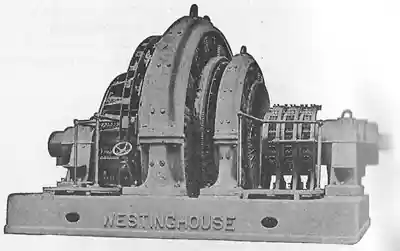
1900s - Three Phase AC power is fully established as the principle
source of power for the world
The development of electrical systems is a long and winding story which I have been researching for some 48 years. From the arc light systems, now forgotten, which played a major role; to the incandescent light systems of Edison and his competitors; through the development of power systems in the 20th century, much has been lost or forgotten. For example, the DC transmission concepts of Rene Thury are all but gone from most reference sources, as are those of later HVDC pioneers.
When it comes to polyphase AC, it appears that there is no true "father," but rather a number of researchers. William Stanley, the inventor of the transformer in the US was funded by George Westinghouse, an industrialist in railway air brake and signal systems who sought to improve upon the limitations of the DC systems. In Germany, Werner Siemens and others took the lead and produced the first long distance transmission of AC power 1891. AC motors were a different matter and the two leading figures on opposite sides of the Atlantic approached the problem independently.
Galileo Ferraris, a physicist at the university of Turin, described in 1885 the rotating field principle. but did not publish until 1888 by which time Nikola Tesla, having conceived the concept as well, had built machines for which patents were granted two weeks after the Ferraris publication. Tesla, seeking commercial development of an AC motor, developed a two phase system of supply. Tesla in a letter to Electrical World of May 25, 1889 recognized Ferraris' work and also cited the work of Oliver Shallenberger at Westinghouse. Shallenberger claimed to have intuited the principle after the observation of the twisting of a meter spring in the field of an AC coil. Electrical World of April 15, 1893 attempted to sort this issue by giving field theory primacy to Ferraris and multiphase system primacy to Tesla. Many, including Thomas Hughes in his book Networks of Power (Johns Hopkins U Press available from Amazon) believe that the issue of primacy of the idea will never be settled completely.
The Tesla system patents, though two phase, were the basis of the Westinghouse system at the Columbian Exposition and then at Niagara Falls. At the time, Tesla's work was the most recognized, having been the subject of demonstrations to the AIEE (now IEEE) and also at Columbia University and having undergone a thorough analysis by Prof. Anthony, director of the electrical engineering program at Cornell. Tesla was subsequently feted by the science academies of London and Paris.
Elihu Thomson of Thomson-Houston arrived at AC by another path. He produced initially AC arc light systems and formed the basis for the GE effort directed by Steinmetz, for GE was an amalgamation of Edison and Sprague companies funded through T-H capital. An article in the IEEE PES from several years ago detailed the birth of 3 phase systems through both AEG and Siemens efforts. In the United States, transmission range was a paramount concern and two phase systems prevailed for several decades wherever AC was supplied to the customer, thus the Tesla/Westinghouse system found a ready market. Three phase customer connections were not common until the 1920s; acceptance delayed by an inability to balance single phase customer loads on three phase AC lines. Only after the work of Charles Fortescu at Westinghouse and also that of Edith Clark at GE in the 1917-20 period were standardized equations available for the engineering of three phase distribution.As for other AC pioneers there are many - Frank Sprague, usually associated with railways, was an early proponent of AC research. Having the mathematical skills to devise the practical formulae to adapt the British Hopkinson 3 wire system to Edison lighting applications, he went on to develop practical industrial motors which made small utility companies financially viable with the establishment of a daytime motor load. As consultant to the Edison company in NY he recommended the use of AC in a large central plant to be distributed through "receiving" stations in which a transformer would step down the voltage and apply it to a "receiving motor" (reversed alternator) to drive DC generators. That report in September ,1886, but a few months after the first Stanley installation in Great Barrington, shows how universal was the thinking toward large scale AC generation. In that sense, the conversion substation could be said to have been invented by Sprague.
Thus the story has many participants, most of whom replicated another's work, sometimes simultaneously, often with no knowledge of the other. Even the standard power converter of the day had multiple fathers. Benjamin Lamme who led development of AC at Westinghouse described his rotary converter as the overlaying of a DC generator on a synchronous motor and believed it unique until he discovered that Charles Bradley (Bradley Electric was later acquired by of GE) had applied for a patent as well and there are indications that others had the same idea.
Much of the AC distribution refinement which led to the practical secondary distribution network was the work of Westinghouse engineers working with the United Electric Light & Power Co. in Manhattan to develop the first practical AC networks. But even at Westinghouse, it was researchers like Guido Pantaleoni, a student of Ferraris, that bridged the ocean by licensing the Gaulard and Gibbs, Siemens, and AEG patents. Sebastian Zinni DeFerrante, a leader in British arc lighting while still in his mid teens, had installed underground 10,000 volt lines in London as early as 1891.
Moreover, in an era prior to the refined understanding of inductance, capacitance and reactive power issues, and prior to the development of steel with magnetic characteristics ideal for alternating fields, the issue of the best frequency was another major concern. Benjamin Lamme's article on the Technical Story of the Frequencies (presented Jan 1918 to the Washington Section AIEE and available online under Google Books) is the best source of 1890s thinking on the issues.
Joseph Cunningham has contributed information for television programs and technical publications.
See more of his articles on the IEEE website. (IEEE membership may be required to view some material)Also join us on Facebook to give us feedback.
Connected Pioneers:
Related Topics:
Article by M.Whelan, Joseph Cunningham and S.Rockwell
Sources:
The Power Makers: Steam, Electricity, and the Men who Invented Modern
America
Networks of Power: Electrification in Western Society, 1880-1930 by
Thomas Parke Hughes
Galileo Ferraris Biography.
IncrediblePeople.com
Wikipedia: Benjamin G. Lamme,
Ferranti, Ferraris
Rochester Historical Society
Great Barrington Historical Society
Workshop of Engineers. John Miller. 1953
Interview with Tom Blalock. Edison Tech Center 2014.
"On the Law of Hysteresis" by Charles Proteus Steinmez. AIEE. 1892
For use of Edison Tech Center images and videos see our licensing agreement.