Galileo Ferraris - Engineering Hall of Fame
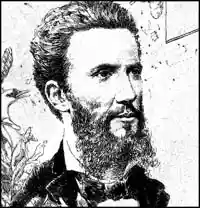
Galileo
Ferraris
Physicist, Pioneer of Alternating Current Systems (1847-1897)
Inventor of the Induction Motor
"Father of three-phase current" - Electrotechnical Congress,
Frankfurt 1891
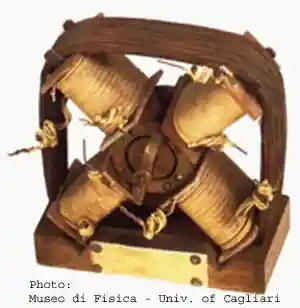
Galileo Ferraris of Turin, Italy is one of the greatest unsung heroes of AC power systems. At one time European newspapers had stated that Ferraris's work on the induction motor and power transmission systems was "One of the greatest inventions of any age". He was involved in the most important early experiments in AC power distance transmission which occurred in Germany and Italy in the early 1880s. His work helped others like Mikhail Dobrovsky and C.P. Steinmetz further develop polyphase electric power. Later on in the 1890s other electrical pioneers rose to fame and the fame of Ferraris gradually faded. One of the most notable inventions of Ferraris was the AC motor without a commutator (Induction Motor). This efficient motor made AC power practical for many uses and launched AC power as the most popular form of electric power.
Ferraris was a scientist, not an entrepreneur. He freely invited visitors to come in and see his lab. American AC pioneer William Stanley testifies seeing his work on the polyphase motor first hand in 1885. Instead of patenting his work, Ferraris did the opposite, he published it to the world. That is how he revealed his greatest single invention: the induction motor in 1888.
Ferraris was inspired by the work of previous pioneers: Walter Baily, Gaulard and Gibbs, Ganz Company and Ferranti. Ferraris himself became a leader and teacher of electric theory and design. He lead many organizations in Italy and was regarded as the foremost authority in electricity in Italy. One of his students Guido Pantaleoni went on to work for Westinghouse and be an instrumental link for licensing patents from Europe.
Galileo Ferraris Life Timeline:
-Born
in Livorno Vercellese (now named Livorno Ferraris)(60km NW of Turin)
1847.
-Bachelor of Mathematics and Civil Engineering from the University and
Engineering School of Turin 1869.
-1879 became a professor of technical physics at the Museo Industrial
-1881 First big exposure to the new field of electricity at the
International Electrical Exhibition of Paris 1881
-1882 He founded the
School of Electrotechnology with Laborary at his workplace (Museo Industriale)
-1883 Attended the Electrical Exhibition in Vienna, Austro-Hungary.
-1884 He hosted the International Electrical Exhibition in
Turin, Italy. During this he worked with Gaulard and Gibbs transformers
during a groundbreaking new experiment in AC power: a 40 kilometer transmission
line from Lanzo Torinese to Turin. This first long distance transmission
set the stage for later work in the next few years.
-1885
discovered the rotary magnetic field
-1885 Conceived
of the idea of the AC motor, worked on it for the next 3 years.
-1888 April 22 - Published a paper in the Royal Academy of Sciences
about the AC polyphase motor. Turin.
-1888 Ferraris leads a number of discoveries and writes 10 papers
on electromagnetism
-1888 December 8 - Nikola Tesla publishes his AC motor design.
This later leads to a court case. See article below "Who
Invented the Polyphase Electric Motor?".
-1891 Ferraris was recognized as the "Father of three-phase
current" by all at the Congress dinner at the Frankfurt Elektrotechnial
Exposition.
-1896 Joined the Italian Electrotechnical Association
-1897 Death
-1899 Most of Ferraris's original models and motors were destroyed
in a fire (along with Volta's original devices) at the National Electrical
and Silk Products Exhibition in Como, Italy.
-1942 The damaged remains of Ferraris's original works were destroyed
completely at the Politecnico di Torino during a World War 2 bombing.
 |
|
Who
Invented the Polyphase Electric Motor?
After Galileo Ferraris died in 1897, Westinghouse(with Nikola
Tesla) manage to rewrite history using the US court system.
A perspective by M.W., part of the Engineering
Forum.
Galileo Ferraris presented his theory of
a polyphase electric motor 8 months prior to Nikola Tesla applying
for a patent on the same technology, yet in the world of the 21st
century Telsa has received all the credit, how is this possible?
This situation is comparable to the situation in software today.
Some designers give away programs free via opensource, while others
make massive amounts of money off of the same technology. Who
is remembered 100 years later? Ferraris was a scientist, not an
entrepreneur, he published his results and invited strangers from
around the world to come and see his lab. Tesla and Westinghouse
had other motives.
We will look at the court cases that changed history and buried Ferraris in the murky depths of history. These cases were between competing corporations. This was not a competition between Ferraris and Tesla in court. Other corporations stated that Ferraris had published the polyphase motor before Tesla, therefore Tesla and Westinghouse could not claim patent infringement.
Court Cases where Tesla had to prove he invented
the motor first:
1901 - Westinghouse Electric Mfg. Co. vs. New England Granite
Co.
1905 - Westinghouse vs. Dayton Fan and Motor Company
The first court case was first held in Catskill, New York by the Circuit Court, The first case ruled in favor of Tesla. The second court decision in the Circuit Court of Appeals reversed the decision, ruling in favor of Ferraris, with proof that a magazine had published Galileo Ferraris's work " by which Prof. Galileo Ferraris, fully described and disclosed the system covered by the patents in suit." - Hazel, District Judge. The Federal Reporter Volume 129. page 213
The Final Decision 1905:
Ferraris officially lost recognition as the first inventor of the polyphase motor in the final court battle, this was ONLY due to a claim by three of Tesla's colleagues who were witnesses that Tesla had conceived the motor in fall of 1887, prior to Ferraris's publication. Tesla claimed he produced a prototype motor, almost completely destroyed by fire. He claims the motor had come from his New York City lab which had caught fire in 1895. Somehow that motor was the only one to survive (hmmm), all others had been completely destroyed... and there was no way to prove the motor's age. Testimony depended entirely on the three witnesses, one of which was not valuable because he had no knowledge of how electricity worked. The judges themselves were barely qualified to understand the technology and found the exhaustively long technical descriptions by experts not much help in the decision. The judges had to weigh the weak witness evidence which from his opinion weighed in favor of Tesla. What about witnesses from Italy?
What about Ferraris? The man was dead and could not provide proof, or discussion, or personal perspective, or physical evidence to defend himself the way that Tesla could. That doesn't sound quite fair.
William Stanley, one of America's earliest AC pioneers found the ongoing dispute disturbing, stating about the prior court case: "[Judges Townsend, Wallace, and Cox] after a most exhaustive and thorough trial, lasting four years, decides that Mr. Tesla failed to prove invention prior to the published description of the same invention made by Professor Ferraris, of Turin, Italy"
"Professor Galileo Ferraris held the chair of physics at the Academy of Sciences in Turin for many years. In Europe he is universally acknowledged to be the original inventor of the induction motor and power transmission system,"
Stanley also stated: " All foreign scientific publications speak of the Ferraris motor, the Ferraris principle and the Ferraris system, for he invented , constructed, and described his work several years before Mr. Tesla claims to have devised it."
And the most powerful statement by Stanley: "I myself have seen the original motors, models, and drawings made by Ferraris in 1885, have personally talked with the men who saw these models in operation and heard Ferraris explain them at that date." - from a letter to the Electrical Review on March 16, 1903 [Electrical Review, Volume 42. 1903. Pg. 415]
Stanley would know because Westinghouse hired him in 1885 to study the Gaulard and Gibbs transformers used by Ferraris at the experimental AC systems in 1884 and 1885 at Turin. Westinghouse had paid for use of the patents and assigned Stanley in charge of building a new, better AC system, which he did in 1886 at Great Barrington.
The gravity of the situation:
If Ferraris had been determined to be first, Westinghouse stood
to lose millions, and loose control of it's most valuable patents.
How much is it worth to them. Westinghouse had a reputation as
being "tricky" and "unethical", this was the
viewpoint by employees and former employees, for whatever that
hearsay is worth.
Some critical questions to ask would be:
How much money does it cost to buy a witness in the 1901?
How much coaching does it take to adjust his story of first seeing
the electric motor from 1888 to the year before?
(Speaking of witnesses Mr. Brown, Mr. Nellis)
How much (from a dollar standpoint) would a pro-Ferraris decision
would have hurt Westinghouse?
Tesla claimed he worked on the motor with a Mr. Szigeti, how come
the Mr. Szigeti could not be found for the trial?
Why did the burned motor prototype survive the fire by coincidence
yet all the other motors were completely destroyed?
In Conclusion:
So... Who invented the polyphase electric motor first? Does it matter? Yes. Although Tesla deserves a great deal of credit, he and Westinghouse lawyers do not have the right to rewrite history in the name of corporate profits. Galileo Ferraris has been erased from the public eye, but hopefully that will change.
This article above represents the viewpoint of the individual author, not the publishing organization. If you wish to write an article, please contact us.
See more articles and opinions at our Engineering
Forum
Also join us on Facebook
to give us feedback.
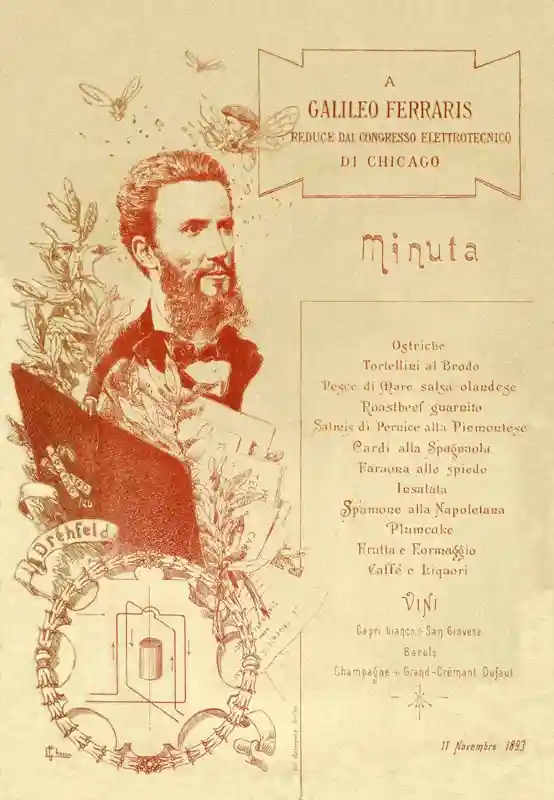
A dinner in honor of Galileo Ferraris, above is the menu, from 1893.
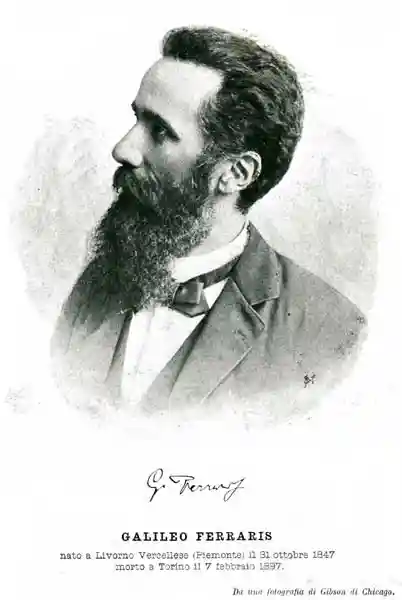
The most common photo of Ferraris above. This photo was taken in Chicago most likely during the International Electrical Congress there in 1893.
Video of the assembly of a large induction motor:
Coils are shown being installed. See that the rotor is inserted in the stator with no brushes needed.