Also found in: Dictionary.
For the spider genus, see Cithaeron (spider).
| Cithaeron | |
|---|---|
Cithaeron Location of Mount Cithaeron in Greece | |
| Highest point | |
| Elevation | 1,409 m (4,623 ft) |
| Coordinates | 38°11′03″N 23°14′57″E / 38.18417°N 23.24917°E |
| Geography | |
| Location | Attica, Greece Boeotia, Greece |
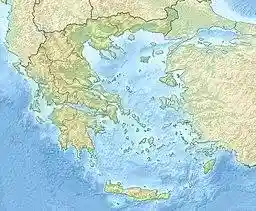

Cithaeron or Kithairon (Κιθαιρών, -ῶνος) is a mountain and mountain range about ten miles (sixteen kilometres) long, in central Greece. The range is the physical boundary between Boeotia in the north and Attica in the south. It is mainly composed of limestone and rises to 1,409 metres (4,623 ft). The north-east side of the range is formed by the mountain Pastra.
The range was the scene of many events in Greek mythology and was especially sacred to Dionysus.[1] In Euripides' Bacchae, Dionysus carries out his dances and rites with his bacchants, his priestesses, on Cithaeron.[2] Oedipus was exposed on the mountain, while Actaeon and Pentheus were both dismembered on its slopes. It was also the place where Heracles or Alcathous hunted and killed the Lion of Cithaeron.
In historic times, the mountain acted as a backdrop to the Battle of Plataea of 479 BC[1] and was the scene of much skirmishing before the battle itself. In later times fortifications were built both at Plataea and Erythrai as the mountain formed the disputed natural border between Athens and Thebes.
The people of Plataea also personified the mountain as their primal king: "But the Plataeans know of no king except Asopus and Cithaeron before him, holding that the latter gave his name to the mountain, the former to the river". (Pausanias 9.1.2)
In the Middle Ages, the village of Myoupolis on its slopes was the site of a monastery founded by Meletios the Younger.[3]
References
- ^ a b Gardner, Ernest Arthur (1911). "Cithaeron" . In Chisholm, Hugh (ed.). Encyclopædia Britannica. 6 (11th ed.). Cambridge University Press. p. 395.
- ^ Euripides, Bacchae, 62-63: 'For my part I will go to the glens of Cithaeron, where the bacchants are, and take part with them in their dances.'
- ^ P. Armstrong and A. Kirby, "Text and Stone: Evergetis, Christodoulos and Meletios", in M. Mullett and A. Kirby (eds.), The Theotokos Evergetis and Eleventh-Century Monasticism (Belfast: Belfast Byzantine Enterprises, 1994), p. 153.
External links
This article is copied from an article on Wikipedia® - the free encyclopedia created and edited by its online user community. The text was not checked or edited by anyone on our staff. Although the vast majority of Wikipedia® encyclopedia articles provide accurate and timely information, please do not assume the accuracy of any particular article. This article is distributed under the terms of GNU Free Documentation License.