Also found in: Medical.
 | |
 | |
| Clinical data | |
|---|---|
| AHFS/Drugs.com | International Drug Names |
| ATC code | |
| Identifiers | |
IUPAC name
| |
| CAS Number | |
| PubChem CID | |
| ChemSpider | |
| UNII | |
| KEGG | |
| ChEMBL | |
| CompTox Dashboard (EPA) | |
| ECHA InfoCard | 100.010.238  |
| Chemical and physical data | |
| Formula | C14H20ClN3O3S |
| Molar mass | 345.84 g·mol−1 |
| 3D model (JSmol) | |
SMILES
| |
| |
| (verify) | |


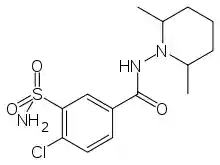
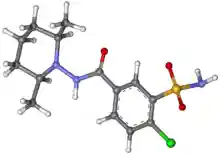
Clopamide (trade name Brinaldix) is a piperidine diuretic.[1]
Mechanism of action
Clopamide is categorised as a thiazide-like diuretic and works in similar way as the thiazide diuretics do. It acts in the kidneys, at the distal convoluted tubule (DCT) of the nephron where it inhibits the sodium-chloride symporter. Clopamide selectively binds at the chloride binding site of the sodium-chloride symporter in the PCT cells on the luminal (interior) side and thus interferes with the reabsorption of sodium chloride, causing an equiosmolar excretion of water along with sodium chloride.
References
- ^ McNeil JJ, Conway EL, Drummer OH, Howes LG, Christophidis N, Louis WJ (September 1987). "Clopamide: plasma concentrations and diuretic effect in humans". Clinical Pharmacology and Therapeutics. 42 (3): 299–304. doi:10.1038/clpt.1987.151. PMID 3621784.
This article is copied from an article on Wikipedia® - the free encyclopedia created and edited by its online user community. The text was not checked or edited by anyone on our staff. Although the vast majority of Wikipedia® encyclopedia articles provide accurate and timely information, please do not assume the accuracy of any particular article. This article is distributed under the terms of GNU Free Documentation License.