Also found in: Dictionary, Thesaurus, Encyclopedia.
This article is about the dessert. For the similar Slavic beverage, see Kompot. For other uses, see Compote (disambiguation).
 | |
| Alternative names | compost (Middle English) |
|---|---|
| Type | Dessert |
| Created by | |
| Serving temperature | Warm or chilled |
| Main ingredients | Fruit, sugar syrup, spices |
| |


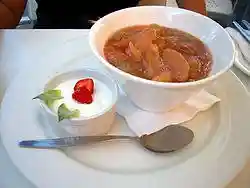
Compote or compôte[1] (French for mixture) is a dessert originating from medieval Europe, made of whole or pieces of fruit in sugar syrup. Whole fruits are cooked in water with sugar and spices. The syrup may be seasoned with vanilla, lemon or orange peel, cinnamon sticks or powder, cloves, other spices, ground almonds, grated coconut, candied fruit or raisins. The compote is served either warm or cold.
History
Compote conformed to the medieval belief that fruit cooked in sugar syrup balanced the effects of humidity on the body. The name is derived from the Latin word compositus, meaning mixture. In late medieval England it was served at the beginning of the last course of a feast (or sometimes the second out of three courses), often accompanied by a creamy potage.[2][3][4] During the Renaissance, it was served chilled at the end of dinner. Because it was easy to prepare, made from inexpensive ingredients and contained no dairy products, compote became a staple of Jewish households throughout Europe.[5] In modern French, the term refers to usually unsweetened fruit purée without fruit chunks, such as applesauce. Today, it is widespread and often served in lieu of vegetables in Northern European countries such as Germany, Holland, Belgium; in Scandinavia; and in France. The Dutch/Flemish word is appelmoes.
Variations
The dessert may be topped with whipped cream, cinnamon, or vanilla sugar. The syrup may be made with wine, as in one early 15th-century recipe for pear compote.[3] Other variations include using dried fruit that have been soaked in water in which alcohol can be added, for example kirsch, rum or Frontignan.[6]
See also
- Fruit fool
- Kompot
- Kissel
- Tomato compote
- Tong sui
- List of French desserts
References
- ^ "Compôte recipes - BBC Food". www.bbc.co.uk. Retrieved 2019-12-10.
- ^ Constance B. Hieatt and Sharon Butler, ed. Curye on Inglysch. The Early English Text Society, New York, 1985.
- ^ a b Thomas Austin, ed. Two Fifteenth-Century Cookery-Books. The Early English Text Society, New York, 1888 (reprinted 1964).
- ^ Information on the Coronation feast of Richard III, taken from Sutton, Anne F. and PW Hammond, The Coronation of Richard III: the Extant Documents, New York; St. Martin's Press, 1983.
- ^ Be Merry / A taste of Poland, Haaretz
- ^ Robuchon, Joël, "Members of the Gastronomic Committee". Larousse Gastronomique. New York: Clarkson Potter/Publishers, 2001, p. 322-323.
This article is copied from an article on Wikipedia® - the free encyclopedia created and edited by its online user community. The text was not checked or edited by anyone on our staff. Although the vast majority of Wikipedia® encyclopedia articles provide accurate and timely information, please do not assume the accuracy of any particular article. This article is distributed under the terms of GNU Free Documentation License.