CROCUS
For the genus of flowering plants, see crocus.
CROCUS is a research reactor at École Polytechnique Fédérale de Lausanne, a research institute and university in Lausanne, Switzerland.
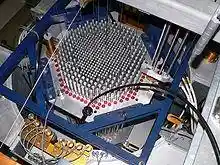
CROCUS' core
The uranium nuclear reactor core is in an aluminium container that measures 130 centimetres (51 in) across with 1.2-centimetre (0.47 in)-thick walls. The aluminum vessel is filled with demineralized light water to serve as both a neutron moderator and a neutron reflector.[1]
Power output is controlled either by adjusting the water level in the reactor—with a ±0.1-millimetre (0.0039 in) level of control, or with the adjustment of two boron carbide (B4C) control rods—with a ±1-millimetre (0.039 in) level of finesse. The reactor has six separate safety systems: two cadmium shields and four storage tanks, any of which can shut down the reaction in less than a second.[1]
CROCUS has a license to produce 100 watts (0.13 hp) or a neutron flux of ~2.5 × 109 cm-2s-1 at the core's center.[1]
References
- ^ a b c "CROCUS Reactor — LRS". École Polytechnique Fédérale de Lausanne. Archived from the original on 12 December 2018. Retrieved 12 December 2018.
See also
 Media related to CROCUS at Wikimedia Commons
This article is copied from an article on Wikipedia® - the free encyclopedia created and edited by its online user community. The text was not checked or edited by anyone on our staff. Although the vast majority of Wikipedia® encyclopedia articles provide accurate and timely information, please do not assume the accuracy of any particular article. This article is distributed under the terms of GNU Free Documentation License.