Deep Space 2
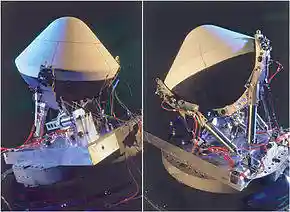 DS2 probe with heatshield and mounting | |||||||||||
| Mission type | Lander / impactor | ||||||||||
|---|---|---|---|---|---|---|---|---|---|---|---|
| Operator | NASA / JPL | ||||||||||
| Website | nmp.jpl.nasa.gov/ds2/ | ||||||||||
| Mission duration | 334 | ||||||||||
| Spacecraft properties | |||||||||||
| Manufacturer | NASA Jet Propulsion Laboratory | ||||||||||
| Launch mass | 2.4 kg (5.3 lb) each | ||||||||||
| Power | 300mW Li-SOCl2 batteries | ||||||||||
| Start of mission | |||||||||||
| Launch date | 20:21:10, January 3, 1999 (UTC) | ||||||||||
| Rocket | Delta II 7425 | ||||||||||
| Launch site | Cape Canaveral AFS SLC-17 | ||||||||||
| End of mission | |||||||||||
| Disposal | failure in transit | ||||||||||
| Last contact | 20:00, December 3, 1999 (UTC)[1] | ||||||||||
| Mars impactor | |||||||||||
| Spacecraft component | Amundsen and Scott | ||||||||||
| Impact date | ~20:15 UTC ERT, December 3, 1999 | ||||||||||
| Impact site | 73°S 210°W / 73°S 210°W (projected) | ||||||||||
| Transponders | |||||||||||
| Band | S-band | ||||||||||
| Bandwidth | 8 kbit/s | ||||||||||
| |||||||||||
 Mars Surveyor 98 mission logo | |||||||||||
Deep Space 2 was a NASA probe part of the New Millennium Program. It included two highly advanced miniature space probes that were sent to Mars aboard the Mars Polar Lander in January 1999.[1] The probes were named "Scott" and "Amundsen", in honor of Robert Falcon Scott and Roald Amundsen, the first explorers to reach the Earth's South Pole. Intended to be the first spacecraft to penetrate below the surface of another planet, after entering the Mars atmosphere DS2 was to detach from the Mars Polar Lander mother ship and plummet to the surface using only an aeroshell impactor, with no parachute. The mission was declared a failure on March 13, 2000, after all attempts to reestablish communications following the descent went unanswered.[2]
The Deep Space 2 development costs were US$28 million.[3]
Overview

Deep Space 2 project manager Sarah Gavit with the engineering hardware of the probe
Deep Space 2, also known as "Mars Microprobe,"[2] was the second spacecraft developed under the NASA New Millennium Program to flight-test advanced technologies concepts for space missions. The purpose of the program was to do high-risk technology demonstration, with a motto "Taking risks to reduce future danger."[4] The project was led and operated by the Jet Propulsion Laboratory in Pasadena, with contributions from The University of Arizona, New Mexico State, Northern Arizona University, the Air Force Research Laboratory, and others.[5]
The Deep Space 2 mission was intended to do an engineering validation of the concept of a penetrator probe, impacting the planet at high velocity, instead of slowing down for a soft landing as done by the probes conventionally used for planetary exploration. The penetrator concept is potentially a lower-cost approach, and has a proposed advantage of giving access to the subsurface of the planet being studied (in this case, Mars.)
Though the primary objective was to validate the technology, the probes also had goals for science analysis at Mars. These goals were “1) to derive the atmospheric density, pressure, and temperature throughout the entire atmospheric column, 2) to characterize the hardness of the soil and possibly the presence of layers at a scale of tens of centimeters, 3) to determine if ice is present in the subsurface soil, and, 4) to estimate the thermal conductivity of the soil at depth.”[6] The eventual goal for such probes was to deploy networks “around a planet using no more resources than a single landing under conventional assumptions.”[7]
The probes were launched with the Mars Polar Lander on January 3, 1999 on a Delta II 7425 Launch Vehicle.
Spacecraft
Each probe[8][6] weighed 2.4 kg (5.3 lb) and was encased in a protective aeroshell. They rode to Mars aboard another spacecraft, the Mars Polar Lander.
Upon arrival near the south polar region of Mars on December 3, 1999,[1] the basketball-sized shells were released from the main spacecraft, plummeting through the atmosphere and hitting the planet's surface at over 179 m/s (590 ft/s). On impact, each shell was designed to shatter, and its grapefruit-sized probe was to punch through the soil and separate into two parts. The lower part, called the forebody, was designed to penetrate as far as 0.6 meters (2 ft 0 in) into the soil. It contained the primary science instrument onboard, the Evolved Water Experiment.[6] The upper part of the probe, or aftbody, was designed to remain on the surface in order to transmit data through its UHF antenna to the Mars Global Surveyor spacecraft in orbit around Mars. The Mars Global Surveyor would act as a relay in order to send the data collected back to Earth. The two sections of the probe were designed to remain connected via a data cable.[2]
Science Instruments
The probes are each equipped with five instruments to enable analysis of the atmosphere, surface, and subsurface.
• Descent accelerometer: The descent accelerometer was a commercially available sensor meant to measure accelerations from drag during descent. Its readings could “be used to derive a density profile of the Martian atmosphere” based on the acceleration data combined with knowledge of the probe’s speed and ballistic coefficient. [9]
• Impact accelerometer: The impact accelerometer was built with a range of ±120,000 g for the large expected acceleration on impact with Mars’ surface. [9]
• Meteorological sensor: provides atmospheric pressure and temperature data at the landing site. This sensor was located on the back of the probe so that it would stay above the surface after impact. It was sampled and recorded by the telecommunications “which enables the acquisition of meteorological data in the event that the microcontroller failed during the impact.”[9]
• Soil Thermal Conductivity Temperature Sensors: Twin platinum resistor temperature sensors would determine rates of cooling in the forebody once submerged in the surface. [9]
• Evolved Water Experiment: A small sample collection system in the forebody would bring Martian regolith into a heating chamber. The sample would then be heated to allow spectroscopy measurements on the resulting vapor using a miniaturized tunable diode laser. The Evolved Water Experiment was the primary instrument onboard the probe. [6]
New Technologies: High Impact and Low Temperature Electronics
Custom electronics and batteries were designed for the Deep Space 2 probes to survive extremely high accelerations on impact with the surface of Mars and the cold temperatures that it would experience once in operation. Both the electronics and the custom cells were required to survive an impact on the order of 80,000 g and operational temperatures as low at -80°C. [10] Additionally, as much as a 30,000 g difference in acceleration was possible between the forebody and aftbody.[11]
Batteries
Together with Yardney Technical Products, JPL designed a battery with two non-rechargeable 6-14V cells using Lithium-Thionyl Chloride (LI-SOCl2) chemistry to survive the expected conditions. The batteries were impact tested and also thermally cycled during development. [11]
Electronics Packaging
Due to the probe’s form factor and the harsh survivability conditions, JPL used novel techniques to secure the onboard electronics. The techniques included chip-on-board (COB) technology to improve packing density.[12] It also used a 1-meter flexible umbilical cable to connect the forebody penetrator that would be displaced upon impact. Mechanical (non-functioning) models were impact tested before launch to determine if the structures would survive. [12]
Mission failure
The probes reached Mars along with the Mars Polar Lander mission, apparently without incident, but communication was never established after impact. It is not known what the cause of failure was.
A failure review board was commissioned to report on the failures of the Mars Polar Lander and Deep Space 2 probes.[13] The review board was unable to identify a probable cause of failure,[14] but suggested several possible causes:
- The probe radio equipment had a low chance of surviving the impact.
- The batteries may have failed on impact.
- The probes may have bounced on impact.
- The probes may have landed on their sides, resulting in bad antenna performance or radio link geometry.
- The probes may simply have hit ground that was too rocky for survival.
- The batteries on the probes, which had been charged prior to launch almost a year earlier, might not have retained sufficient power.
The board concluded that the probes and their components were not tested adequately before launch.[13][14]
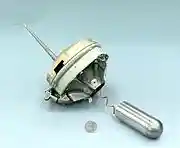
Deep Space 2 penetrator

Deep Space 2 surface element
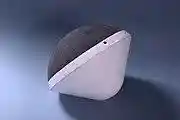
DS-2 entry aeroshell
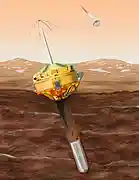
Visualization of Deep Space 2 as deployed after penetration
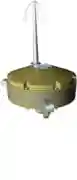
DS2 functional animation
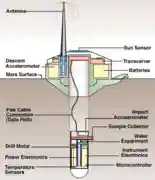
DS2 probe components
See also
- Exploration of Mars
- Deep Space 1
- InSight – successful Mars lander carrying similar burrowing probe with temperature sensor
- List of missions to Mars
- List of spacecraft powered by non-rechargeable batteries
References
- ^ a b c Davis, Phil; Munsell, Kirk (January 23, 2009). "Missions to Mars: Deep Space 2 - Key Dates". Solar System Exploration. NASA. Archived from the original on April 20, 2009. Retrieved July 8, 2009.
- ^ a b c "Deep Space 2 (DEEPSP2)". NSSDC Master Catalog. NASA - National Space Science Data Center. 2000. Retrieved July 8, 2009.
- ^ "Mars Polar Lander Mission Costs". The Associated Press. 1999-12-08. Retrieved 2020-09-30.
- ^ Redd, Nola Taylor (February 12, 2019). "NASA's New Millennium Program: Taking Risks to Reduce Future Danger". Space.com. Retrieved 6 March 2019.
- ^ "1998 Mars Missions Press Kit" (Press release). National Aeronautics and Space Administration. December 1998. Archived from the original (PDF) on . Retrieved 2020-11-05.
- ^ a b c d Smrekar, Suzanne; Catling, David; Lorenz, Ralph; Magalhães, Julio; Moersch, Jeffrey; Morgan, Paul; Murray, Bruce; Presley, Marsha; Yen, Albert; Zent, Aaron; Blaney, Diana (1999). "Deep Space 2: The Mars Microprobe Mission". Journal of Geophysical Research: Planets. 104 (E11): 27013–27030. Bibcode:1999JGR...10427013S. doi:10.1029/1999JE001073. ISSN 2156-2202.
- ^ Hecht, Michael H. (1996-01-15). "Microinstruments and Micro Electromechanical Systems in Support of Earth and Space Science in the New Millenium".
- ^ Gavit, Sarah A.; Powell, George (1996). "The new Millennium Program's Mars Microprobe Mission". Acta Astronautica. 39 (1–4): 273–280. Bibcode:1996AcAau..39..273G. doi:10.1016/S0094-5765(96)00145-2. ISSN 0094-5765.
- ^ a b c d Blue, R. C. (1998-04-27). "Mars Microprobe Project Instrumentation Package".
- ^ Russell, P.G.; Carmen, D.; Marsh, C.; Reddy, T.B.; Bugga, R.; Deligiannis, F.; Frank, H.A. (1998). "Development of a lithium/thionyl chloride battery for the Mars Microprobe Program". Thirteenth Annual Battery Conference on Applications and Advances. Proceedings of the Conference. IEEE: 341–346. doi:10.1109/bcaa.1998.653891. ISBN 0-7803-4098-1. S2CID 93199878.
- ^ a b Rutnakumar, B.; Frank, H.; Kindler, A.; Deligiannis, F.; Davies, E.; Blakevoort, J.; Surampudi, S. (1998-10-27). "DS2 Mars Microprobe Battery".
- ^ a b Arakaki, G.; D'Agostino, S. (March 1999). "New Millennium DS2 electronic packaging an advanced electronic packaging "sandbox"". 1999 IEEE Aerospace Conference. Proceedings (Cat. No.99TH8403). 2: 205–213 vol.2. Bibcode:1999aero....2..205A. doi:10.1109/AERO.1999.793162. ISBN 0-7803-5425-7. S2CID 96712180.
- ^ a b "Report on the Loss of the Mars Polar Lander and Deep Space 2 Missions" (PDF). Jet Propulsion Laboratory. 22 March 2000.
- ^ a b Young, Thomas (March 14, 2000). "Mars Program Independent Assessment Team Summary Report". Draft #7 3/13/00. House Science and Technology Committee. Retrieved April 22, 2009.
Bibliography
- JPL, Deep Space 2 Fact Sheet
- NSSDC Data Archive, Deep Space 2
- "Press Kit: 1998 Mars Missions" (.PDF) (Press release). National Aeronautics and Space Administration. December 8, 1998. Retrieved April 22, 2009.
External links
- Deep Space 2 website at JPL


Curiosity (2012) →

Rosalind Franklin rover (2023) ↓
←Perseverance rover (2021)

Mars 6 (1973) →
Polar Lander (1999) ↓
↑ Opportunity (2004)

Schiaparelli EDM (2016) →

Spirit (2004) ↑
↓Tianwen-1 rover (2021)

This article is copied from an article on Wikipedia® - the free encyclopedia created and edited by its online user community. The text was not checked or edited by anyone on our staff. Although the vast majority of Wikipedia® encyclopedia articles provide accurate and timely information, please do not assume the accuracy of any particular article. This article is distributed under the terms of GNU Free Documentation License.