IBM eServer
(redirected from Eserver)
This article is about the IBM family of computer servers. For the open access electronic text archive, see EServer.org.
 | |
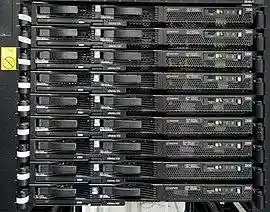 IBM xSeries 336 servers | |
| Developer | IBM |
|---|---|
| Type | Desktop server or Rack-mounted server |
| Release date | 2000 |
| Discontinued | 2006 |
IBM eServer was a family of computer servers from IBM Corporation. Announced in the year 2000, it combined the various IBM server brands (AS/400, Netfinity, RS/6000, S/390) under one brand.[1] The various sub-brands were at the same time rebranded from:
- IBM RS/6000 to IBM eServer pSeries, p for POWER
- IBM AS/400 to IBM eServer iSeries, i for Integrated
- IBM Netfinity to IBM eServer xSeries, x for eXtended architecture (with respect to "commodity" Intel-based servers)
and the IBM System/390 was replaced by the 64-bit IBM eServer zSeries, z for Zero downtime.
The RS/6000 SP supercomputer line was also replaced by Blue Gene platform.
Discontinuation
In 2005 announced a new brand, IBM System as an umbrella for all IBM server and storage brands. The name change was finished in 2006 when the IBM xSeries became the IBM System x (then Lenovo System x).
- IBM eServer zSeries became IBM System z
- IBM eServer pSeries became IBM System p
- IBM eServer iSeries became IBM System i
- IBM eServer xSeries became Lenovo System x
- IBM TotalStorage became IBM Storage
- IBM eServer BladeCenter became IBM BladeCenter
- IBM eServer 1350 became IBM System Cluster 1350
References
- ^ Vijayan, Jaikumar (October 4, 2000). "IBM launches new mainframe amid rebranding effort". Computerworld.
External links
| Preceded by IBM S/390 | IBM System z 2000 - 2008
| Succeeded by IBM zEnterprise System | ||||||||||||
| Preceded by IBM RS/6000 | IBM System p 2000 - 2008 | Succeeded by IBM Power Systems | ||||||||||||
| Preceded by IBM AS/400 | IBM System i 2000 - 2008 | |||||||||||||
| Preceded by IBM Netfinity | IBM System x 2000 - 2014 | Succeeded by Lenovo System x | ||||||||||||
| Preceded by none | IBM BladeCenter 2000 - 2012
| Succeeded by IBM Flex System | ||||||||||||
| Succeeded by IBM iDataPlex | ||||||||||||||
This article is copied from an article on Wikipedia® - the free encyclopedia created and edited by its online user community. The text was not checked or edited by anyone on our staff. Although the vast majority of Wikipedia® encyclopedia articles provide accurate and timely information, please do not assume the accuracy of any particular article. This article is distributed under the terms of GNU Free Documentation License.