Gudea
| Gudea ������ | |
|---|---|
| Ruler of Lagash | |
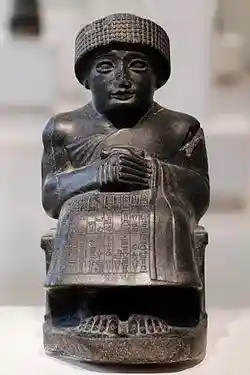 Diorite statue of Gudea, prince of Lagash, dedicated to the god Ningishzida, Louvre Museum. | |
| Reign | c. 2144–2124 BC |
| Predecessor | Ur-Baba |
| Successor | Ur-Ningirsu |
| Dynasty | Kings of Lagash |
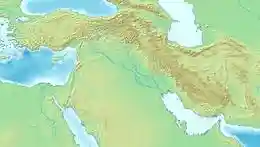

Gudea (Sumerian: ������, Gu3-de2-a) was a ruler (ensi) of the state of Lagash in Southern Mesopotamia who ruled c. 2144–2124 BC. He probably did not come from the city, but had married Ninalla, daughter of the ruler Ur-Baba (2164–2144 BC) of Lagash, thus gaining entrance to the royal house of Lagash. He was succeeded by his son Ur-Ningirsu. Gudea ruled at a time when the center of Sumer was ruled by the Gutian dynasty, and when Ishtup-Ilum ruled to the north in Mari.[1] Under Gudea, Lagash had a golden age, and seemed to enjoy a high level of independence from the Gutians.[2]
Inscriptions
Inscriptions mention temples built by Gudea in Ur, Nippur, Adab, Uruk and Bad-Tibira. This indicates the growing influence of Gudea in Sumer. His predecessor, Urbaba, had already made his daughter Enanepada high priestess of Nanna at Ur, which indicates a great deal of political power as well. The 20 years of his reign are all known by name; the main military exploit seems to have occurred in his Year 6, called the "Year when Anshan was smitten with weapons".[3]
Title
.jpg)
Gudea Ensi Lagashki, "Gudea, Governor of Lagash", in an inscription.
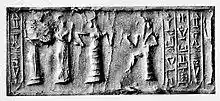
Cylinder seal of Gudea. It reads "Gudea, patesi of Lagash; Lugal-me, scribe, thy servant".[4]
Gudea chose the title of énsi (town-king or governor), not the more exalted lugal (Akkadian šarrum), although he did style himself "god of Lagash". Gudea claimed to have conquered Elam and Anshan, but his inscriptions emphasize the building of irrigation channels and temples, and the creation of precious gifts to the gods.[5] Materials for his buildings and statues were brought from all parts of western Asia: cedar wood from the Amanus mountains, quarried stones from Lebanon, copper from northern Arabia, gold and precious stones from the desert between Canaan and Egypt, diorite from Magan (Oman), and timber from Dilmun (Bahrain).[6][7][8]
As the power of the Akkadian empire waned, Lagaš again declared independence, this time under Puzer-Mama, who declared himself lugal of Lagaš. Thereafter, this title would not be associated with Lagaš, at least until the end of the Gudean period. Lagašite rulers, including Ur-Ningirsu and Ur-Bau, whose reigns predated Gudea, referred to themselves as énsi, or governor, of Lagaš, and reserved the term lugal only for their gods or as a matter of rank in a relationship, but never as a political device. The continued use of lugal in reference to deities seems to indicate a conscious attempt on the parts of the rulers to assume a position of humility in relation to the world—whether this was honest humility or a political ploy is unknown.
Statues of Gudea
.jpg)
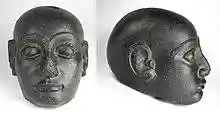
Sculpture of the head of Sumerian ruler Gudea, c. 2150 BC
Twenty-six statues of Gudea have been found so far during excavations of Telloh (ancient Girsu) with most of the rest coming from the art trade. The early statues were made of limestone, steatite and alabaster; later, when wide-ranging trade-connections had been established, the more costly exotic diorite was used. Diorite had already been used by old Sumerian rulers (Statue of Entemena). These statues include inscriptions describing trade, rulership and religion. These were one of many types of Neo-Sumerian art forms.
Reference to Goa
The first known reference to Goa in India possibly appears as Gubi in a Cuneiform dating to King Gudea's time.[9] At the time, Sumerians had established trade contacts with India.[9]
Religion

Foundation figurines of gods in copper alloy, reign of Gudea, c. 2150 BCE, from the temple of Ningirsu at Girsu (British Museum, London).

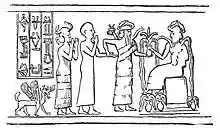
Votive stele of Gudea, ruler of Lagash, to the temple of Ningirsu: Gudea being led by Ningishzida into the presence of a deity who is seated on a throne. From Girsu, Iraq. 2144-2124 BCE. Ancient Orient Museum, Istanbul

Sacred basin, a gift from Gudea to the temple of Ningirsu. From Girsu, Iraq. 2144-2122 BCE. Ancient Orient Museum, Istanbul

Diorite mortar, an offering from Gudea to Enlil. From Nippur, Iraq. 2144-2124 BCE. Ancient Orient Museum, Istanbul
The pleas to the gods under Gudea and his successors appear more creative and honest: whereas the Akkadian kings followed a rote pattern of cursing the progeny and tearing out the foundations of those that vandalize a stele, the Lagašite kings send various messages. Times were violent after the Akkadian empire lost power over southern Mesopotamia, and the god receiving the most attention from Gudea was Ningirsu—a god of battle. Though there is only one mention of martial success on the part of Gudea, the many trappings of war which he builds for Ningirsu indicate a violent era. Southern Mesopotamian cities defined themselves through their worship, and the decision on Gudea's part for Lagaš to fashion regalia of war for its gods is indicative of the temperament of the times.
Though obviously the foundation and progeny curse was not the only religious invocation by the political powers during the Akkadian empire, it demonstrates a certain standardization, and with it, stagnation, of the position of the gods that likely did not sit well with the people of Lagaš. Ur-Ningirsu I, with whom the Gudean dynasty of Lagaš begins, leaves little in the way of inscriptions, and though some mention of various gods seems to indicate a more central role, it is not until Gudea that there can be a side-by-side comparison with the old curse of Sargon of Akkad. The inscription on a statue of Gudea as architect of the House of Ningirsu,[10] warns the reader of doom if the words are altered, but there is a startling difference between the warnings of Sargon or his line and the warnings of Gudea. The one is length; Gudea's curse lasts nearly a quarter of the inscription's considerable length,[11] and another is creativity. The gods will not merely reduce the offender's progeny to ash and destroy his foundations, no, they will, "let him sit down in the dust instead of on the seat they set up for him". He will be "slaughtered like a bull… seized like an aurochs by his fierce horn".[12]
But these differences, though demonstrating a Lagašite respect of religious figures simply in the amount of time and energy they required, are not as telling as the language Gudea uses to justify any punishment. Whereas Sargon or Naram-Sin simply demand punishment to any who change their words, based on their power, Gudea defends his words through tradition, “since the earliest days, since the seed sprouted forth, no one was (ever) supposed to alter the utterance of a ruler of Lagaš who, after building the Eninnu for my lord Ningirsu, made things function as they should”.[13] Changing the words of Naram-Sin, the living god, is treason, because he is the king. But changing the words of Gudea, simple governor of Lagaš, is unjust, because he made things work right.
Reforms
The social reforms instituted during Gudea's rulership, which included the cancellation of debts and allowing women to own family land, may have been honest reform or a return to old Lagašite custom.
His era was especially one of artistic development. But it was Ningirsu who received the majority of Gudea's attention. Ningirsu the war god, for whom Gudea built maces, spears, and axes, all appropriately named for the destructive power of Ningirsu—enormous and gilt. However, the devotion for Ningirsu was especially inspired by the fact that this was Gudea's personal god and that Ningirsu was since ancient times the main god of the Lagashite region (together with his spouse Ba'u or Baba).
In matters of trade, Lagash under Gudea had extensive commercial communications with distant realms. According to his own records, Gudea brought cedars from the Amanus and Lebanon mountains in Syria, diorite from eastern Arabia, copper and gold from central and southern Arabia and from Sinai, while his armies were engaged in battles in Elam on the east.[14]
The Gudea cylinders, written after the life of Gudea, paints an attractive picture of southern Mesopotamia during the Lagaš supremacy. In it, “The Elamites came to him from Elam… loaded with wood on their shoulders… in order to build Ningirsu’s House” (p. 78), the general tone being one of brotherly love in an area that has known only regional conflict.
Gudea built more than the House of Ningirsu, he restored tradition to Lagaš. His use of the title ensi, when he obviously held enough political influence, both in Lagaš and in the region, to justify lugal, demonstrates the same political tact as his emphasis on the power of the divine.
Ur-Ningirsu II, the next ruler of Lagaš, took as his title, "Ur-Ningirsu, ruler of Lagaš, son of Gudea, ruler of Lagaš, who had built Ningirsu’s house" (p. 183).
International relations
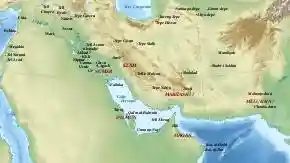
Location of foreign lands for the Mesopotamians, including Meluhha.
Main article: Indus-Mesopotamia relations
In an inscription, Gudea referred to the Meluhhans who came to Sumer to sell gold dust, carnelian etc...[14] In another inscription, he mentioned his victory over the territories of Magan, Meluhha, Elam and Amurru.[14]
In the Gudea cylinders, Gudea mentions that "I will spread in the world respect for my Temple, under my name the whole universe will gather in it, and Magan and Meluhha will come down from their mountains to attend" (cylinder A, IX).[15] In cylinder B, XIV, he mentions his procurement of "blocks of lapis lazuli and bright carnelian from Meluhha."[16]
Later influence
Gudea's appearance is recognizable today because he had numerous statues or idols, depicting him with unprecedented, lifelike realism, placed in temples throughout Sumer. Gudea took advantage of artistic development because he evidently wanted posterity to know what he looked like. And in that he has succeeded—a feat available to him as royalty, but not to the common people who could not afford to have statues engraved of themselves.
Gudea, following Sargon, was one of the first rulers to claim divinity for himself, or have it claimed for him after his death. Some of his exploits were later added to the Gilgamesh Epic (N. K. Sandars, 1972, The Epic of Gilgamesh).
Following Gudea, the influence of Lagaš declined, until it suffered a military defeat by Ur-Nammu, whose Third Dynasty of Ur then became the reigning power in Southern Mesopotamia.
Important artifacts
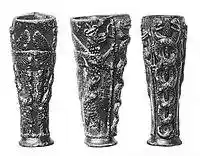
The "Libation vase of Gudea" with the dragon Mušḫuššu, dedicated to Ningishzida (21st century BC short chronology). The caduceus (right) is interpreted as depicting god Ningishzida. Inscription; ""To the god Ningiszida, his god, Gudea, Ensi (governor) of Lagash, for the prolongation of his life, has dedicated this"
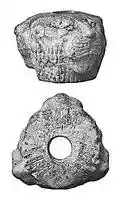
Lion macehead of Gudea, Girsu.[17]
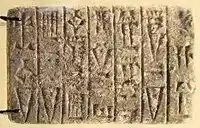
Gudea tablet: "For Hendursaga, his master, Gudea, ruler of Lagash, built his house."[18] Vorderasiatisches Museum, Berlin

Foundation nail of Gudea, Cleveland Museum of Art
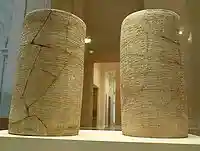
The Gudea cylinders.[19]
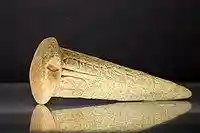
Foundation nail for the temple of Ningirsu in Lagash. Reign of Gudea.

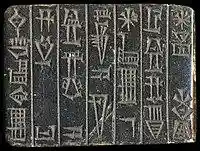
Mudbrick stamped with a cuneiform text mentioning the name of Gudea, ruler of Lagash. From Girsu, Iraq, c. 2115 BCE. Vorderasiatisches Museum, Berlin
References
- ^ Durand, M.L. (2008). Supplément au Dictionnaire de la Bible: TELL HARIRI/MARI: TEXTES (PDF). p. 227.
- ^ Corporation, Marshall Cavendish (2010). Ancient Egypt and the Near East: An Illustrated History. Marshall Cavendish. p. 54–56. ISBN 978-0-7614-7934-5.
- ^ Year-names for Gudea, Cuneiform Digital Library Initiative.
- ^ Ward, W. H. (1910). The seal cylinders of western Asia. Рипол Классик. pp. 23–24 Note 13, Seal N.38. ISBN 9785878502252.
- ^ Steinkeller, Piotr. Puzur-Inˇsuˇsinak at Susa: A Pivotal Episode of Early Elamite History Reconsidered. p. 299.
- ^ Thomason, Allison Karmel (2017). Luxury and Legitimation: Royal Collecting in Ancient Mesopotamia. Routledge. p. 87. ISBN 978-1-351-92113-8.
- ^ Moorey, Peter Roger Stuart (1999). Ancient Mesopotamian Materials and Industries: The Archaeological Evidence. Eisenbrauns. p. 245. ISBN 978-1-57506-042-2.
- ^ Thapar, Romila (1975). "A Possible Identification of Meluḫḫa, Dilmun and Makan". Journal of the Economic and Social History of the Orient. 18 (1): 1–42. doi:10.2307/3632219. ISSN 0022-4995. JSTOR 3632219.
- ^ a b Souza, Teotonio R. De (1990). Goa Through the Ages: An economic history. Concept Publishing Company. p. 2. ISBN 978-81-7022-259-0.
- ^ Edzard (1997), pp. 31–8.
- ^ Edzard (1997), pp. 36–8.
- ^ Edzard (1997), p. 38.
- ^ Edzard (1997), p. 37.
- ^ a b c "MS 2814 - The Schoyen Collection". www.schoyencollection.com.
- ^ "J'étendrai sur le monde le respect de mon temple, sous mon nom l'univers depuis l'horizon s'y rassemblera, et [même les pays lointains] Magan et Meluhha, sortant de leurs montagnes, y descendront" (cylindre A, IX)" in "Louvre Museum".
- ^ Moorey, Peter Roger Stuart (1999). Ancient Mesopotamian Materials and Industries: The Archaeological Evidence. Eisenbrauns. p. 87. ISBN 978-1-57506-042-2.
- ^ de Sarzec, Ernest. Découvertes en Chaldée. L. Heuzey. p. 229.
- ^ D. O. Edzard, The Royal inscriptions of Mesopotamia, Early periods, vol. 3/1, Gudea and His Dynasty, Toronto, 1997, p. 117-118
- ^ "Louvre Museum".
Sources
- Edzard, Dietz-Otto (1997). Gudea and His Dynasty. University of Toronto Press. ISBN 9780802041876.
- Black, J.A.; Cunningham, G.; Dahl, Jacob L.; Fluckiger-Hawker, E.; Robson, E.; Zólyomi, G. (1998). "The Electronic Text Corpus of Sumerian Literature". University of Oxford.
- Frayne, Douglas R. (1993). Sargonic and Gutian Periods. University of Toronto Press.
- F. Johansen, "Statues of Gudea, ancient and modern". Mesopotamia 6, 1978.
- A. Parrot, Tello, vingt campagnes des fouilles (1877-1933). (Paris 1948).
- N.K. Sandars, "Introduction" page 16, The Epic of Gilgamesh, Penguin, 1972.
- H. Steible, "Versuch einer Chronologie der Statuen des Gudea von Lagas". Mitteilungen der Deutschen Orient-Gesellschaft 126 (1994), 81-104.
External links
| Regnal titles | ||
|---|---|---|
| Preceded by Ur-Baba | King of Lagash ca. 22nd century BC | Succeeded by Ur-Ningirsu |
Rulers of the Ancient Near East | |||||||||||||||||||||||||||||||||||||||||||||||||||||||||||||||||||||||||||||||||||||||||||||||||||||||||||||||||||||||||||||||||||||||||||||||||||||||||||||||||||||||||||||||||||||||||||||||||||||||||||||||||||||||||||||||||||||||||||||||||||||||||||||||||||||||||||||||||||||||||||||||||||||||||||||||||||||||||||||||||||||||||||||||||||||||||||||||||||||||||||||||||||||||||||||||||||||||||||||||||||||||||||||||||||||||||||||||||||||||||||||||||||||||||||||||||||||||||||||||||||||||||||||||||||||||||||||||||||||||||||||||||||||||||||||||||||||||||||||||||||||||||||||||||||||||||||||||||||||||||||||||||||||||||||||||||||||||||||||||||||||||||||||||||||||||||||||||||||||||||||||||||||||||
|---|---|---|---|---|---|---|---|---|---|---|---|---|---|---|---|---|---|---|---|---|---|---|---|---|---|---|---|---|---|---|---|---|---|---|---|---|---|---|---|---|---|---|---|---|---|---|---|---|---|---|---|---|---|---|---|---|---|---|---|---|---|---|---|---|---|---|---|---|---|---|---|---|---|---|---|---|---|---|---|---|---|---|---|---|---|---|---|---|---|---|---|---|---|---|---|---|---|---|---|---|---|---|---|---|---|---|---|---|---|---|---|---|---|---|---|---|---|---|---|---|---|---|---|---|---|---|---|---|---|---|---|---|---|---|---|---|---|---|---|---|---|---|---|---|---|---|---|---|---|---|---|---|---|---|---|---|---|---|---|---|---|---|---|---|---|---|---|---|---|---|---|---|---|---|---|---|---|---|---|---|---|---|---|---|---|---|---|---|---|---|---|---|---|---|---|---|---|---|---|---|---|---|---|---|---|---|---|---|---|---|---|---|---|---|---|---|---|---|---|---|---|---|---|---|---|---|---|---|---|---|---|---|---|---|---|---|---|---|---|---|---|---|---|---|---|---|---|---|---|---|---|---|---|---|---|---|---|---|---|---|---|---|---|---|---|---|---|---|---|---|---|---|---|---|---|---|---|---|---|---|---|---|---|---|---|---|---|---|---|---|---|---|---|---|---|---|---|---|---|---|---|---|---|---|---|---|---|---|---|---|---|---|---|---|---|---|---|---|---|---|---|---|---|---|---|---|---|---|---|---|---|---|---|---|---|---|---|---|---|---|---|---|---|---|---|---|---|---|---|---|---|---|---|---|---|---|---|---|---|---|---|---|---|---|---|---|---|---|---|---|---|---|---|---|---|---|---|---|---|---|---|---|---|---|---|---|---|---|---|---|---|---|---|---|---|---|---|---|---|---|---|---|---|---|---|---|---|---|---|---|---|---|---|---|---|---|---|---|---|---|---|---|---|---|---|---|---|---|---|---|---|---|---|---|---|---|---|---|---|---|---|---|---|---|---|---|---|---|---|---|---|---|---|---|---|---|---|---|---|---|---|---|---|---|---|---|---|---|---|---|---|---|---|---|---|---|---|---|---|---|---|---|---|---|---|---|---|---|---|---|---|---|---|---|---|---|---|---|---|---|---|---|---|---|---|---|---|---|---|---|---|---|---|---|---|---|---|---|---|---|---|---|---|---|---|---|---|---|---|---|---|---|---|---|---|---|---|---|---|---|---|---|---|---|---|---|---|---|---|---|---|---|---|---|---|---|---|---|---|---|---|---|---|---|---|---|---|---|---|---|---|---|---|---|---|---|---|---|---|---|---|---|---|---|---|---|---|---|---|---|---|---|---|---|---|---|---|---|---|---|---|---|---|---|---|---|---|---|---|---|---|---|---|---|---|---|---|---|---|---|---|---|---|---|---|---|---|---|---|---|---|---|---|---|---|---|---|---|---|---|---|---|---|---|---|---|---|---|---|---|---|---|---|---|---|---|---|---|---|---|---|---|---|---|---|---|---|---|---|---|---|---|---|---|---|---|---|---|---|---|---|---|---|---|---|---|---|---|---|---|---|---|---|---|---|
| |||||||||||||||||||||||||||||||||||||||||||||||||||||||||||||||||||||||||||||||||||||||||||||||||||||||||||||||||||||||||||||||||||||||||||||||||||||||||||||||||||||||||||||||||||||||||||||||||||||||||||||||||||||||||||||||||||||||||||||||||||||||||||||||||||||||||||||||||||||||||||||||||||||||||||||||||||||||||||||||||||||||||||||||||||||||||||||||||||||||||||||||||||||||||||||||||||||||||||||||||||||||||||||||||||||||||||||||||||||||||||||||||||||||||||||||||||||||||||||||||||||||||||||||||||||||||||||||||||||||||||||||||||||||||||||||||||||||||||||||||||||||||||||||||||||||||||||||||||||||||||||||||||||||||||||||||||||||||||||||||||||||||||||||||||||||||||||||||||||||||||||||||||||||
.jpg)


.jpg)


.jpg)


.jpg)
.jpg)


_Colorized_per_source.jpg)


_%252c_Kerma_Museum%252cSudan_(2).jpg)


%252c_Hamadan_mint.jpg)

This article is copied from an article on Wikipedia® - the free encyclopedia created and edited by its online user community. The text was not checked or edited by anyone on our staff. Although the vast majority of Wikipedia® encyclopedia articles provide accurate and timely information, please do not assume the accuracy of any particular article. This article is distributed under the terms of GNU Free Documentation License.