Also found in: Dictionary, Thesaurus, Medical, Encyclopedia.
This article is about the exhaust system component. For other uses, see Muffler (disambiguation).
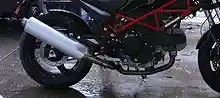
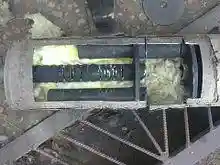
A silencer cut open to show the insulation, chambers and piping inside the shell
A muffler (North American English) or silencer (British English) is a device for reducing the noise emitted by the exhaust of an internal combustion engine—especially a noise-deadening device forming part of the exhaust system of an automobile.[1]
Description

Dual tailpipes attached to the muffler on a passenger car to reduce the sound produced.
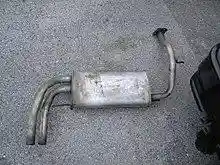
A muffler with pipes
Mufflers are installed within the exhaust system of most internal combustion engines. The muffler is engineered as an acoustic device to reduce the loudness of the sound pressure created by the engine by acoustic quieting. The noise of the burning-hot exhaust gas exiting the engine at high speed is abated by a series of passages and chambers lined with roving fiberglass insulation and/or resonating chambers harmonically tuned to cause destructive interference, wherein opposite sound waves cancel each other out.
An unavoidable side effect of this noise reduction is restriction of the exhaust gas flow, which creates back pressure, which can decrease engine efficiency. This is because the engine exhaust must share the same complex exit pathway built inside the muffler as the sound pressure that the muffler is designed to mitigate.
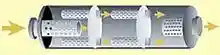
A cutaway muffler showing the interior pipes and chambers which reduces Horsepower
Some aftermarket mufflers claim to increase engine output and/or reduce fuel consumption by slightly reduced back pressure. This usually entails less noise reduction (i.e., more noise).
On May 18, 1905, the state of Oregon passed a law that required vehicles to have "a light, a muffler, and efficient brakes".[2]
The legality of altering a motor vehicle's original equipment exhaust system varies by jurisdiction; in many developed countries such as the United States,[3] Canada,[4] and Australia,[5] such modifications are highly regulated or strictly prohibited.
Aftermarket mufflers usually alter the way a vehicle performs, due to back-pressure reduction.[6]
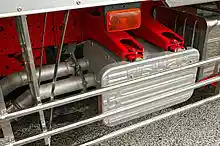
A muffler on a large diesel-powered truck
See also
- Noise control
- Soundproofing
- Anechoic chamber
- Vibration isolation
- Shock absorber
- Buffer (disambiguation)
- Cushioning
- Damped wave
- Damping
- Damper (disambiguation)
- Sound Attenuators
References
- ^ Merriam-Webster Dictionary. "Definition of muffler". Retrieved 16 June 2020.
- ^ Goeres-Gardner, Diane L.; Douglas County Museum (2010). Roseburg. Arcadia Pubpishers. p. 97. ISBN 9780738580319. Retrieved 4 September 2019.
- ^ "Regulations Section". Federal Motor Carrier Safety Administration. Retrieved 18 December 2018.
- ^ Queen's Printer, Victoria, British Columbia, Canada (9 June 2020). "Motor Vehicle Act Regulations". Retrieved 16 June 2020.
- ^ "vehicle-noise". NSW Environment & Heritage. Retrieved 18 December 2018.
- ^ D. W. Herrin (2012). "Vibro-Acoustic Design in Mechanical Systems" (PDF). University of Kentucky.
External links
This article is copied from an article on Wikipedia® - the free encyclopedia created and edited by its online user community. The text was not checked or edited by anyone on our staff. Although the vast majority of Wikipedia® encyclopedia articles provide accurate and timely information, please do not assume the accuracy of any particular article. This article is distributed under the terms of GNU Free Documentation License.