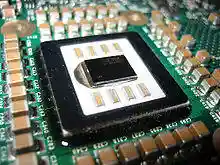
The PowerPC 970 was released in 2003 and was one of the first 64-bit processors developed for consumer-type computers, PowerMac G5 in this case.
ppc64 is an identifier commonly used within the Linux, GNU Compiler Collection (GCC) and LLVM open-source software communities to refer to the target architecture for applications optimized for 64-bit big-endian PowerPC and Power ISA processors.[1]
ppc64le is a pure little-endian mode that has been introduced with the POWER8 as the prime target for technologies provided by the OpenPOWER Foundation, aiming at enabling porting of the x86 Linux-based software with minimal effort.[2]
Details
These two identifiers are frequently used when compiling source code to identify the target architecture.[3]
64-bit Power and PowerPC processors are the following:
- PowerPC 620
- RS64 – Apache, RS64-II Northstar, RS64-III Pulsar/IStar, and RS64-IV SStar
- POWER3 and POWER3-II
- POWER4 and POWER4+
- PowerPC 970, 970FX, 970MP and 970GX
- POWER5 and POWER5+
- PPE in Cell BE, PowerXCell 8i and Xenon.
- PWRficient
- POWER6 and POWER6+
- POWER7 and POWER7+
- A2, A2I (used in the Blue Gene/Q) and A2O
- PowerPC e5500 core based
- PowerPC e6500 core based
- POWER8 – P8-6c Murano, P8-12c Turismo and Venice, P8E (with NVLink) and CP1
- POWER9 – P9C Cumulus, P9N Nimbus and P9 AIO Axone
- POWER10
- Microwatt, open source soft core.
- Chiselwatt, open source soft core.
Defunct 64-bit PowerPC processors are the Motorola G5 and PowerPC e700.
References
- ^ "Gentoo Handbook: Main Page". gentoo.org. April 2, 2015. Retrieved August 12, 2015.
- ^ "SUSE Linux Enterprise Server 12 on IBM POWER8" (PDF). novell.com. February 2014. Retrieved August 12, 2015.
- ^ "GNU Autoconf 2.63 Manual, Section 15.3 Compiling For Multiple Architectures". gnu.org. September 9, 2008. Retrieved August 12, 2015.
External links
- Power.org at the Library of Congress Web Archives (archived 2011-07-29)
- Linux Standard Base Specification for the PPC64 Architecture 2.1, 2003
This article is copied from an article on Wikipedia® - the free encyclopedia created and edited by its online user community. The text was not checked or edited by anyone on our staff. Although the vast majority of Wikipedia® encyclopedia articles provide accurate and timely information, please do not assume the accuracy of any particular article. This article is distributed under the terms of GNU Free Documentation License.