Sinoconodon
| Sinoconodon | |
|---|---|
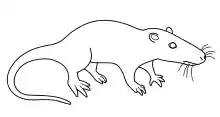 | |
| Restoration of S. rigneyi | |
Scientific classification  | |
| Kingdom: | Animalia |
| Phylum: | Chordata |
| Clade: | Therapsida |
| Clade: | Cynodontia |
| Clade: | Mammaliamorpha |
| Order: | †Sinoconodontiformes Kinman, 1994 |
| Family: | †Sinoconodontidae Mills, 1971 |
| Genus: | †Sinoconodon Patterson & Olson, 1961 |
| Species: | †S. rigneyi |
| Binomial name | |
| †Sinoconodon rigneyi Patterson & Olson, 1961 | |
| Synonyms | |
| List
| |
Sinoconodon is an extinct genus of mammaliamorphs that appears in the fossil record of the Lufeng Formation of China in the Sinemurian stage of the Early Jurassic period, about 193 million years ago.[1] While sharing many plesiomorphic traits with other non-mammaliaform cynodonts, it possessed a special, secondarily evolved jaw joint between the dentary and the squamosal bones, which in more derived taxa would replace the primitive tetrapod one between the articular and quadrate bones. The presence of a dentary-squamosal joint is a trait historically used to define mammals.[2][3]
Sinoconodon closely resembled early mammaliaforms like Morganucodon, but it is regarded as more basal,[4] differing substantially from Morganucodon in its dentition and growth habits. Like most other non-mammalian tetrapods, such as reptiles and amphibians, it was polyphyodont, replacing many of its teeth throughout its lifetime, and it seems to have grown slowly but continuously until its death. It was thus somewhat less mammal-like than mammaliaforms such as morganucodonts and docodonts.[2][5] The combination of basal tetrapod and mammalian features makes it a unique transitional fossil.[6]
Taxonomy
Sinoconodon was named by Patterson and Olson in 1961. Its type is Sinoconodon rigneyi. It was assigned to Triconodontidae by Patterson and Olson in 1961; to Triconodonta by Jenkins and Crompton in 1979; to Sinoconodontidae by Carroll in 1988; to Mammaliamorpha by Wible in 1991; to Mammalia by Luo and Wu in 1994; to Mammalia by Kielan-Jaworowska et al. in 2004; and to Mammaliaformes by Luo et al. in 2001 and Bi et al. in 2014.[7]
Phylogeny
References
- ^ Lucas, Spencer (2001). Chinese Fossil Vertebrates. New York: Columbia University Press. pp. 130–150. ISBN 978-0231084833.
- ^ a b Kielan-Jaworowska, Z; Luo, ZX; Cifelli, RL (2004). Mammals from the Age of Dinosaurs. Columbia University Press. Chapter 4. ISBN 9780231119184.
- ^ Luo, Z.-X. (2005). "FOSSIL VERTEBRATES | Mesozoic Mammals". Encyclopedia of Geology. Elsevier. pp. 527–534. doi:10.1016/b0-12-369396-9/00008-3. ISBN 9780123693969.
- ^ Luo, ZX; Kielan-Jaworowska, Z; Cifelli, RL (2002). "In quest for a phylogeny of Mesozoic mammals". Acta Palaeontologica Polonica. 47 (1): 1–78.
- ^ Close, Roger A.; Friedman, Matt; Lloyd, Graeme T.; Benson, Roger B.J. (August 2015). "Evidence for a Mid-Jurassic Adaptive Radiation in Mammals". Current Biology. 25 (16): 2137–2142. doi:10.1016/j.cub.2015.06.047. ISSN 0960-9822. PMID 26190074.
- ^ Mammals of the Mesozoic: The least mammal-like mammals
- ^ "PBDB". paleobiodb.org. Retrieved 2018-05-21.
External links
This article is copied from an article on Wikipedia® - the free encyclopedia created and edited by its online user community. The text was not checked or edited by anyone on our staff. Although the vast majority of Wikipedia® encyclopedia articles provide accurate and timely information, please do not assume the accuracy of any particular article. This article is distributed under the terms of GNU Free Documentation License.