Soyuz programme
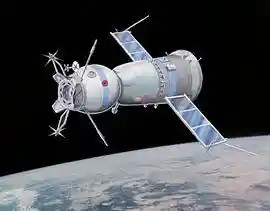 Artist's impression of the Soyuz 19 spacecraft from the Apollo–Soyuz mission | |
| Country | Soviet Union Russia |
|---|---|
| Organization | Roscosmos (1991–present) |
| Status | Ongoing |
| Programme history | |
| First crewed flight | Soyuz 1 |
| Launch site(s) | Baikonur |
| Vehicle information | |
| Uncrewed vehicle(s) | Progress |
| Crewed vehicle(s) | Soyuz |
| Crew capacity | 1–3 |
| Launch vehicle(s) |
|
The Soyuz programme ( SOY-yooz, SAW-; Russian: Союз [sɐˈjus], meaning "Union") is a human spaceflight programme initiated by the Soviet Union in the early 1960s. The Soyuz spacecraft was originally part of a Moon landing project intended to put a Soviet cosmonaut on the Moon. It was the third Soviet human spaceflight programme after the Vostok and Voskhod programmes.
The programme consists of the Soyuz spacecraft and the Soyuz rocket and is now the responsibility of the Russian Roscosmos. After the retirement of the Space Shuttle in 2011, Soyuz was the only way for human spaceflight to the International Space Station (ISS) until 30 May 2020, when Crew Dragon flew to the ISS for the first time with astronauts.
Soyuz rocket
Main article: Soyuz (rocket family)
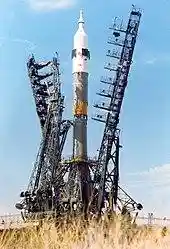
Soyuz rocket on launch pad.
The launch vehicles used in the Soyuz expendable launch system are manufactured at the Progress State Research and Production Rocket Space Center (TsSKB-Progress) in Samara, Russia. As well as being used in the Soyuz programme as the launcher for the crewed Soyuz spacecraft, Soyuz launch vehicles are now also used to launch robotic Progress supply spacecraft to the International Space Station and commercial launches marketed and operated by TsSKB-Progress and the Starsem company. Currently Soyuz vehicles are launched from the Baikonur Cosmodrome in Kazakhstan and the Plesetsk Cosmodrome in northwest Russia and, since 2011, Soyuz launch vehicles are also being launched from the Guiana Space Centre in French Guiana.[1] The Spaceport's new Soyuz launch site has been handling Soyuz launches since 21 October 2011, the date of the first launch.[2] As of December 2019, 19 Guiana Soyuz launches had been made from French Guiana Space Centre, all successful.[3][4][5]
Soyuz spacecraft
Main article: Soyuz (spacecraft)
The basic Soyuz spacecraft design was the basis for many projects, many of which were never developed. Its earliest form was intended to travel to the Moon without employing a huge booster like the Saturn V or the Soviet N-1 by repeatedly docking with upper stages that had been put in orbit using the same rocket as the Soyuz. This and the initial civilian designs were done under the Soviet Chief Designer Sergei Pavlovich Korolev, who did not live to see the craft take flight. Several military derivatives took precedence in the Soviet design process, though they never came to pass.
A Soyuz spacecraft consists of three parts (from front to back):
- a spheroid orbital module
- a small aerodynamic reentry module
- a cylindrical service module with solar panels attached
There have been many variants of the Soyuz spacecraft, including:
- Soyuz-A 7K-9K-11K circumlunar complex proposal (1963)
- Soyuz 7K crewed spacecraft concept
- Soyuz 9K proposed booster
- Soyuz 11K proposed fuel tanker
- Soyuz 7K-OK (1967–1970)
- Soyuz 7K-L1 Zond (1967–1970)
- Soyuz 7K-L3 LOK (1971–1972)
- Soyuz 7K-OKS (1971)
- Soyuz 7K-T or "ferry" (1973–1981)
- Soyuz 7K-T/A9 (1974–1978)
- 7K-MF6 (1976)
- Soyuz 7K-TM (1974–1976)
- Soyuz-T (1976–1986)
- Soyuz-TM (1986–2003)
- Soyuz-TMA (2003–2012)
- Soyuz-ACTS (2006)
- Soyuz-TMA-M (2010–2016)
- Soyuz MS (since 2016)
- Military Soyuz (P, PPK, R, 7K-VI Zvezda, and OIS)
- Soyuz P crewed satellite interceptor proposal (1962)
- Soyuz R command-reconnaissance spacecraft proposal (1962)
- Soyuz 7K-TK (1966)
- Soyuz PPK revised version of Soyuz P (1964)
- Soyuz 7K-VI Zvezda space station proposal (1964)
- Soyuz OIS (1967)
- Soyuz OB-VI space station proposal (1967)
- Soyuz 7K-S military transport proposal (1974)
- Soyuz 7K-ST concept for Soyuz T and TM (1974)
Derivatives
The Zond spacecraft was designed to take a crew around the Moon, but never achieved the required degree of safety or political need. Zond 5 did circle the Moon in September, 1968, with two tortoises and other life forms, and returned safely to Earth although in an atmospheric entry which probably would have killed human travelers.
The Progress series of robotic cargo ships for the Salyut, Mir, and ISS use the engine section, orbital module, automatic navigation, docking mechanism, and overall layout of the Soyuz spacecraft, but are incapable of reentry.
While not a direct derivative, the Chinese Shenzhou spacecraft follows the basic template originally pioneered by Soyuz.[6][7]
Soyuz crewed flights
Further information: List of Soviet human spaceflight missions and List of Russian human spaceflight missions
- Soviet human spaceflight missions started in 1961 and ended in 1991 with the dissolution of the Soviet Union.
- The Russian human spaceflight missions program started in 1991 and continues to this day. Soyuz crewed missions were the only spacecraft visiting the International Space Station, starting from when the Space Shuttle program ended in 2011, until the launch of Crew Dragon Demo-2 on 30 May 2020.[8][9] The International Space Station always has at least one Soyuz spacecraft docked at all times for use as an escape craft.[10][11]
Soyuz uncrewed flights
- Kosmos 133 - launch failure
- Kosmos 140 - reentry damage
- Kosmos 186
- Kosmos 188
- Kosmos 212
- Kosmos 213
- Kosmos 238
- Soyuz 2 - failed to dock
- Kosmos 379
- Kosmos 396
- Kosmos 434
- Kosmos 496
- Kosmos 573
- Kosmos 613
- Kosmos 638
- Kosmos 656
- Kosmos 670
- Kosmos 672
- Kosmos 772 - partial fail
- Soyuz 20
- Kosmos 869
- Kosmos 1001
- Kosmos 1074
- Soyuz T-1
- Soyuz TM-1
- Soyuz MS-14
Gallery
Soyuz TMA-3 launch
_spacecraft.jpg)
Soyuz 19 as seen from the Apollo spacecraft during Apollo–Soyuz Test Project, July 1975
.jpg)
Soyuz TMA-14M landing
.jpg)
Soyuz TMA-16M approaching the ISS
See also
- Shenzhou, a Chinese spacecraft influenced by Soyuz
- Space Shuttle
- Buran (spacecraft)
- List of spaceflight-related accidents and incidents
References
- ^ "Soyuz & Vega at the Spaceport". Archived from the original on 15 April 2009.
- ^ "Galileo: Europe readies itself for October launch".
- ^ "CNES at Europe's Spaceport". European Space Agency. ESA.
- ^ "ESA at Europe's Spaceport". European Space Agency. ESA.
- ^ "Arianespace at Europe's Spaceport". European Space Agency. ESA.
- ^ Shenzhou-5 – Quick Facts Archived 2010-02-01 at the Wayback Machine. Astronautix.com. Retrieved on 2013-10-23.
- ^ [1] Archived December 2, 2010, at the Wayback Machine
- ^ "Launch and Landing". NASA. Retrieved 1 July 2011.
- ^ "SpaceX Launched Two Astronauts—Changing Spaceflight Forever". Wired. Retrieved 31 May 2020.
- ^ LA times, U.S.-Russian Crew Blasts Off to Space, By David Holley, April 26, 2003, Times Staff Writer
- ^ Beyond the Saga of Rocket Science: In Space to Stay, By Walter Sierra, page 225-226, 2019
This article is copied from an article on Wikipedia® - the free encyclopedia created and edited by its online user community. The text was not checked or edited by anyone on our staff. Although the vast majority of Wikipedia® encyclopedia articles provide accurate and timely information, please do not assume the accuracy of any particular article. This article is distributed under the terms of GNU Free Documentation License.