Interactive Black Hole Simulation: Schwarzschild & Kerr Black Hole

This project provides a real-time, interactive simulation of both a static Schwarzschild black hole and a rotating Kerr black hole. It demonstrates key phenomena predicted by General Relativity, such as gravitational lensing, the accretion disk, the relativistic Doppler effect, and the incredible frame-dragging effect of a spinning black hole.
The core rendering logic and shader framework were initially inspired by the excellent C++/OpenGL project Blackhole by rossning92. However, this project has since evolved into a complete, physically-robust implementation featuring a switchable physics core that allows for the direct comparison between static and rotating black holes.
A key goal of this project is to make this complex simulation more accessible and significantly easier to run. The Python version is platform-independent and requires no compilation, effectively lowering the barrier for anyone wishing to experience or experiment with these fascinating cosmic objects.
Also, you may visit the online version of this project here.
Key Features
- Dual Physics Cores: Seamlessly switch between a Schwarzschild (static) and a Kerr (rotating) black hole simulation with the press of a button.
- Frame-Dragging (Lense-Thirring Effect): Witness the mind-bending "spacetime vortex" around the Kerr black hole, which drags and twists the accretion disk and background starlight from any viewing angle.
- Extreme Relativistic Beaming: The side of the accretion disk moving towards the observer becomes intensely bright, while the side moving away fades into darkness, accurately modeled using the orbital velocities of a Kerr spacetime.
- Gravitational Lensing: Simulates the bending of light paths, causing the background starfield to appear distorted and creating multiple images of the accretion disk (e.g., the "light arch" over the top).

- Deformed Event Horizon Shadow: Observe how the black hole's shadow deforms from a perfect circle (Schwarzschild) to a "D" shape (Kerr) due to frame-dragging.
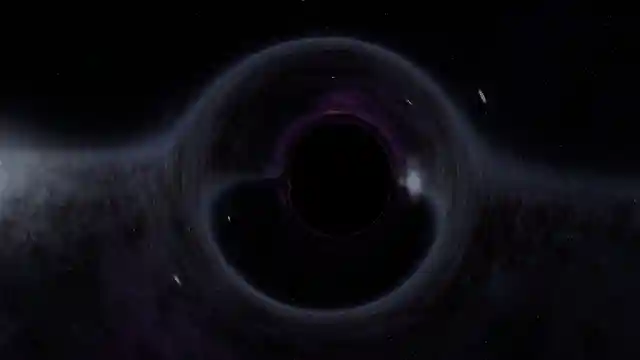

- Higher-Order Lensing and the Photon Ring: Thanks to the simulation's physical accuracy, you can observe one of the most stunning predictions of General Relativity. Light from the accretion disk can be captured by the intense gravity near the photon sphere, loop around the black hole one or more times, and then escape towards the observer. Each loop creates a new, progressively thinner and more distorted image of the entire accretion disk. These nested images stack up right against the edge of the black hole's shadow, forming what is known as the Photon Ring. Look closely at the boundary between the bright disk and the black shadow to see these delicate, nested rings of light..

- Real-time and Interactive: The simulation is fully interactive, allowing you to move the camera, and toggle visual components on the fly.


A Note on Performance: This simulation performs complex, real-time physics calculations on the GPU and is therefore computationally demanding. For the best experience at default settings, a modern dedicated graphics card is recommended (e.g., NVIDIA RTX 4060 or equivalent).
If you experience low frame rates, you can easily reduce the computational load on your system by lowering the target frame rate. Simply modify the last line in the
run()method:Changing
60to a lower value (e.g.,30or15) will result in a smoother experience on less powerful hardware.
Interaction Guide
How It Works: The Rendering Pipeline
This simulation uses a screen-space ray marching technique executed entirely on the GPU via a fragment shader.
-
Backward Ray Tracing: For each pixel, a light ray is cast from the camera into the scene.
-
Numerical Integration (4th Order Runge-Kutta): The path of the light ray is curved by gravity. We simulate this path with high precision using the 4th Order Runge-Kutta (RK4) method. In a loop, we repeatedly update the ray's position and velocity based on a unified acceleration formula.
-
Collision Detection & Color Determination: During the ray marching loop:
- Fell into Event Horizon: If the ray's distance is less than the horizon radius (which differs for Schwarzschild and Kerr), the pixel is colored black.
- Hit the Accretion Disk: If the ray intersects the
y=0plane, we calculate the color based on a noise texture and the physically-correct Doppler and gravitational redshift effects. - Escaped to Space: If the ray travels far enough, the pixel is colored by sampling a background skybox texture.
Core Principles & Mathematical Formulas
This simulation is based on the physical phenomena described by General Relativity, which are approximated using numerical methods within the fragment shader.
1. Gravitational Model
We use a single, unified function to calculate the acceleration of a light ray, which adapts based on whether the black hole is rotating.
a) Schwarzschild Gravity (Post-Newtonian Approximation)
For a static black hole, the acceleration includes the standard Newtonian gravity plus a first-order relativistic correction term, which is crucial for correctly simulating light bending.
$$ \vec{a}_{\text{Schwarzschild}} = - \frac{M}{|\vec{p}|^3}\vec{p} \left( 1 + \frac{3|\vec{L}|^2}{|\vec{p}|^2} \right) $$
Where:
- $M$ is the mass of the black hole.
- $\vec{p}$ is the photon's position vector.
- $\vec{L} = \vec{p} \times \vec{v}$ is the photon's specific angular momentum.
vec3 acc_schwarzschild = -M * pos / pow(r, 3.0) * (1.0 + 3.0 * dot(cross(pos, vel), cross(pos, vel)) / (r2));
b) Frame-Dragging (Gravitomagnetism)
For a rotating Kerr black hole, we add an additional acceleration term that models the Lense-Thirring (frame-dragging) effect. This term acts like a "gravitational Lorentz force," creating the spacetime vortex.
$$ \vec{a}_{\text{drag}} \approx - \frac{6M}{|\vec{p}|^3} (\vec{v} \times \vec{J}) $$
Where:
- $\vec{J}$ is the angular momentum vector of the black hole (pointing along its spin axis).
- $\vec{v}$ is the velocity of the photon.
- The cross product
(v x J)ensures the force is perpendicular to both the photon's motion and the spin axis, creating the characteristic swirl.
if (u_kerr_enabled) {
    vec3 J = vec3(0, a * M, 0);
    float r3 = r2 * r;
    vec3 acc_drag = -(6.0 * M / r3) * cross(vel, J);

    return acc_schwarzschild + acc_drag;
}
2. Numerical Integration: 4th Order Runge-Kutta (RK4)
To ensure stability and accuracy, especially in the extreme gravity near the event horizon, we use the RK4 method to integrate the ray's path. Unlike the simpler Euler method, RK4 takes four samples of the acceleration within each time step to calculate a weighted average, dramatically reducing error and preventing visual artifacts.
$$ \begin{aligned} \vec{k}_{v1} &= \Delta t \cdot \vec{a}(\vec{p}_i, \vec{v}_i) \\ \vec{k}_{p1} &= \Delta t \cdot \vec{v}_i \\ \vec{k}_{v2} &= \Delta t \cdot \vec{a}(\vec{p}_i + \frac{\vec{k}_{p1}}{2}, \vec{v}_i + \frac{\vec{k}_{v1}}{2}) \\ \vec{k}_{p2} &= \Delta t \cdot (\vec{v}_i + \frac{\vec{k}_{v1}}{2}) \\ \vec{k}_{v3} &= \Delta t \cdot \vec{a}(\vec{p}_i + \frac{\vec{k}_{p2}}{2}, \vec{v}_i + \frac{\vec{k}_{v2}}{2}) \\ \vec{k}_{p3} &= \Delta t \cdot (\vec{v}_i + \frac{\vec{k}_{v2}}{2}) \\ \vec{k}_{v4} &= \Delta t \cdot \vec{a}(\vec{p}_i + \vec{k}_{p3}, \vec{v}_i + \vec{k}_{v3}) \\ \vec{k}_{p4} &= \Delta t \cdot (\vec{v}_i + \vec{k}_{v3}) \\ \vec{p}_{i+1} &= \vec{p}_i + \frac{1}{6}(\vec{k}_{p1} + 2\vec{k}_{p2} + 2\vec{k}_{p3} + \vec{k}_{p4}) \\ \vec{v}_{i+1} &= \vec{v}_i + \frac{1}{6}(\vec{k}_{v1} + 2\vec{k}_{v2} + 2\vec{k}_{v3} + \vec{k}_{v4}) \end{aligned} $$
vec3 k1_vel = DT * get_acceleration(ray_pos, velocity);
vec3 k1_pos = DT * velocity;

vec3 k2_vel = DT * get_acceleration(ray_pos + k1_pos * 0.5, velocity + k1_vel * 0.5);
vec3 k2_pos = DT * (velocity + k1_vel * 0.5);

vec3 k3_vel = DT * get_acceleration(ray_pos + k2_pos * 0.5, velocity + k2_vel * 0.5);
vec3 k3_pos = DT * (velocity + k2_vel * 0.5);

vec3 k4_vel = DT * get_acceleration(ray_pos + k3_pos, velocity + k3_vel);
vec3 k4_pos = DT * (velocity + k3_vel);

ray_pos += (k1_pos + 2.0 * k2_pos + 2.0 * k3_pos + k4_pos) / 6.0;
velocity += (k1_vel + 2.0 * k2_vel + 2.0 * k3_vel + k4_vel) / 6.0;
3. Kerr Accretion Disk Physics
The extreme brightness of the Kerr disk's approaching side is due to the physically accurate orbital velocity of the gas. For a particle in a prograde (co-rotating) orbit in the equatorial plane of a Kerr black hole, the angular velocity is:
$$ \Omega = \frac{\sqrt{M}}{r^{3/2} + a\sqrt{M}} $$
Where:
- $r$ is the orbital radius.
- $a$ is the black hole's spin parameter.
This formula shows that as spin a increases, the orbital velocity v = Ωr becomes much higher than in the Schwarzschild case (a=0), leading to a far more dramatic Doppler effect.
float omega = sqrt(M) / (pow(r_cyl, 1.5) + a * sqrt(M));
float v_mag = omega * r_cyl;
--
Acknowledgments
This project's journey began with the goal of re-implementing the excellent C++/OpenGL simulation by @rossning92:
- Inspirational Project: rossning92/Blackhole
However, during the development process, a deeper dive into the physics revealed opportunities for greater accuracy. We identified that the original project's visually-effective but approximate geodesic equation could be improved. This led to the first major evolution of our project:
- The original force law was replaced with a more physically robust Post-Newtonian formula (
a_schwarzschild) that more accurately models the behavior of light in a strong gravitational field. - The simple Euler integrator was upgraded to a 4th-Order Runge-Kutta (RK4) method to ensure numerical stability and eliminate the visual artifacts that can occur near the event horizon.
Building on this more accurate foundation for a static black hole, the project's scope was then expanded significantly beyond the original inspiration. The second, and most substantial, phase of this project was the independent development and implementation of a complete, physically-grounded simulation for a rotating Kerr black hole, including the crucial frame-dragging effect.
Therefore, while we remain deeply grateful to rossning92/Blackhole for providing the foundational spark and the initial challenge that set this entire journey in motion, our final simulation stands as a distinct and expanded work.
--
References and Further Reading
Project Inspiration
- rossning92/Blackhole
https://github.com/rossning92/Blackhole
Key Physical and Computational Concepts
-
Image of a Spherical Black Hole with a Thin Accretion Disk (J.P. Luminet, 1979)
https://ui.adsabs.harvard.edu/abs/1979A&A....75..228L/abstract
-
The Lense-Thirring / Frame-Dragging Effect (NASA Overview)
https://science.nasa.gov/science-news/science-at-nasa/2004/26apr_frame
-
Post-Newtonian Formalism (Wikipedia)
https://en.wikipedia.org/wiki/Post-Newtonian_formalism
-
Runge–Kutta Methods (Wikipedia)
https://en.wikipedia.org/wiki/Runge–Kutta_methods
Developmental Reference
- Geodesics in the Kerr Spacetime (T. Gantumur, McGill University)
https://math.mcgill.ca/gantumur/math599w17/project-kerr.pdf
License
Distributed under the MIT License. See LICENSE for more information.