




Create a GraphQL interface by implementing nodes and calls, then running queries.
Example Implementation
- See test implementation in
/spec/support/dummy_app/nodes.rb - See
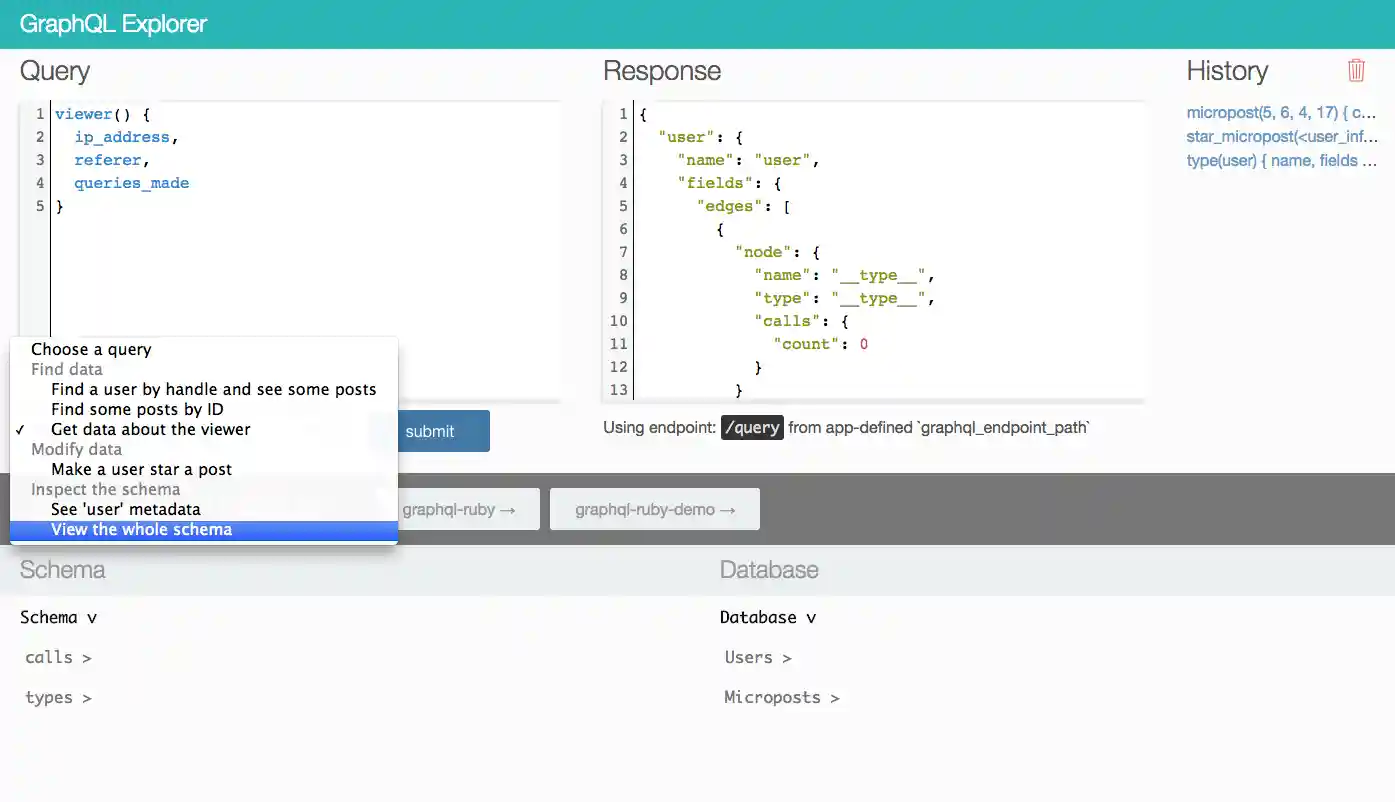
graphql-ruby-demowith Rails on github or heroku
Usage
Create a GraphQL interface:
- Implement nodes that wrap objects in your application
- Implement calls that expose those objects (and may mutate the application state)
- Execute queries on the system.
API docs: Ruby gem, master branch
Nodes
Nodes are delegators that wrap objects in your app. You must whitelist fields by declaring them in the class definition.
class FishNode < GraphQL::Node
  exposes "Fish"
  cursor(:id)
  field.number(:id)
  field.string(:name)
  field.string(:species)
  # specify an `AquariumNode`:
  field.aquarium(:aquarium)
end
You can also declare connections between objects:
class AquariumNode < GraphQL::Node
  exposes "Aquarium"
  cursor(:id)
  field.number(:id)
  field.number(:occupancy)
  field.connection(:fishes)
end
You can make custom connections:
class FishSchoolConnection < GraphQL::Connection
  type :fish_school # now it is a field type
  call :largest, -> (prev_value, number)  { fishes.sort_by(&:weight).first(number.to_i) }

  field.number(:count) # delegated to `target`
  field.boolean(:has_more)

  def has_more
    # the `largest()` call may have removed some items:
    target.count < original_target.count
  end
end
Then use them:
class AquariumNode < GraphQL::Node
  field.fish_school(:fishes)
end
And in queries:
aquarium(1) {
  name,
  occupancy,
  fishes.largest(3) {
      edges {
        node { name, species }
      },
      count,
      has_more
    }
  }
}
Calls
Calls selectively expose your application to the world. They always return values and they may perform mutations.
Calls declare returns, declare arguments, and implement #execute!.
This call just finds values:
class FindFishCall < GraphQL::RootCall
  returns :fish
  argument.number(:id)
  def execute!(id)
    Fish.find(id)
  end
end
This call performs a mutation:
class RelocateFishCall < GraphQL::RootCall
  returns :fish, :previous_aquarium, :new_aquarium
  argument.number(:fish_id)
  argument.number(:new_aquarium_id)

  def execute!(fish_id, new_aquarium_id)
    fish = Fish.find(fish_id)

    # context is defined by the query, see below
    if !context[:user].can_move?(fish)
      raise RelocateNotAllowedError
    end

    previous_aquarium = fish.aquarium
    new_aquarium = Aquarium.find(new_aquarium_id)
    fish.update_attributes(aquarium: new_aquarium)
    {
      fish: fish,
      previous_aquarium: previous_aquarium,
      new_aquarium: new_aquarium,
    }
  end
end
Queries
When your system is set up, you can perform queries from a string.
query_str = "find_fish(1) { name, species } "
query     = GraphQL::Query.new(query_str)
result    = query.as_result

result
# {
#   "1" => {
#     "name" => "Sharky",
#     "species" => "Goldfish",
#   }
# }
Each query may also define a context object which will be accessible at every point in execution.
query_str = "move_fish(1, 3) { fish { name }, new_aquarium { occupancy } }"
query_ctx = {user: current_user, request: request}
query     = GraphQL::Query.new(query_str, context: query_ctx)
result    = query.as_result

result
# {
#   "fish" => {
#     "name" => "Sharky"
#   },
#   "new_aquarium" => {
#     "occupancy" => 12
#   }
# }
You could do something like this inside a Rails controller.
To Do:
- testing with JSON args
- Make root calls plain ol' calls, on the root?
- Make fields like calls with no args?
- improve debugging experience
- build nodes for Date, DateTime, Time, Hash
- How do you express failure? HTTP response?
errorskey? - Handle blank objects in nested calls (how? wait for spec)
- Implement calls as arguments
- double-check how to handle
pals.first(3) { count } - Implement call argument introspection (wait for spec)