An identity in calculus of variations discovered in 1868 by Beltrami. The Euler-Lagrange differential equation is
 |
(1) |
Now, examine the derivative of  with respect to
 |
(2) |
Solving for the  term gives
 |
(3) |
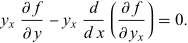
Now, multiplying (1) by  gives
gives
 |
(4) |
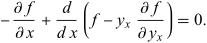
Substituting (3) into (4) then gives
 |
(5) |
 |
(6) |
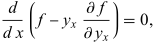
This form is especially useful if  , since in that case
 |
(7) |
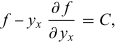
which immediately gives
 |
(8) |
where  is a constant of integration (Weinstock 1974, pp. 24-25; Arfken 1985, pp. 928-929;
Fox 1988, pp. 8-9).
is a constant of integration (Weinstock 1974, pp. 24-25; Arfken 1985, pp. 928-929;
Fox 1988, pp. 8-9).
The Beltrami identity greatly simplifies the solution for the minimal area surface of revolution about a given axis between two specified points. It also allows straightforward solution of the brachistochrone problem.
See also
Brachistochrone Problem, Calculus of Variations, Euler-Lagrange Differential Equation, Surface of Revolution
Explore with Wolfram|Alpha
References
Arfken, G. Mathematical Methods for Physicists, 3rd ed. Orlando, FL: Academic Press, 1985.Fox, C. An Introduction to the Calculus of Variations. New York: Dover, 1988.Weinstock, R. Calculus of Variations, with Applications to Physics and Engineering. New York: Dover, 1974.
Referenced on Wolfram|Alpha
Cite this as:
Weisstein, Eric W. "Beltrami Identity." From MathWorld--A Wolfram Resource. https://mathworld.wolfram.com/BeltramiIdentity.html