
The Cauchy distribution, also called the Lorentzian distribution or Lorentz distribution, is a continuous distribution describing resonance behavior. It also describes the distribution of horizontal distances at which a line segment tilted at a random angle cuts the x-axis.
Let  represent the angle that a line, with fixed point of rotation,
makes with the vertical axis, as shown above. Then
represent the angle that a line, with fixed point of rotation,
makes with the vertical axis, as shown above. Then
so the distribution of angle  is given by
 |
(5) |
This is normalized over all angles, since
 |
(6) |
and

The general Cauchy distribution and its cumulative distribution can be written as
where  is the half width at half maximum and
  is the statistical median.
In the illustration about,
is the statistical median.
In the illustration about,  .
.
The Cauchy distribution is implemented in the Wolfram Language as CauchyDistribution[m, Gamma/2].
The characteristic function is
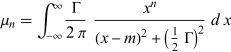
The moments  of the distribution are undefined since the integrals
 |
(14) |
diverge for  .
.
If  and
and  are variates with a normal distribution, then
 has a Cauchy distribution with statistical median
  and full width
 |
(15) |
The sum of  variates each from a Cauchy distribution has itself a Cauchy distribution, as can
be seen from
variates each from a Cauchy distribution has itself a Cauchy distribution, as can
be seen from
where  is the characteristic function and
 ](https://txtdot.deep-swarm.xyz/proxy/img?url=https%3A%2F%2Fmathworld.wolfram.com%2Fimages%2Fequations%2FCauchyDistribution%2FInline53.svg) is the inverse Fourier
transform, taken with parameters
is the inverse Fourier
transform, taken with parameters  .
.
See also
Explore with Wolfram|Alpha
References
Papoulis, A. Probability, Random Variables, and Stochastic Processes, 2nd ed. New York: McGraw-Hill, p. 104, 1984.Spiegel, M. R. Theory and Problems of Probability and Statistics. New York: McGraw-Hill, pp. 114-115, 1992.
Referenced on Wolfram|Alpha
Cite this as:
Weisstein, Eric W. "Cauchy Distribution." From MathWorld--A Wolfram Resource. https://mathworld.wolfram.com/CauchyDistribution.html