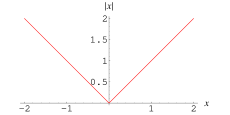
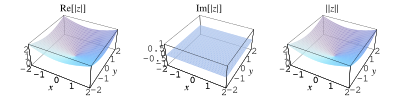
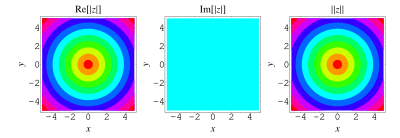
The modulus of a complex number  , also called the complex norm, is denoted
  and defined by
 |
(1) |
If  is expressed as a complex exponential (i.e., a phasor),
then
is expressed as a complex exponential (i.e., a phasor),
then
 |
(2) |
The complex modulus is implemented in the Wolfram Language as Abs[z], or as Norm[z].
The square  of
of  is sometimes called the absolute square.
Let  and
and  be two complex numbers. Then
so
 |
(5) |
Also,
so
 |
(8) |
and, by extension,
 |
(9) |
The only functions satisfying identities of the form
 |
(10) |
are  ,
,
 , and
, and  (Robinson 1957).
See also
Absolute Square, Absolute Value, Complex Argument, Complex Number, Imaginary Part, Maximum Modulus Principle, Minimum Modulus Principle, Real Part
Related Wolfram sites
http://functions.wolfram.com/ComplexComponents/Abs/
Explore with Wolfram|Alpha
References
Abramowitz, M. and Stegun, I. A. (Eds.). Handbook of Mathematical Functions with Formulas, Graphs, and Mathematical Tables, 9th printing. New York: Dover, p. 16, 1972.Krantz, S. G. "Modulus of a Complex Number." §1.1.4 n Handbook of Complex Variables. Boston, MA: Birkhäuser, pp. 2-3, 1999.Robinson, R. M. "A Curious Mathematical Identity." Amer. Math. Monthly 64, 83-85, 1957.
Referenced on Wolfram|Alpha
Cite this as:
Weisstein, Eric W. "Complex Modulus." From MathWorld--A Wolfram Resource. https://mathworld.wolfram.com/ComplexModulus.html