In the Minkowski space of special relativity, a four-vector is a four-element vector  that transforms under a Lorentz
transformation like the position four-vector.
In particular, four-vectors are the vectors in special relativity which transform
as
that transforms under a Lorentz
transformation like the position four-vector.
In particular, four-vectors are the vectors in special relativity which transform
as
 |
(1) |
where  is the Lorentz tensor.
In the context of general relativity, four-vectors satisfy a more general transformation rule (Morse and Feshbach 1973).
Throughout the literature, four-vectors are often expressed in the form
 |
(2) |
where  is the time coordinate and
 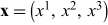 is the (Euclidean) three-vector of space coordinates. Using this convention, the
imaginary unit
is the (Euclidean) three-vector of space coordinates. Using this convention, the
imaginary unit  is dropped and
  is assumed for the speed of light in the expression of the time coordinate
  ; moreover, writing
  implicitly makes use of the
  metric signature and hence the
 |
(3) |
decomposition of Minkowski space is implicitly assumed in this convention. Given the alternative  decomposition, a four-vector would have the analogous
form
decomposition, a four-vector would have the analogous
form  .
Though subtle, this distinction is important when computing the norm
of a four-vector
.
Though subtle, this distinction is important when computing the norm
of a four-vector  .
.
Multiplication of two four-vectors with the metric tensor  yields products of
the form
yields products of
the form
 |
(4) |
a result due to the fact that the metric tensor  has the matrix form
![diag(-1,1,1,1)=[-1 0 0 0; 0 1 0 0; 0 0 1 0; 0 0 0 1]](https://txtdot.deep-swarm.xyz/proxy/img?url=https%3A%2F%2Fmathworld.wolfram.com%2Fimages%2Fequations%2FFour-Vector%2FNumberedEquation5.svg) |
(5) |
in any Lorentz frame (Misner et al. 1973). One of the immediate consequences of this product rule is that the squared norm of a nonzero four-vector may be either positive, zero, or negative, corresponding vectors which are spacelike, lightlike, and timelike, respectively.
In the case of the position four-vector,  and any product of the form
  is an invariant known
as the spacetime interval (Misner et al. 1973).
is an invariant known
as the spacetime interval (Misner et al. 1973).
See also
Four-Vector Norm, Gradient Four-Vector, Lightlike, Lorentz Transformation, Metric Tensor, Minkowski Space, Position Four-Vector, Quaternion, Spacelike, Tensor, Timelike, Vector
Portions of this entry contributed by Christopher Stover
Explore with Wolfram|Alpha
References
Misner, C. W.; Thorne, K. S.; and Wheeler, J. A. Gravitation. San Francisco, CA: W. H. Freeman, p. 53, 1973.Morse, P. M. and Feshbach, H. "The Lorentz Transformation, Four-Vectors, Spinors." §1.7 in Methods of Theoretical Physics, Part I. New York: McGraw-Hill, pp. 93-107, 1953.Ratcliffe, J. G. Foundations of Hyperbolic Manifolds. New York: Springer-Verlag, 2006.Weinberg, S. Gravitation and Cosmology: Principles and Applications of the General Theory of Relativity. New York: Wiley, pp. 31 and 35, 1972.
Referenced on Wolfram|Alpha
Cite this as:
Stover, Christopher and Weisstein, Eric W. "Four-Vector." From MathWorld--A Wolfram Resource. https://mathworld.wolfram.com/Four-Vector.html