The tabulation of raw data obtained by dividing it into classes of some size and computing the number of data elements (or their fraction out of the total) falling within each pair of class boundaries. The following table shows the frequency distribution of the data set illustrated by the histogram below.
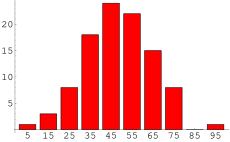
| class interval | class mark | absolute frequency | relative frequency | cumulative absolute frequency | relative cumulative frequency |
| 0.00- 9.99 | 5 | 1 | 0.01 | 1 | 0.01 |
| 10.00-19.99 | 15 | 3 | 0.03 | 4 | 0.04 |
| 20.00-29.99 | 25 | 8 | 0.08 | 12 | 0.12 |
| 30.00-39.99 | 35 | 18 | 0.18 | 30 | 0.30 |
| 40.00-49.99 | 45 | 24 | 0.24 | 54 | 0.54 |
| 50.00-59.99 | 55 | 22 | 0.22 | 76 | 0.76 |
| 60.00-69.99 | 65 | 15 | 0.15 | 91 | 0.91 |
| 70.00-79.99 | 75 | 8 | 0.08 | 99 | 0.99 |
| 80.00-89.99 | 85 | 0 | 0.00 | 99 | 0.99 |
| 90.00-99.99 | 95 | 1 | 0.01 | 100 | 1.00 |
See also
Absolute Frequency, Class, Cumulative Count, Cumulative Frequency, Class Boundaries, Histogram, Relative Frequency, Relative Cumulative Frequency
Explore with Wolfram|Alpha
References
Kenney, J. F. and Keeping, E. S. "Frequency Distributions." §1.8 in Mathematics of Statistics, Pt. 1, 3rd ed. Princeton, NJ: Van Nostrand, pp. 12-19, 1962.
Referenced on Wolfram|Alpha
Cite this as:
Weisstein, Eric W. "Frequency Distribution." From MathWorld--A Wolfram Resource. https://mathworld.wolfram.com/FrequencyDistribution.html