
The Fritsch graph is the 9-node planar graph illustrated above that tangles the Kempe chains in Kempe's algorithm and thus provides an example of how Kempe's supposed proof of the four-color theorem fails.
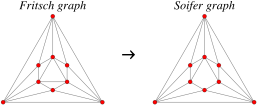
The Fritsch graph and Soifer graph provide smallest possible counterexamples for Kempe's false proof. In fact, removing a particular edge from the Fritsch graph gives the Soifer graph.
The Fritsch graph is isomorphic to the skeleton of the triaugmented triangular prism.
See also
Errera Graph, Four-Color Theorem, Heawood Four-Color Graph, Kempe Chain, Kittell Graph, Poussin Graph, Soifer Graph, Triaugmented Triangular Prism
Explore with Wolfram|Alpha
References
Fritsch, R. and Fritsch, G. The Four-Color Theorem. New York: Springer-Verlag, 1998.Gethner, E. and Springer, W. M. II. "How False Is Kempe's Proof of the Four-Color Theorem?" Congr. Numer. 164, 159-175, 2003.Kempe, A. B. "On the Geographical Problem of Four-Colors." Amer. J. Math. 2, 193-200, 1879.
Referenced on Wolfram|Alpha
Cite this as:
Weisstein, Eric W. "Fritsch Graph." From MathWorld--A Wolfram Resource. https://mathworld.wolfram.com/FritschGraph.html